
-
Posted by Lachlan McGowan-Hugh
- |
-
28 April, 2026
THE GULF crisis has exposed a critical weakness in Australia’s economy: a near-total reliance on foreign-flagged shipping. While this strategy has supported economic efficiency under normal market conditions, this dependency introduces a national resilience shortfall when considering the event of a major disruption or crisis.
The implications for national security are significant. In the absence of sovereign shipping capacity, Australia cannot compel foreign vessels to perform voyages that serve its national interest in a crisis. The operational capacity of Australian-flagged vessels across liquid bulk, dry bulk and container trades is essentially zero. This leaves the economy and the Australian Defence Force reliant upon commercial and geopolitical goodwill to sustain essential logistics.
Given Australia’s limited fuel reserves and its geographic distance from suppliers, even short-term interruptions to maritime trade could result in shortages, halt industrial production and undermine defence readiness.
The Australian International Shipping Register (AISR) was intended to solve exactly the problem Australia now faces, but more than a decade later, it has failed to deliver. In 2012, the then Australian Labor government established the AISR as a second register aimed at attracting vessels to fly the Australian flag.
Why the AISR?
The AISR was designed to provide competitive advantages such as tax incentives and greater flexibility in crewing, including the use of mixed nationality crews.
Policy documents at the time presented the AISR as a measure to align Australia with international practice, where many countries operate second registers to supplement their national fleets. For example, the Norwegian International Ship Register was highly successful, providing Norwegian shipowners with a cost advantage that encouraged new vessel investment, attracted ships back from foreign flags and ultimately quadrupled Norway’s share of the world fleet.
Despite the Australian government’s initiative, uptake of the AISR has been unsuccessful. The Maritime Union asserts that the register has not been sufficiently attractive to offset the cost disadvantages of operating under the Australian flag and the crewing requirements provide little in building Australia’s maritime expertise. Academic analysis of the AISR is scarce, but the registry numbers have shown it has been less than attractive for shipowners. Put simply, operating under the Australian flag remains significantly more expensive than under foreign registers and the AISR has failed to close that gap.
Stronger incentives
This leaves open the question of whether reforming the AISR via stronger incentives, regulatory adjustments, or integration into a strategic fleet policy could provide a viable pathway to rebuilding national shipping capacity.
Dr Peter Fanam of the Australian Maritime College and myself conducted a survey in an eight-week period asking shipping professionals within Australia various questions related to maritime resilience and Australia’s flag-state shipping. The survey received 281 responses, with 194 participants reporting more than 21 years of experience in the shipping industry.
Some 84% of participants reported they were very familiar with flag state shipping and 39% reported they were very familiar with the AISR and 44% reported somewhat familiar. A total of 86% of participants reported that maintaining an Australian-flagged commercial fleet was extremely important, while 69% strongly disagreed and 21.7% disagreed with the question, “Do you believe Australia currently has sufficient flag-state commercial shipping capacity?”
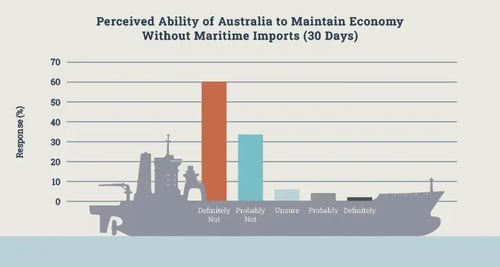
A total of 90.9% of participants reported that Australia’s supply chain was very vulnerable to major international supply chain disruptions and 80% strongly agreed that the absence of Australian-flagged ships limits the government’s ability to react during a major disruption or crisis.
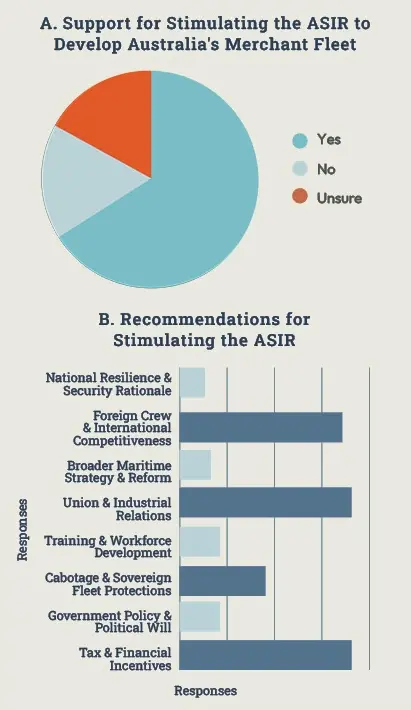
Some 60% of participants indicated that the AISR is not effective in supporting Australia’s maritime resilience and flag-state strategy. When asked, “Do you believe stimulating the AISR could help Australia achieve a sufficient merchant fleet? If yes, what specific actions, incentives, or policy changes would you recommend to make the AISR more effective?”, some 66% of respondents answered yes and 17% answered unsure and no respectively.
The AISR was intended to provide a competitive pathway for Australian shipowners through flexible crewing and tax incentives, yet 60% of respondents judged it ineffective. However, two-thirds still supported reforming the register to help rebuild the merchant fleet. This apparent contradiction suggests that participants recognise the AISR’s potential but believe its current design lacks sufficient competitiveness. The recommendations that were most frequent among respondents (tax and financial incentives, greater flexibility for international competitiveness and government will) correspond closely with critiques that the AISR’s current design fails to offset the cost disadvantages of operating under the Australian flag. Brewer (2022) calls for upgrading the AISR with taxation arrangements supporting Australian officers.
Comparison with Singapore
A useful international comparison is the Singapore Registry of Ships, which has successfully attracted and retained tonnage through a highly competitive fiscal framework. Under the scheme, qualifying operators can access full or partial tax exemptions for up to ten years or elect an alternative tax basis tied to vessel tonnage. Ancillary shipping services are eligible for a concessionary 10% tax rate on qualifying income for renewable five-year periods, while ship leasing entities may also obtain five-year tax concessions and preferential treatment for financing arrangements.
Singapore’s registry highlights what the AISR lacks: a competitive, integrated fiscal framework that actively attracts tonnage. While national circumstances differ and no single model can be directly replicated, Singapore’s framework illustrates the potential value of integrated fiscal incentives in enhancing registry competitiveness and supporting maritime capability development.
Final thoughts
Australia does not have the tanker capacity to ensure critical supply lines are protected. While the current Government is making steps to solve this issue through the development of the Strategic Fleet, swift reforms to the AISR could provide a quick and effective way get vessels flying the Australian flag. Accelerating AISR reform, alongside the Strategic Fleet, offers one of the most practical pathways to rebuilding sovereign maritime capability.
This article appeared in the April | May 2026 edition of DCN Magazine