-
Posted by DCN Partner
- |
-
19 Dec, 2025
In a significant development for both Victorian and national supply chains, the newest and largest intermodal terminal in Australia, the $400 million Melbourne Intermodal Terminal (MIT) backed by Aware Super, commenced freight train services in November.
Designed, constructed and operated by the Intermodal Terminal Company (ITC), the MIT is a central component of a broader $1.6 billion investment by Aware Real Estate and Barings called the Melbourne Intermodal & Industrial Exchange (MIIX) at Somerton.
In a further positive development, the Port of Melbourne (PoM) has enlisted the ITC-MIT as an anchor in a ground-breaking incentive program to help shift more containerised freight volumes in Victoria from road to rail.
PoM, in collaboration with the Victorian Government and industry, has devised an incentive scheme to help achieve this modal shift called the Port Rail Shuttle Network (PRSN) Start up Incentive Program.
The program is aimed at supporting base load import TEU volumes during the MIT’s ramp-up phase and encourage the timely take-up of rail freight services now the MIT is operational.
The current proposal contemplates an attractive discount offer of $100 per TEU and $200 per FEU for import containers moved by rail from the port to the ITC-MIT.
Mr Maharaj said: “Port of Melbourne must be congratulated for working closely with both government and industry to deliver what is a significant incentive to incorporate rail into the supply chain of importers.
“This incentive helps importers bring their goods and products in from the port in a cost-effective manner, whilst also avoiding congested roads and tolled motorways around inner Melbourne,” he said.
“Use of the MIT helps to reduce traffic congestion, road accidents and damage and vehicle emissions in Melbourne and Victorian transport networks – factors very attractive to the community as well as a diverse range of supply chain customers and their shareholders,” he said.
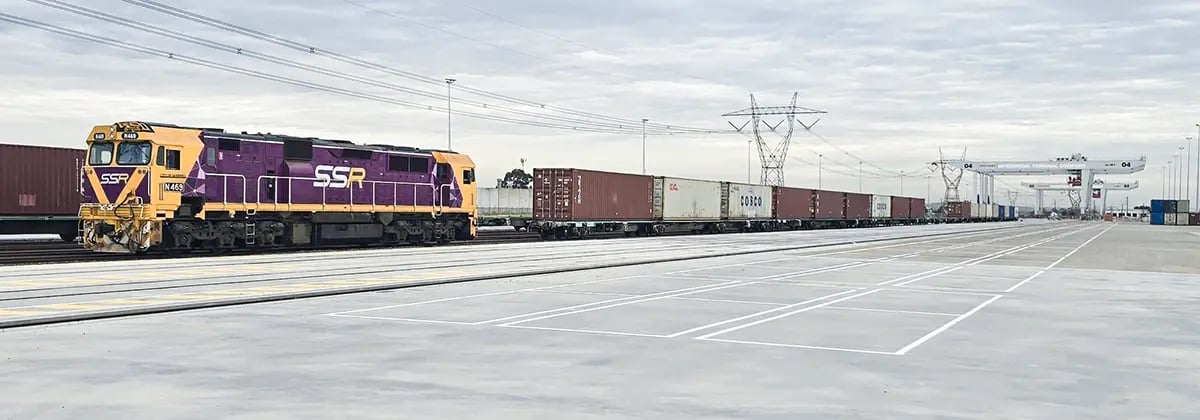
SSR freight train at the MIT
With the transport sector forecast to be the largest emitter of greenhouse gases in Australia by 2030, the haulage of freight by rail represents a ready-made solution for freight owners and governments to help achieve legislated emissions reduction targets.
ITC CEO Mishkel Maharaj said: “since mid-November when terminal construction was completed the ITC has been ramping up operations to deliver more than 1,000 boxes from the MIT to the port by Christmas, notably 40-foot containers filled with timber logs for export to Asia.
“Logging trucks deliver product from regional Victoria to Somerton before the timber is loaded into containers at the MIT and then seamlessly hauled by rail to port via the ARTC standard-gauge network, thereby avoiding congested zones and tolls found on roads closer to the city,” he said.
Southern Shorthaul Railroad (SSR) is the above-rail operator hauling the containerised timber volumes from the MIT to port, currently deploying freight trains 600-metres in length which transport approximately 80 TEUs each trip.
Such as been the success of current services, the ITC and SSR are now planning to significantly increase the length of these port shuttle services in 2026.
Mr Maharaj said: “the use of rail haulage allows heavier containers to be safely and efficiently transported all the way into the port stevedoring terminals, removing the need for those containers to otherwise be moved by road and creating efficiencies in the supply chain.
“The MIT is in a ‘Goldilocks freight and logistics zone’ – not too far, not too close; only 20km by rail to Port of Melbourne, adjacent to the Hume Freeway and with direct access to both Victorian and interstate rail networks.
“Within a short radius of the MIT is about 20 per cent of Victoria’s containerised freight volumes and 3.5 million square metres of warehousing,” he said.
The MIT is also a “one stop shop” for customers by providing customs-bonded storage, areas to process and recycle empty cargo containers back into the supply chain and on-site facilities to wash, fumigate and repair containers.
Initially, the MIT is planned to have a total annual capacity of one million containers (TEUs), with approximately 650,000 and 350,000 TEUs for interstate and port shuttle operations, respectively.
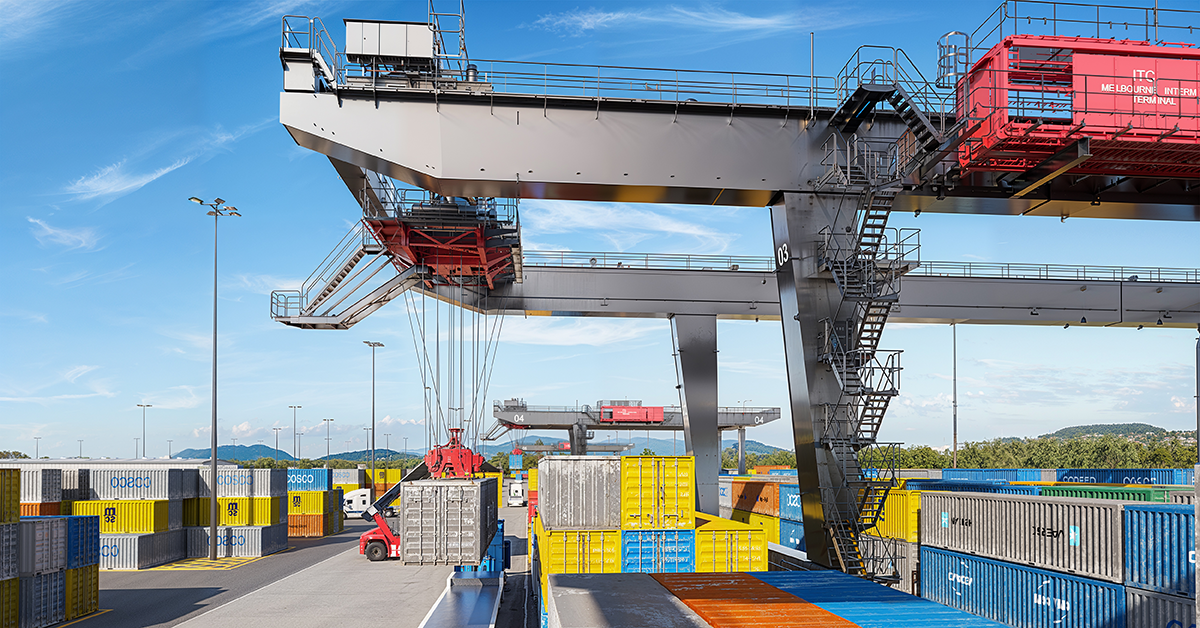
The MIT also features sophisticated freight handling equipment and machinery, including 350-tonne rail mounted gantry cranes which are fully electric and can regenerate electricity back into the grid by the kinetic process of lifting and loading shipping containers.