

-
Posted by Daily Cargo News
- |
-
16 Feb, 2026
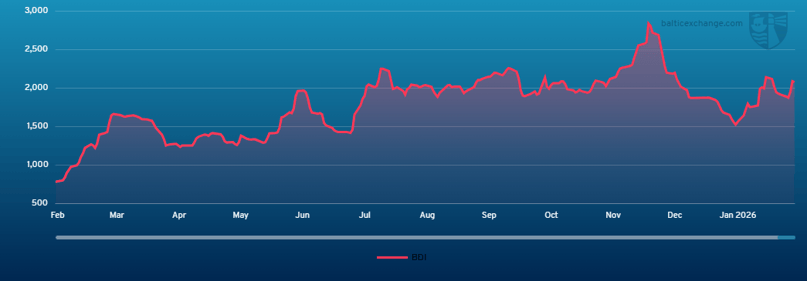
THE BALTIC Dry Index rebounded last week, finishing at 2083 for the week ending 13 February 2026, up from the previous week's 1923.
Capesize
The Capesize market started the week on a softer note but gradually reversed course from mid‑week as both basins lent support. The Capesize 5 Timecharter average (C5TC 182) opened at $25,692 and closed at $28,849, marking a $3,157 rise over the five trading days. Among all routes, the transpacific run delivered the strongest contribution to this week’s overall gains prior to the Pacific market heading to Chinese New Year holidays. The C5 West Australia to Qingdao route lifted mid‑week to $9.378 before soft landing at $9.272 by the close. A similar pattern emerged on the C3 Brazil to Qingdao route after the laycan window fully shifted into early‑March dates. The route traded in the mid $24s for second half March loading but eased to $23.923 by Friday. The North Atlantic region was active before the weekend approached, with the transatlantic and fronthaul run marked at $34,344 and $55,028 respectively.
Panamax
The week closed on a firmer note overall, with sentiment improving across both basins despite some late divergence. Early signs of prompt transatlantic demand set the tone, and activity built steadily through midweek as charterers moved to secure nearby tonnage. Grain flows from East Coast South America remained consistent, while North Coast South America and the US Gulf provided additional Atlantic support, although momentum eased slightly toward the end of the week as rates began to stabilise.
In the Pacific, strength was more pronounced. Indonesian short-haul business tightened prompt supply, while Australian and NoPac runs generated healthy enquiry and fixing volumes. Period interest also remained active. Reflecting the improved sentiment, the P5TC average climbed from $14,829 on Monday to $15,989 by Friday, marking a solid week-on-week gain.
Ultramax/Supramax
Position was the key this week depending on which side of the fence you are. The Atlantic saw strong gains from key areas like the US Gulf. Brokers saw Ultramax vessels reach more than $30,000 for fronthaul business and mid $30,000s for transatlantic runs. Stronger demand was also seen from the South Atlantic, a 62,000-dwt fixing a trip to the Arabian Gulf at $17,000 plus $700,000 ballast bonus, from there. By contrast from Asia, charterers remained in the driving seat with little fresh enquiry appearing from both the north and south. A 60,000-dwt vessel was fixed delivery Philippines via Indonesia, redelivery South China at mid $10,000s, whilst a 57,000-dwt was fixed delivery SE Asia via West Australia, redelivery Indonesia, at $14,000 with salt. The Indian Ocean remained a bit more active, with a 63,000-dwt fixing delivery Mina Saqr trip Bangladesh at $16,000. Period cover was short, a 57,000-dwt open in the Mediterranean fixing 5 to 7 months trading redelivery worldwide in the low $14,000s.
Handysize
Handysize market showed gradual improvement in the Atlantic, while the Pacific remained under pressure, resulting in a mixed but steadily firmer tone overall. The South Atlantic and US Gulf were the clear outperformers of the week. Active transatlantic business, combined with tight tonnage for February dates, supported higher numbers. A 36,000-dwt was fixed from Recalada to Algeria at $20,000, while a 40,000-dwt fixed from Mississippi River to EC Mexico at $22,000. The Continent–Mediterranean stayed generally balanced, with only marginal firming seen. A 38,000 dwt, open Aveiro, was fixed via Morocco to EC South America at $6,700. The Pacific market remained soft throughout the week, as limited cargo flow and a growing tonnage list continued to weigh on rates. A 41,000 dwt, open CJK (7–10 February), was fixed to Southeast Asia at $7,000. On the period side, activity picked up modestly, with a number of fixtures reported. A 40,000-dwt was reported fixed for delivery Far East, redelivery worldwide, for 3 years at 120.5% of BHSI.
Clean
LR2
Freight levels on MEG LR2’s took a tumble again this week. The TC1 75kt MEG/Japan rate dropped from WS189 to WS168, moving the corresponding TCE down to $37,300/day on Baltic description round trip.
A voyage west on TC20 90kt MEG/UK-Continent also continued down this week by $225,000 to $4.05 million.
The TC15 80kt Mediterranean/East index remained level this week at around the $4.94-4.95 million mark.
LR1
MEG LR1’s also suffered a downturn this week. The TC5 55kt MEG/Japan index went from WS202 to WS179.
A run west on TC8 65kt MEG/UK-Continent ended the week down $200,000 at $3.17 million.
On the UK-Continent, LR1 freight spent another week unmoved, the TC16 60kt ARA/West Africa index still around WS160-162.
MR
MR freight in the MEG was knocked down again this week. The TC17 35kt MEG/East Africa index fell 55 points to WS191. This took the Baltic TCE for the route to $16,200/day round trip.
On the UK-Continent, MRs were flat with softening sentiments this week. The TC2 37kt ARA/US-Atlantic Coast index was assessed 6 points lower than last week at WS147 with the Baltic TCE for the round trip at $11,000/day.
In the US Gulf, MR freight level came crashing down this week. The TC14 38kt US Gulf/UK-Continent run is currently assessed at WS235 (+67.5 points) with the Baltic round trip TCE for the run now at $29,600/day. The Caribbean voyage on TC21, 38kt US-Gulf/Caribbean is currently marked at $1.29 million (-$628,000).
The MR Atlantic Triangulation Basket TCE went from $52,500/day to $39,600/day.
Handymax
In the Mediterranean, Handymax’s on TC6, 30kt Cross-Mediterranean index sunk another 60 points to WS215 this week.
The TC23 30kt Cross UK-Continent route climbed another 28 points this week to WS257.
VLCC
The VLCC market freight levels, slackened slightly during the week, except for TD22 which made gains. The rate for the 270,000mt Middle East Gulf to China trip (TD3C) is 7 points lower than a week ago at WS132.78 which corresponds to a daily round-trip TCE of $117,360 for the standard Baltic VLCC.
In the Atlantic market, the rate for 260,000mt West Africa/China (TD15) was reduced by 5 points to WS121.44 giving a round voyage TCE of a little over $103,700. The US Gulf to China route (TD22) rose by over $330,000 to a little over $14,000,000 which means a daily round trip TCE of just under $94,900.
Suezmax
In the Suezmax sector, small gains were made in the West, while the Middle East eased very slightly. The rate for the 130,000mt Nigeria/UK Continent voyage (TD20) trip gained a point to WS157.78 which translates into a daily round-trip TCE of just shy of $69,900. The TD27 route (Guyana to UK Continent basis 130,000mt) similarly gained a point to about WS160 giving a daily round trip TCE of just over $72,300. In the Black Sea, rates for the TD6 route of 135,000mt CPC/Augusta slipped a point and then settled at the WS200 level, meaning a daily TCE of just over $116,200. In the Middle East, the TD23 route of 140,000mt Middle East Gulf to the Mediterranean (via the Suez Canal) slipped another 3 points to about WS117.
The new Baltic route of 145,000mt USG/UKC (TD33), recovered 6 points to WS143.
Aframax
In the North Sea, the rate for 80,000mt Cross-UK Continent route (TD7) remained flat at the WS190 level, giving a daily round-trip TCE of just under $93,300 basis Hound Point to Wilhelmshaven.
In the Mediterranean, the rate for 80,000mt Cross-Mediterranean (TD19) slipped another 5 points to WS237.5 (basis Ceyhan to Lavera, that shows a daily round trip TCE of about $83,800).
Across the Atlantic, the market significantly bounced back on both short and longer-haul voyages. The 70,000mt East Coast Mexico/US Gulf route (TD26) regained 73 points to about the WS390 level (giving a daily round-trip TCE of over $128,650) and the 70,000mt Covenas/US Gulf route (TD9) rose 61 points to the WS370 level (translating into a daily round trip TCE of over $110,200).
The rate for the transatlantic route of 70,000mt US Gulf/UK Continent (TD25) gained 15 points to WS297.78 which gives a round trip TCE basis Houston/Rotterdam of just over $81,800/day.
On the Vancouver exports, the rate for TD28 (80,000mt crude oil Vancouver to China) gained about $50,000 and is now assessed at $3,500,000 while TD29 (80,000mt crude oil Vancouver to Pacific Area Lightering point off the USWC) stands 19 points higher than at the end of last week.
LNG
The LNG spot market strengthened this week, driven by a sharp rebound in the Atlantic while the Pacific remained comparatively stable. Improved cargo flow in the West and a tightening tonnage list shifted momentum.
On the BLNG1 Australia–Japan route, 174k cbm vessels eased marginally by $200 to $28,200/day. The East remained relatively steady, supported by consistent enquiry and a balanced tonnage list, limiting volatility despite broader market moves elsewhere.
In contrast, the BLNG2 US Gulf–Continent route surged $9,700 to $21,900/day. A reduction in available Atlantic tonnage, combined with a string of uncovered cargoes, drove an upward correction.
Similarly, the BLNG3 US Gulf–Japan route climbed $9,700 to $23,700/day. The tightening vessel availability in the West underpinned the week-on-week gains.
In the time-charter market, the six-month rate fell $3,000 to $23,900/day. The one-year term held flat at $38,075/day, while the three-year period firmed $1,333 to $60,000/day.
LPG
The LPG market lost momentum this week, with activity slowing as IE Week in London took centre stage. With many participants away from their desks, enquiry thinned and fixing levels came under modest pressure across the main routes.
On the BLPG1 Ras Tanura–Chiba route, rates fell $4.15 to $95.17, with TCE earnings declining $4,745 to $84,383/day. After briefly pushing above the $100 mark early in the week, softer enquiry and a more comfortable tonnage position weighed on sentiment into the close.
The BLPG2 Houston–Flushing route eased $0.38 to $88.63, while TCE returns slipped $744 to $94,370/day.
Similarly, the BLPG3 Houston– Chiba route edged down $0.75 to $159.08. TCE earnings fell $690 to $83,775/day, as fresh cargo flow slowed.
Container
In recent weeks, many of the Major liner owners have announced drops in their earnings, this could well be signalling that the current tonnage oversupply situation, combined with a potential gradual Red Sea return, may lead to softer container rates this year. Since Covid, rates have seen highs and moderate levels that were never achievable pre-Covid. Perhaps we will see a return to post Covid levels, unless carriers take measures such as scrapping older vessels to reduce oversupply. FBX01 (China/East Asia – USA West Coast) has lost just $21 from last Friday, ending the week at $1,878. FBX03 (China/East Asia – USA East Coast) remained almost flat week on week, ending the week at $3,047 down just $14. FBX11 (China/East Asia – North Europe) came off $164 from last Friday, ending the week at $2,407. FBX13 (China/East Asia – Mediterranean) was down just $69 since last Friday closing the week at $3,705.