

-
Posted by Daily Cargo News
- |
-
16 Mar, 2026
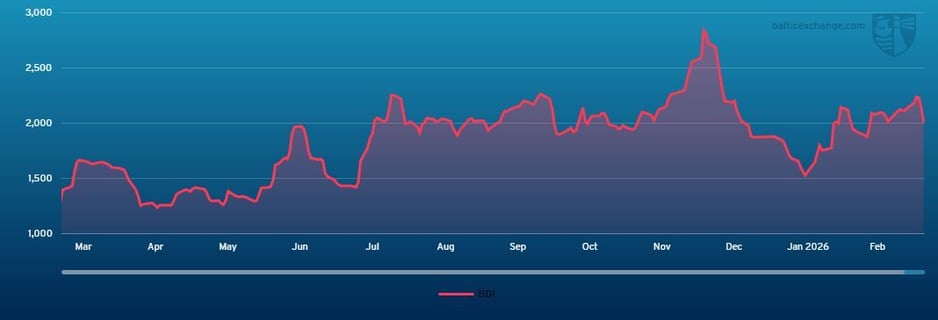
THE BALTIC Index (BDI) increased slightly last week, closing at 2028 points for 13 March 2026, up from the previous period's figure of 2010.
Capesize
The market experienced a volatile but ultimately firmer week, shaped largely by fluctuations in bunker prices. Early in the week, the market strengthened sharply as Brent crude surged above the $100 threshold, inflating voyage calculations and pushing freight rates higher, particularly on C5. However, this move proved short-lived, with the market correcting on Tuesday as oil prices eased following geopolitical commentary suggesting the Middle East conflict could de-escalate sooner than expected. This prompted a retracement of some bunker-driven gains, most noticeably in the Pacific. Despite the volatility, underlying cargo volumes in the Pacific remained relatively healthy throughout the week. Consistent miner presence, supported by operator activity, helped sentiment improve into the latter part of the week, allowing the market to recover and pushing C5 back into the low-to-mid $12 range. The Atlantic basin displayed a gradually strengthening tone. While the South Brazil and West Africa to China markets began the week subdued, with wide bid-offer spreads and limited index-date activity, momentum built through midweek as fixing volumes increased and spreads narrowed. Stronger fixtures for both index and forward laycans lifted C3, with rates moving from the high $27s area at the start of the week to shade over $29 by week’s end.
Panamax
Overall, the week saw subdued activity across both the Atlantic and Pacific basins, with limited enquiry and cautious market sentiment. In the Atlantic, cargo volumes remained thin while tonnage lists gradually built, though by midweek signs emerged that rates had reached a floor. Firmer bids and slightly improved fixtures were reported, allowing the P1A to recover later in the week. In Asia, cargo demand was present for trades such as Indonesia to India and West Australia rounds, but volatile bunker prices and limited willingness from owners to sell bunkers continued to complicate negotiations. Additionally, weaker-than-expected Chinese import demand from Indonesia weighed on sentiment and fixture volumes. Overall, the market remained cautious, with the P5TC softening earlier in the week before stabilising to $16,546 by Friday.
Ultramax/Supramax
Overall, the week was marked by weak sentiment, slower trading activity, and declining rates across most regions, with rising bunker costs adding further pressure to the market. In the Continent and Mediterranean, conditions remained subdued with limited visible activity. While some early-week demand provided brief support, momentum gradually faded and the market turned quieter. A 63,000-dwt vessel open Otranto 11–13 March was reportedly fixed from Aliaga to Conakry with clinker at $19,000. The US Gulf and South Atlantic faced the most persistent downward pressure. Growing tonnage, coupled with a thin cargo book, led to softer rate levels as charterers continued to test the market at lower ideas. A 61,000-dwt vessel was placed on subjects for a trip delivery Rio de Janeiro to the US Gulf at $18,000, while another 61,000-dwt vessel was placed on subjects from the US Gulf to the Far East with grains at $21,000. In Asia, sentiment remained cautious. Activity slowed as the week progressed, with charterers adopting a wait-and-see approach amid rising bunker prices and availability concerns. The North Pacific in particular saw limited fresh demand, with fixtures concluded below previously reported levels. A 56,000-dwt vessel open Lianyungang 19–20 March was reportedly fixed for a trip to West Africa at $18,000.
Handysize
The market displayed a gradual softening trend during the week, with overall activity remaining limited across both basins. In the Continent and Mediterranean, conditions stayed relatively stable with only minor fluctuations. A 43,000-dwt vessel was reportedly fixed via Egypt to the Adriatic at around $16,000. Rates were occasionally quoted slightly firmer, partly supported by rising bunker prices, although trading activity remained subdued. In the South Atlantic and US Gulf, markets continued to face pressure as the growing tonnage list and limited fresh demand weighed on sentiment, resulting in softer rate levels. A 37,000-dwt vessel was reported fixed for a trip from Recalada to the Mediterranean at $21,500, while a 35,000-dwt vessel secured a trip from SW Pass to Atlantic Colombia at $22,000. Across Asia, the week began on a stronger note with healthy activity and tightening tonnage in parts of Southeast Asia and the North Pacific. However, momentum slowed toward the end of the week as trading activity eased, and market participants became more cautious amid rising fuel prices and concerns over bunker availability. A 40,000-dwt vessel open in Singapore was reportedly fixed for multiple legs at $17,500.
Clean
LR2
MEG LR2 freight fell this week. The TC1 75kt MEG/Japan index went from WS391 to WS358 with the corresponding TCE dropping to $80,200/day on Baltic description round trip.
A voyage west saw the TC20 90kt MEG/UK-Continent index also come off to the $7.45 million mark (-$737,000).
The TC15 80kt Mediterranean/East index climbed by $975,000 to $7.97 million this week.
LR1
The TC5 55kt MEG/Japan index currently sits at W361, down 60 points.
A run west on TC8 65kt MEG/UK-Continent ended the week with the index $41,600 lower to over $5.73 million.
On the UK-Continent, LR1 freight added another 30 points this week to WS279 for the TC16 60kt ARA/West Africa index.

MR
The TC17 35kt MEG/East Africa index lost 25 points to WS380. This took the Baltic TCE for the route to $33,300/day round trip.
On the UK-Continent, MRs were tested down this week. The TC2 37kt ARA/US-Atlantic Coast index was assessed 16 points lower than last week at WS220, with the Baltic TCE for the round trip at $19,300/day.
In the US Gulf, MR freight also sunk this week. The TC14 38kt US Gulf/UK-Continent run is currently assessed at WS385 after beginning the week at WS405. The Baltic round trip TCE for the run is now at $54,000/day. The Caribbean voyage on TC21, 38kt US-Gulf/Caribbean is presently pegged at $1.97 million (down $407,000).
The MR Atlantic Triangulation Basket TCE went from $76,700/day to $68,900/day.
Handymax
In the Mediterranean, Handymax’s on TC6, 30kt Cross-Mediterranean index fell 90 points to WS333 this week.
The TC23 30kt Cross UK-Continent route firmed again to WS391 this week (+10) which generates $72,500/day on Baltic TCE round trip.
VLCC
As the USA & Israeli action against Iran continued, an extraordinarily difficult week was experienced for the Baltic panellists. The extreme risk to shipping via the Straits of Hormuz has reduced those owners previously willing to chance it, to no longer bear that risk. At present, our panellists remain able to price Middle East loading for the Crude Oil shipping market. Rates for the TD3C route (270,000mt Middle East Gulf to China) were being assessed at WS466.67 last Friday and is now being rated at WS348.89 which corresponds to a daily round trip TCE of $326,198 for the standard Baltic VLCC.
In the Atlantic market, the rate for the 260,000mt West Africa to China route (TD15) has softened from WS252.81 last Friday but remains dramatically firm at WS178.44, giving a round voyage TCE of $134,849, while the US Gulf to China route (TD22) fell from $26,055,556 to $21,244,444 which gives a daily round trip TCE of just over $126,000.
Suezmax
In the Suezmax sector, the rate for the 130,000mt Nigeria/UK Continent voyage (TD20) trip fell from WS311.94 to WS249.33 which translates into a daily round trip TCE of about $123,500. The TD27 route (Guyana to UK Continent basis 130,000mt) retracted from WS300 to WS261, giving a daily round trip TCE of about $132,680. In the Black Sea, rates for the TD6 route of 135,000mt CPC/Augusta fell from WS343.88 to about WS250, meaning a daily TCE of nearly $234,900. In the Middle East, the TD23 route of 140,000mt Middle East Gulf to the Mediterranean (via the Suez Canal) rose from about WS515 to just over WS518.
The new Baltic route of 145,000mt USG/UKC (TD33), eased from WS280 to WS252.5.

Aframax
In the North Sea, the rate for 80,000mt Cross-UK Continent route (TD7) moved down from WS244.17 to WS207.5, giving a daily round trip TCE of about $103,750 basis Hound Point to Wilhelmshaven.
In the Mediterranean, the rate for 80,000mt Cross-Mediterranean (TD19) slipped from WS340.5 last Friday to WS333.22 (basis Ceyhan to Lavera, that shows a daily round trip TCE of just above $125,250).
Across the Atlantic, the market has also faced the shrinking effect. The 70,000mt East Coast Mexico/US Gulf route (TD26) fell from WS445 to WS298 (giving a daily round trip TCE of almost $79,400) and the 70,000mt Covenas/US Gulf route (TD9) shrank from WS420 to WS280 (translating into a daily round trip TCE of nearly $67,900).
The rate for the transatlantic route of 70,000mt US Gulf/UK Continent (TD25) tumbled from WS398 to WS289 which gives a round trip TCE basis Houston/Rotterdam of almost $55,900/day.
On the Vancouver exports, the rate for TD28 (80,000mt crude oil Vancouver to China) has slipped from $4,775,000 to $4,475,000 (a round trip TCE of about $66,300/day) while TD29 (80,000mt crude oil Vancouver to Pacific Area Lightering point off the USWC) has fallen from WS398 to WS375.
LNG
The LNG spot market cooled this week, with rates correcting across all major routes as the recent rally began to unwind. A growing tonnage list and fewer cargoes weighed on sentiment, driving a steady decline in earnings.
On the BLNG1 Australia–Japan route, 174k cbm vessels fell $33,600 week-on-week to settle at $158,000/day, as the Pacific market began to ease from the previous week’s highs.
The BLNG2 US Gulf–Continent route also saw a correction, with earnings dropping $49,600 to $164,000/day. Similarly, the BLNG3 US Gulf–Japan route declined $52,200 to $168,000/day, reflecting the broader softening in Atlantic activity as vessel availability improved.
In the time charter market, period rates also moved lower following the spike in spot earnings. The six-month rate fell $41,700 to $103,300/day, while the one-year term dropped $8,400 to $94,600/day. Further out the curve, the three-year period slipped $7,000 to $81,000/day, reflecting a more cautious longer-term outlook as the market cools from recent highs.
LPG
After Atlantic fixtures were concluded last week at premiums to previous levels, the LPG market briefly paused before activity picked up again early this week. Sentiment remained somewhat mixed, with the Atlantic softening initially before stabilising as fresh enquiry returned to the market.
On the BLPG1 Ras Tanura–Chiba route, the index settled at $100.25, with TCE earnings at $63,089/day.
The BLPG2 Houston–Flushing route experienced some early softness before rebounding later in the week, ultimately settling at $78.00, with TCE earnings at $67,137/day.
Similarly, the BLPG3 Houston–Chiba route saw volatility through the week, falling initially before recovering to settle at $134.83, with TCE returns at $41,809/day.
Container
With the conflict in the Middle East Gulf continuing, we have seen war risk premiums increase and, on the back of rising oil prices, bunker prices have tripled in some cases to what they cost a fortnight ago. In the short to near term, we expect to see all container freight rates increasing due to increased costs. The conflict also stalls any hopes of a return to more Red Sea transits in the near future. FBX01 (China/East Asia – USA West Coast) has remained fairly flat, ending the week at $2,041, just $24 higher than last Friday. FBX03 (China/East Asia – USA East Coast) has increased by $322 from the start of the month, ending the week at $3,006. FBX11 (China/East Asia – North Europe) lost just $32 from last Friday, ending the week at $2,877, but is up $485 since the MEG conflict began. FBX13 (China/East Asia – Mediterranean) gained $346 since last Friday, ending the week at $4,063.