
-
Posted by Daily Cargo News
- |
-
15 Aug, 2026
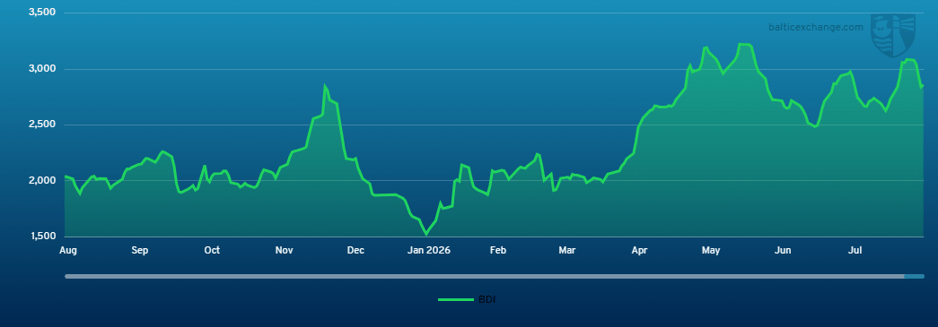
THE BALTIC Dry Index (BDI) ended last week at 2,863 points for 13 August 2026, down from 7th August's figure of 3089.
Capesize
The market came under sustained pressure this week, with the BCI 5TC falling from $46,300 to $41,155 as softer Pacific conditions outweighed pockets of resilience in the Atlantic. Trading initially lacked momentum due to the Singapore public holiday and the absence of major miners, while the subsequent return of chartering activity failed to provide meaningful support. The Pacific was the principal driver of the decline. Although miner participation improved, an expanding tonnage list, partly reflecting vessels returning following the previous week’s weather disruptions, shifted the balance firmly in charterers’ favour. Owners increasingly competed for limited cargoes, prompting a sharp correction on West Australia to China, with the C5 index retreating from above $16 to $14.110 by the close. In contrast, the South Brazil and West Africa to China markets remained steadier, supported by relatively strong first half September demand and a tight ballaster list, with C3 fixing around $35 to $36 despite limited overall engagement. The North Atlantic softened more gradually, with softer transatlantic fixtures weighing on sentiment despite intermittent fronthaul enquiry being concluded around the mid-$70,000s.
Panamax-Kamsarmax
After a relatively quiet start to the week, sentiment diverged between the Atlantic and Pacific basins. The Pacific remained supported by consistent demand, with tightening prompt tonnage and weather-related disruptions helping maintain owners' confidence. Several notable fixtures highlighted the region's resilience, including an 81,000-dwt vessel fixing a North Pacific round trip at $19,000, an 82,000-dwt securing an EC Australia to South China trip at $19,750, and a 75,000-dwt vessel fixing a short Indonesia round at $17,500. In contrast, the Atlantic lost momentum as the week progressed, with vessel availability
outpacing demand and increasing competition for cargoes. This placed pressure on transatlantic and fronthaul rates, prompting owners to lower expectations to secure employment. Among the reported fixtures, an 81,000-dwt vessel fixed a NC South America to the Far East at $25,000 plus a $500,000 ballast bonus. Grain cargoes loading further south for September proved more resilient, with 82,000-dwt vessels open in Singapore fixing at $20,000 and $21,000. Period activity remained active, with an 82,000-dwt vessel fixing for one year at $21,000, while two 85,000-dwt vessels secured similar employment at $22,000 and $20,750 respectively. All three were open in China, reflecting continued appetite for longer-term cover.

Ultramax/Supramax
Overall, the market showed a small improvement this week. The North Americas remained steady with a 63,000-dwt fixed at the beginning of the week at $30,750 for grains to the Continent, and these levels were maintained as the Ultramaxes benefitted from the firm Panamax market recently. The Continent was relatively quiet but rates unchanged, whilst the Mediterranean saw rates soften for early positions with insufficient demand for available tonnage. The South Atlantic was more positive this week with rates nudging up slightly, although vessels willing to ballast from West Mediterranean counteracted some of the gains. In Asia North Pacific grains increased and saw improved rates with a 61,000-dwt fixed from Zhoushan via NoPac to Pakistan at $19,000, and round voyages fixed between $18,000-$19,000 on Ultramaxes. There was also more backhaul enquiry supporting the market in the north with a 61,000-dwt in Zhoushan fixed for clinker to West Africa at $15,000. Meanwhile Southeast Asia and the Indian Ocean did not fare as well, with Indonesia quiet at the start of the week rates dropped, and in India a 61,000-dwt fixed from Kandla via South Africa to China at $15,000 which would have achieved around $17,000 last week. There were a few period trades concluded, including a 61,000-dwt ex dry dock in Dalian fixed for 10 to 13 months at $19,000.
Handysize
The market remained subdued over the week, with sentiment largely cautious across both basins, reflecting limited fresh momentum and softer fundamentals in several key regions. The Continent and Mediterranean opened the week with some underlying activity and firmer bidding on selected business, but sentiment gradually turned softer as fresh enquiry remained limited and available tonnage weighed on rate ideas. A 37,000-dwt open Liverpool 20-25 August fixed for a trip via Germany to the East Mediterranean with steels at $19,400. The South Atlantic showed some signs of support early in the week, although momentum remained very modest. In the US Gulf, activity stayed sluggish throughout, with high tonnage counts and limited fresh demand continuing to pressure rates. A 37,000-dwt open US Gulf fixed for an inter-Caribbean trip at $13,000. Across Asia, the market was generally quiet but relatively stable, with a steady cargo book and only minor shifts in tonnage availability. A 35,000-dwt was reported fixed via Japan to Thailand with slag at $16,900. Period interest remained present, with longer-duration enquiry gaining attention, highlighted by a 34,000-dwt open Namura fixing for one year at 102% of the BHSI.
Clean
LR2
The TC1 75kt MEG/Japan index dropped a modest 5 points this week to WS517. A voyage west also dropped a little, -$43,700 on the TC20 90kt MEG/UK-Continent index to $8.72 million. In Europe the TC15 80kt Mediterranean/East index came off $160,000 to $5.32 million, the corresponding TCE is now at just over $27,500/day on Baltic description round trip via Suez.
LR1
MEG LR1's eastbound remained relatively flat this week with the TC5 55kt MEG/Japan index losing 8 points to WS533. A run west however on TC8, 65kt MEG/UK-Continent saw the index climb by $135,000 to $7.09 million.
MR
The TC17 35kt MEG/East Africa index dropped again this week from WS499 to WS485, this took the Baltic TCE for the run to $53,500/day round trip. On the UK-Continent, MRs also suffered again this week with the TC2 37kt ARA/US-Atlantic Coast dropping 15 points to WS109. The Baltic TCE for the round trip is now at -$3,000/day. In the US Gulf MR freight dropped early in the week only to resurge with gusto following a flurry of mid-week fixing activity. The TC14 38kt US Gulf/UK-Continent index went from WS175 to WS150 on Wednesday and then back up to WS192. The Baltic round trip TCE for the run is now at $15,100/day. The Caribbean voyage on TC21, 38kt US Gulf/Caribbean followed the same pattern and is currently at $610,700. The corresponding TCE is now at $11,700/day on Baltic description. The MR Atlantic Triangulation Basket TCE went from $19,800/day, bottomed out at $13,100/day and then returned to $19,800/day at time of writing.
Handymax
In the Mediterranean, Handymax rates came off circa 42 points this week. The TC6 30kt Cross-Mediterranean index is now at WS175 generating a Baltic TCE of $10,900/day, down 54% from last week. The TC23 30kt Cross UK-Continent dropped from WS231 to WS181 this week, taking returns from $24,300/day to just $8,800/day on Baltic description.
Dirty
The dirty tanker market posted a generally positive performance this week, led by a significant improvement in Suezmax earnings and continued strength across many Atlantic Basin routes. While VLCC returns eased from the exceptionally high levels seen at the end of the previous week, overall sentiment remained firm and supported by healthy cargo activity.
The VLCC sector remained profitable despite some moderation in rates. Middle East Gulf export activity continued to generate a steady flow of business, although softer returns on eastbound voyages weighed on earnings. The Baltic VLCC TCE ended the week at $234,821/day, compared with $241,916/day a week earlier. West Africa and Oman export routes remained well supported, helping to limit downside pressure.
Suezmax
The standout performer was the Suezmax segment. Stronger demand in the Atlantic Basin drove substantial gains on West Africa, Guyana and US Gulf export routes, with owners benefiting from increased enquiry and tighter vessel availability. These improvements lifted the Baltic Suezmax TCE to $269,824/day, an increase of more than $30,000/day from the previous week's close of $238,201/day.

Aframax
Aframax markets remained comparatively stable. Rates in the Mediterranean, Caribbean and US Gulf continued to find support from consistent cargo volumes, although regional volatility persisted. The Baltic Aframax TCE closed at $77,182/day, marginally below the previous week's $77,866/day, reflecting a balanced market rather than any meaningful deterioration in fundamentals.
Elsewhere, regional tanker markets continued to strengthen, with improvements noted in both Panamax and Handy sectors. Overall, the week concluded with tanker earnings remaining at elevated levels across all major crude carrier classes, supported by resilient export volumes and firm Atlantic Basin demand.
LNG
The LNG market softened further this week, with rates in the West coming under pressure as a growing number of open vessels compete for a limited number of cargoes. East of Suez remained relatively more balanced, with cargo availability broadly matching vessel supply and helping to support rates.
On the BLNG1 Australia–Japan route, rates declined by $5,400 week-on-week to settle at $66,500/day. While the Pacific market remained more balanced than the Atlantic, sentiment softened following the West.
The BLNG2 US Gulf–Continent route fell by $20,267 to close at $28,600/day. An increasing tonnage list and a lack of fresh enquiries weighed heavily on sentiment, leading to a sharp correction in freight rates throughout the week.
Similarly, the BLNG3 US Gulf–Japan route dropped off for the same reasons and declined $17,567 week-on-week to settle at $45,000/day.
In the time charter market, sentiment also weakened across all periods. The six-month rate fell by $11,100 to $69,400/day, while the one-year term declined by $2,600 to $63,567/day. Further out the curve, the three-year period eased by $500 to $74,500/day.
LPG
The LPG market recovered this week, with activity picking up in the West as the arbitrage improved and additional cargoes entered the market. A tight front-end tonnage list also provided support, helping freight rates move higher.
On the BLPG1 Ras Tanura–Chiba route, rates settled at $218.75, with TCE earnings closing at $208,259/day.
The BLPG2 Houston–Flushing route increased by $5.75 week-on-week to settle at $165.25, with TCE earnings rising by $6,232 to $193,151/day following improved sentiment in the Atlantic Basin.
Similarly, the BLPG3 Houston–Chiba route gained $27.50 to close at $281.67, while TCE returns increased by $19,770 to $165,761/day. The route saw stronger support as Eastbound cargo demand improved from an improved arb, while a tight tonnage list provided additional support to freight rates.
Container
Liner freight rates remained firm over the past week with gains across most of the major east-west trades. The transpacific market once again led the advance, with FBX01 (China/East Asia – US West Coast) rising by $410 week-on-week to $7,422. Strength was also evident on the US East Coast route where FBX03 gained $288 to finish the week at $9,432. Both routes continue to trade at historically elevated levels as carriers seek to maintain pricing discipline heading into the latter part of the third quarter.
Asia-Europe markets also strengthened, although to a lesser extent. FBX11 (China/East Asia – North Europe) increased by $164 to $5,140, suggesting that carriers have largely stabilised rates following the volatility experienced earlier in the summer. The Mediterranean trade was the only major route to post a decline, with FBX13 slipping by $19 to $5,775, although the move was marginal and leaves the route broadly stable week-on-week.
Broader market sentiment remains positive following strong second-quarter earnings from Maersk and upgraded full-year guidance, reflecting continued cargo demand and resilient freight markets. While carriers continue to benefit from elevated rate levels, attention remains focused on the outlook for global trade demand, infrastructure constraints and geopolitical developments, all of which could influence freight pricing and market direction during the remainder of the year.