

-
Posted by DCN Partner
- |
-
5 May, 2026
An interview with the CEO of Pacific Tug Group, Chris Peters
When Pacific Tug Group first began exploring the development of a new heavy-lift general cargo wharf in Bundaberg, the ambition was clear: deliver infrastructure that genuinely reflects the cargoes Australia now needs to move.
"Project cargo has changed," Mr Peters says. "It’s heavier, more complex, often time-critical, and increasingly sensitive from a safety and regulatory perspective. Existing ports are under pressure, and many simply aren’t designed for what’s coming next."
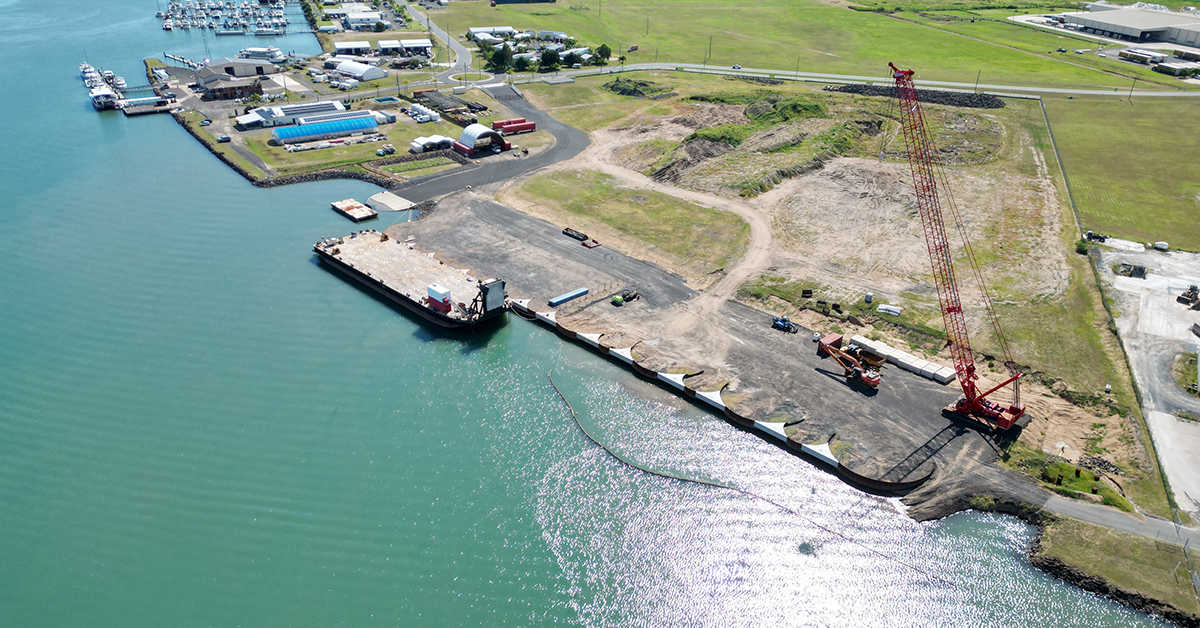
That thinking led to the creation of Pacific Marine Base Bundaberg (PMBB) — the first major port infrastructure development at the Port of Bundaberg in more than 60 years.

Pacific Tug Group CEO, Chris Peters
An idea shaped by real-world logistics
As a long-standing marine services provider, Pacific Tug Group has been closely involved in supporting complex project logistics across Australia.
"We were repeatedly seeing the same challenges," Mr Peters explains. "Congested berths, limited laydown, rigid operating windows, road access constraints, and growing scrutiny around the handling of oversized, over-mass and regulated cargo."
Bundaberg stood out as a solution. Low port congestion, proximity to Central & South East Queensland project sites, approved NHVR routes for OSOM transport, and direct access to regional and international shipping lanes positioned it as a compelling alternative to the traditional east coast gateways.
Engineered for heavy lift — and regulated cargo
PMBB has been designed from the ground up as a heavy-lift, project cargo and general cargo facility, rather than retrofitted from legacy infrastructure.
The 190-metre cellular wharf delivers ultra-high load capacity enabling the safe handling of some of the most demanding cargo profiles in the market. A 20-metre-wide hybrid RoRo ramp, capable of accommodating vessels up to 32 metres beam, allows flexible ship-to-barge, RoRo and crane-based operations.
Critically, the site is particularly well suited to the storage and handling of regulated cargo, including Class 9 dangerous goods such as large lithium battery energy storage units. Pacific Tug Group intends to achieve formal Class 9 DG approval for temporary storage and handling at PMBB, reflecting the rapidly growing demand for compliant infrastructure to support energy transition projects.
In parallel, Pacific Tug Group also intends to work closely with the Department of Agriculture, Fisheries and Forestry to progressively develop the site toward achieving Class 1.1 AA biosecurity approval, further strengthening PMBB’s credentials as a future-ready gateway for international and regulated cargo.
"Energy transition cargo is a perfect example of why PMBB exists," Mr Peters says. "Large lithium battery systems are heavy, regulated and require separation, space and controlled handling. The combination of wharf strength and extensive waterside laydown provides a safer, more practical solution than congested urban ports."
The operational advantage of waterside laydown
One of PMBB’s defining features is its significant waterside laydown capability, with access to up to 130,000 square metres of hardstand directly adjacent to the wharf.
"For project cargo such as wind farm blades, turbines, mining machinery and dangerous goods, this is critical," Mr Peters explains. "Being able to land cargo directly into a controlled waterside laydown area reduces double handling, minimises public interface, improves safety outcomes and provides greater flexibility for staging and commissioning."
For large lithium battery storage units in particular, the ability to segregate, space and manage cargo in a low-congestion environment is increasingly important for regulators, insurers and project proponents alike.
Backing the vision through long-term investment
Developing PMBB has required patience, conviction and sustained investment. Construction commenced in 2022, with cellular piling now complete and wharf fit-out progressing toward full completion in the Q4 2026.
More than $25 million has already been invested, with total investment expected to exceed $35 million once complete. "This has always been a long-term play," Mr Peters says. "You don’t build infrastructure like this unless you believe in its role in Australia’s supply chain for decades to come."
Strong early interest
PMBB is already attracting strong interest from across energy and renewables, mining, construction, defence, agriculture, heavy manufacturing and specialised project logistics.
"There is particularly strong demand from proponents moving large, regulated or high-value cargo," Mr Peters notes. "They’re looking for certainty around access, safety, scheduling and compliance — and that’s exactly what PMBB has been designed to deliver."
Unlocking full vessel access
While the wharf itself has been designed to accommodate vessels over 200 metres LOA, current port limitations restrict access to 190 metres.
"Our intention is to work constructively with Gladstone Ports Corporation and the Queensland Government to increase vessel access LOA to 200 metres," Mr Peters confirms. "That would allow the vast majority of breakbulk and project vessels to access PMBB without restriction and represents a logical evolution for the Port of Bundaberg."
A catalyst for the Wide Bay-Burnett economy
Beyond its operational capability, PMBB represents a major long-term investment in the Wide Bay-Burnett economy. The development is already generating local employment through construction and specialist trades, and once operational will underpin new logistics activity, attract project-driven investment and create sustained flow-on benefits for transport operators, service providers and regional industry.
Pacific Tug Group sees PMBB as a catalyst for economic diversification in the region, strengthening Bundaberg’s role in national supply chains while delivering lasting economic value to the local community.
A regional port with national relevance
Pacific Tug Group does not see PMBB as competing with major east coast ports, but rather complementing them.
"This facility is about choice," Mr Peters concludes. "Choice for industry, choice for project proponents and choice for government as Australia’s supply chain evolves."
"With PMBB, Bundaberg is positioned not just as a regional port, but as a nationally relevant gateway for the next generation of cargo."
This advertorial appeared in the April | May 2026 edition of DCN Magazine


