
-
Posted by Oliver Greeves
- |
-
21 Oct, 2026
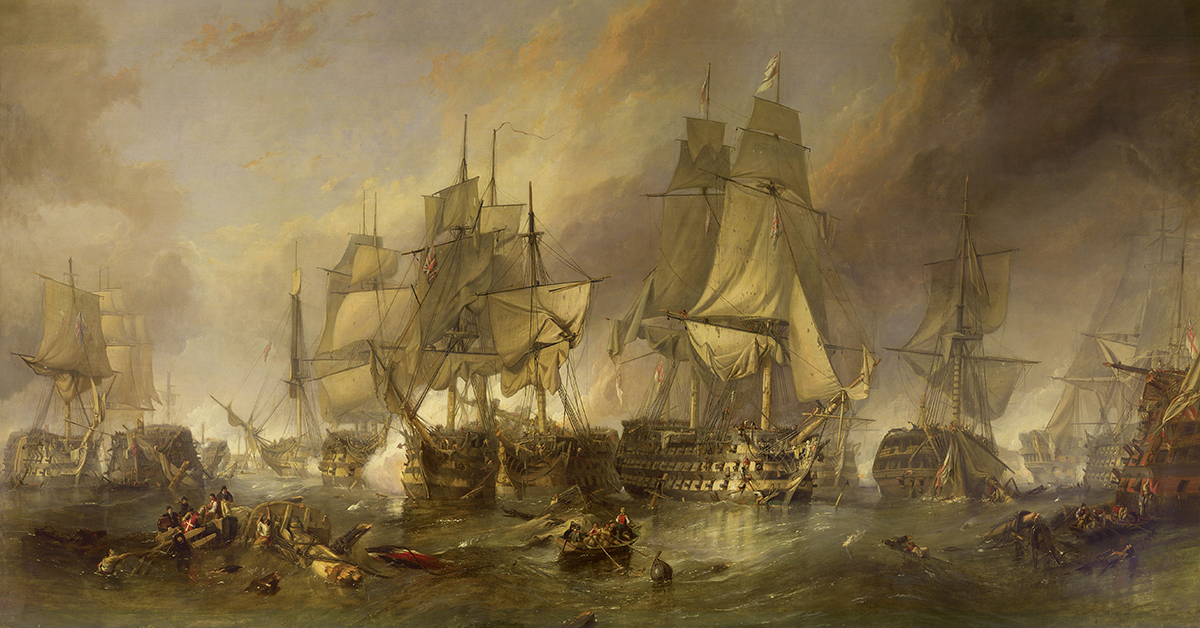
TRAFALGAR Day commemorates the British victory at the great battle of Trafalgar and the tragic death of Lord Nelson in the battle. The tradition is well established. According to the famous Nelson historian Colin White, in the 1840’s it was a custom to decorate HMS Victory with flags signalling the famous message “England Expects Every Man to do his Duty…” on Trafalgar day. A special Trafalgar Day dinner was held on board in 1846 at which the toast “To the immortal memory of Lord Nelson and those who fell with him” was drunk. The custom of a celebration on Trafalgar day spread throughout the Empire. In 1895 a commemorative service in Trafalgar Square was held and continues. On HMS Victory, on Trafalgar day a formal dinner will be held in Lord Nelson’s Great Cabin on this day as in the past. There are numerous celebrations throughout Britain and overseas.
Years ago, when I attended my first Trafalgar Day dinner, the celebration was a ritual for members of the Royal Australian Navy, whose retired members co-sponsored the occasion. The dinners were held in the evenings at a city club. I was a little daunted by the august company of the many captains and admirals. Dinner jackets and decorations were worn. A great deal of drinking went on. Times changed; the event is now a lunch organised by the Pioneer’s Club and the Royal Automobile Club and; dress is now a lounge suit. More women attend and the speakers give nuanced talks about aspects of the great man and the battle. One year I gave the talk.
Lord Nelson was arguably the greatest hero in British Naval History. During his life he was credited with victory in four major sea battles, the last being Trafalgar. But before that he won the famous battle of the Nile in which he destroyed the French fleet in a night action in Aboukir Bay, Egypt where the French ships were moored, thereby stranding Napoleon and his army. Only two French Ships out of thirteen battleships escaped. The French Flagship, L’Orient, with a thousand sailors aboard blew up in the middle of the fight lighting up the night sky.

The Fall of Lord Nelson, Battle of Trafalgar, 21 October 1805 by Denis Dighton. Source: Royal Museums Greenwich / Wikimedia
Lord Nelson was more than a successful Admiral. He was known for his ability to weld a group of naval commanders together and give them autonomy in battle. He was also very popular with warrant officers and ordinary seamen for his kindness to them while demanding their all in battle conditions. Morale at Trafalgar was at an all time high.
After his death and magnificent funeral, he was buried in St Paul’s Cathedral in London. His legend was about to begin. Biographers and later film makers created a story of mythical proportions over the next century. Lord Nelson became the model for every schoolboy with an ambition for glory.
It served different purposes at different times. My research suggests the myth-making victory at Trafalgar and a global navy kept Britain’s enemies away from the trade routes and colonies and thereby sustained the development of the British Empire. For Australia this was of the highest importance. The fleets of convicts, immigrants and then merchantmen, clippers and liners all operated under the protection of a mighty naval organisation. It lasted until Australia was able to protect itself. Throughout this process, the memory of Trafalgar and the courage and determination of its leader, Lord Nelson continued to inspire our mariners and seamen. Trafalgar contributed to the foundation of Australia and may even be the reason we speak English than French in Australia. If you agree, raise a glass “to the Immortal Memory” on 21 October.