-
Posted by Lindsay Reed
- |
-
13 May, 2026
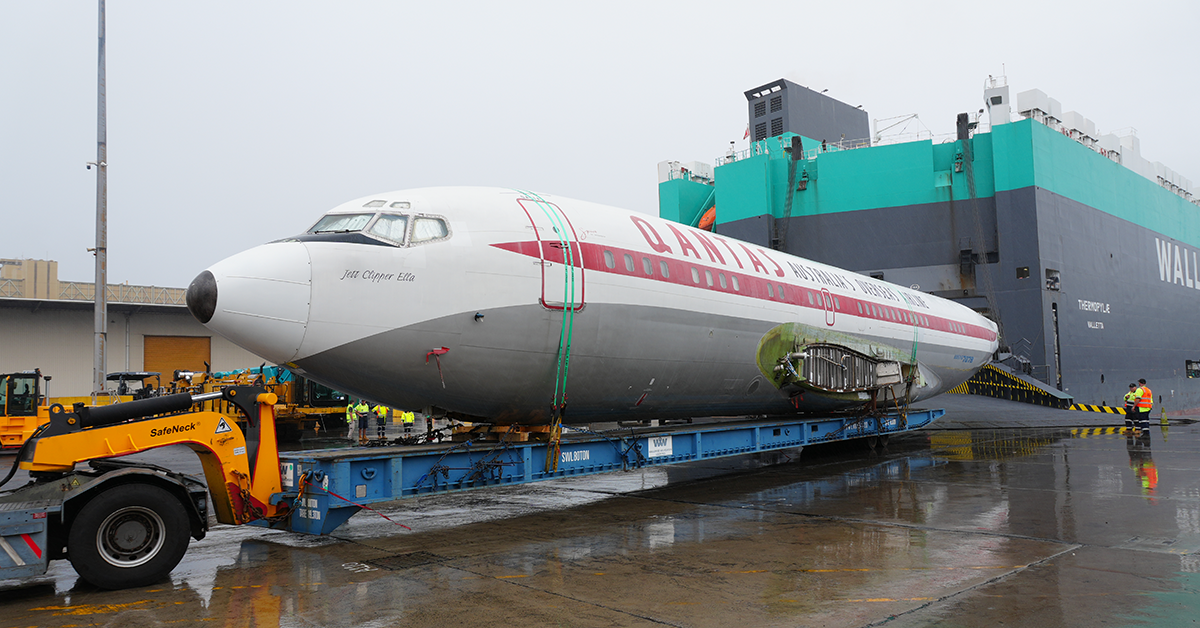
JOHN Travolta doesn’t often feature in DCN, but his name was very much on the lips of those at Port Kembla on Wednesday, as the Wallenius Wilhelmsen ro-ro vessel Thermopylae delivered the fuselage and wings of his former Qantas Boeing 707 to the port.
The project to bring the aircraft to Australia for the Historical Aircraft Restoration Society museum at Shellharbour has been more than a decade in the making, with coordination between Qube, AAT, Wallenius Wilhelmsen, NSW Ports and freight forwarders, AAW Global Logistics, across the supply chain.
HARS vice-president Maureen Massey and president and chief pilot Bob de la Hunty said the aircraft carried a remarkable history long before its final voyage Down Under.
“Prior to John Travolta owning it, it was owned by Frank Sinatra, which most people don’t know,” she said.
“So the aircraft itself has got a very colourful history, and if the walls could talk, I’m sure it’d be very juicy.”
“We found out it was open for adoption, so we approached John, and John was thrilled to give it to HARS.”
Mr de la Hunty said the aircraft had still been performing strongly during testing before the decision was made to ship it instead.
“We ran the thing up full power on the engines. It was absolutely performing and rearing to go,” he said.
“I would have liked to have taken it to the end of the runway, taken off, flown back to Australia.”
He said the organisation had spent years weighing whether to fly or ship the aircraft before ultimately deciding sea freight was the safest option.
“Make no mistake, this is a huge project,” he said.
“When you see the airplane flying, you look at it and everything else. When you see it all in components, you realise the work ahead of us.”


Images: Simon Reed
The aircraft will now be reassembled at the HARS facility in Shellharbour by volunteers and apprentices, with Mr de la Hunty describing it as “a huge Meccano set”.
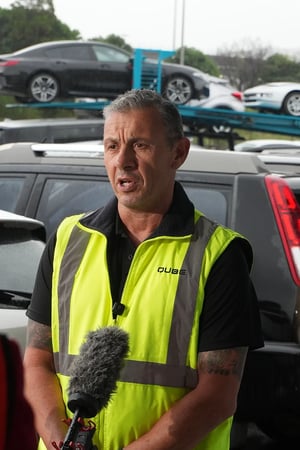
Qube Ports operations manager Paul Rabbas.
Image: Simon Reed
Speaking at the terminal before discharge operations began, Qube Ports operations manager Paul Rabbas said the aircraft was unusual, but still firmly within Port Kembla’s heavy-lift wheelhouse.
“Although it’s a fuselage, which is a little bit out of the ordinary, we are accustomed to handling a lot of cargo that is out of the ordinary,” Mr Rabbas said.
Those watching the operation were fortunate enough to be given unusually close access to the vessel, offering a front-row perspective of the unfolding activity. As the nose section of the Boeing 707 slowly emerged from the cargo hold of the Thermopylae, a real sense of excitement and celebration filled the scene.
Planning for the discharge began in January, with teams needing to assess dimensions, weight, tidal charts and ramp gradients before the aircraft could safely be moved from the vessel.
“Operationally, this cargo is longer than what we normally discharge,” Mr Rabbas said.
“Being 130 feet, the mafi trailer that we use is only 80 foot long, so therefore there’s a considerable overhang.”
The Australian-based freight forwarder coordinating the move, AAW Global Logistics state manager – New South Wales Stephen Hearty, said the project had cost “about half a million” dollars all up, substantially cheaper than flying the aircraft to Australia.
Mr Hearty said the operation involved around 10 containers of aircraft parts, including engines, undercarriage and other components shipped separately through Sydney and Port Kembla.
Asked whether it was the most challenging project he had worked on, Mr Hearty said:
“It’s maybe not the most complicated, but it’s definitely been more interesting.”
“I’m really humbled that they’ve asked me to jump in and help them out with this.”
Despite the scale of the task, Mr Hearty said the project had progressed surprisingly smoothly.
“I’ve been trying really, really hard to plan for contingencies and contingencies and contingencies,” he said, noting that fortunately, none had been required.
“It’s oddly smooth.”