-
Posted by Max Berry
- |
-
05 Nov, 2026
Queensland is expanding freight capacity through rail, road and regional port investment, with Brisbane, Mackay and Gladstone central to resilient, lower-emission trade growth.
WITH Queensland’s freight task set to grow by 20% by 2032, driven by population growth and large energy and resource projects, the Queensland Government’s publication of a new freight strategy is timely. Brisbane will host the Olympic and Paralympic Games that year.
Released in September after consultations with more than 500 stakeholders, Queensland Freight Delivery Plan 2026 sets out 70 actions aimed at planning key freight corridors, investing in infrastructure, improving freight system performance, reforming access arrangements and strengthening partnerships and collaboration.
With its long, inhabited coastline and strategic location on the continent’s north-east corner, Queensland has become a global trading hub with 18 trading ports and annual exports from the resource-rich state now worth $105 billion, the plan notes.
Incentivising rail freight
Headline actions include an incentive scheme to move containers by rail along the lines of similar schemes interstate, such as Victoria’s Mode Shift Incentive Scheme. To be trialled over three years, the Rail Freight Container Incentive Scheme aims to move an extra 250 TEU a year by rail on the North Coast Line, Mount Isa Line and Southern Queensland rail network through a 50% rebate of the below-rail freight charge.
To support that rail incentive, there’s a commitment to upgrading the Mount Isa rail line. Rail freight on the line to Queensland’s north-west will benefit from a new "discounted diesel fuel access charge", a 10% subsidy for all customers on the line and setting the rail access charges for rock phosphate at 30% below the standard bulk charge.
Regional freight in Queensland is often moved inefficiently due to limited transport alternatives, with goods transported from regional production zones to central hubs — such as Brisbane — for consolidation, before being shipped back out to other regional areas.
Queensland Freight Delivery Plan 2026
The latter initiative supports the strategic North West Minerals Province, home to rich deposits of copper, zinc, lead, silver and gold. The NWMP also contains phosphate, uranium, rhenium, molybdenum, cobalt and rare earths, making it important for both traditional and emerging industries in the electrification era.
But recognising that trucks remain critical in freight, especially for "first- and last-mile" movements, there’s a suite of road initiatives, starting with fixing black spots on the notorious Bruce Highway. Major upgrades are planned for another 13 key roads, including the Gore, Cunningham, Landsborough, Kennedy and Captain Cook Highways.
Other road initiatives have a more "live" face — for both drivers and the animals they transport. A major Queensland export is beef, requiring the transport of cattle by road trains. Objective 23 in the plan is to "deliver new fit-for-purpose livestock effluent disposal facilities on key road freight routes to support productivity and industry compliance with environmental and biosecurity regulation and to ensure animal welfare". The strategy found that Queensland’s intrastate freight movements are often based on a hub-and-spokes model, causing wasteful journeys.
"Regional freight in Queensland is often moved inefficiently due to limited transport alternatives, with goods transported from regional production zones to central hubs—such as Brisbane — for consolidation, before being shipped back out to other regional areas," the strategy comments.
The plan responds by recommending a state-wide freight modelling program supported by data from operators, industry, local councils and government agencies. This new collaboration would culminate in the publication of a Queensland State of Freight Snapshot.
Recognising the strains on all transport infrastructure during the 2032 Brisbane Olympic and Paralympic Games, the plan proposes a trial of relaxed operating-hour restrictions to enable off-peak (night) urban freight operations on roads during and leading up to the Games.
Largely focused on land transport, Queensland Freight Delivery Plan 2026 promises "upgraded sea freight infrastructure in Northern Queensland to support improved sea freight operations", a recognition of the importance of the north Queensland ports.
The plan also recognises the strains of competing passenger and freight streams to and from the Port of Brisbane in a commitment to "targeted interventions" on the South East Queensland rail network.

Port of Brisbane: the state’s freight gateway
As the manager of the principal freight gateway to Queensland, Port of Brisbane Pty Ltd — now celebrating its 50th birthday — has its own 35-year plan, Vision 2060, released in 2025.
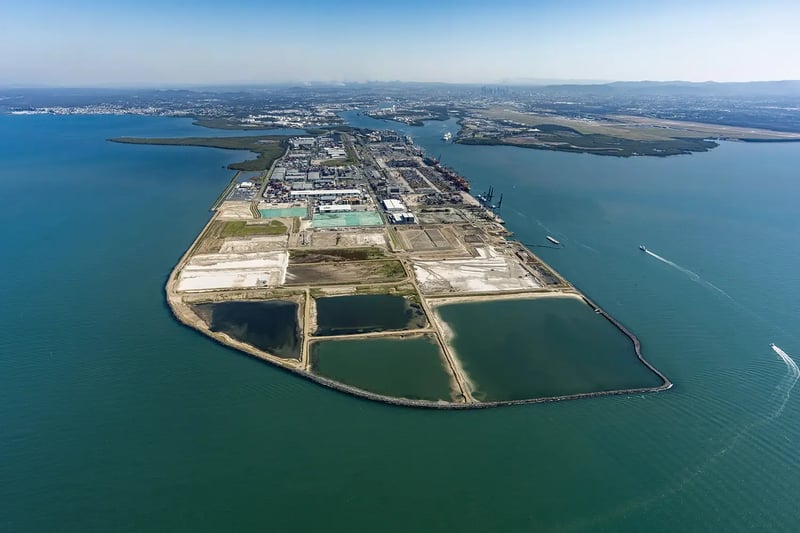
Port of Brisbane’s Fisherman Islands site. Image: Port of Brisbane
This year marks 50 years since the Queensland Government made the decision to establish the Port of Brisbane Authority and create a modern, deepwater port at Fisherman Islands off the mouth of the Brisbane River. Privately owned Port of Brisbane Pty Limited (PBPL) became port manager under 99-year leases from the Queensland Government in 2010.
Releasing Vision 2060, Port of Brisbane CEO Neil Stephens said the plan was "deliberately aspirational" and aligned with three goals: clean energy-powered, seamlessly connected and designed for future generations.
"That includes work with customers and stakeholders on renewable energy opportunities, research into autonomous short-haul container transfers within the port, supported higher productivity freight vehicle trials for port customers and our ‘Green Button’ technology for waterside stakeholders," Mr Stephens said in a statement for DCN. "[We have also] established a new Here for the Future Fund to support initiatives that create a positive legacy, including the establishment of a Port of Brisbane Aboriginal and Torres Strait Islander Scholarship Fund with The University of Queensland (UQ)."
A key element is deepening the port’s existing 15-metre-deep access channels to accommodate next-generation vessels, which require a channel depth of at least 17 metres. A call for submissions on the Port of Brisbane Channel Enhancement project environmental impact statement was issued in April and has now closed. The draft environmental impact statement is on track to be lodged with the Queensland Government Office of the Coordinator-General in mid-2027, before being released for public consultation.
Vision 2060 also emphasises green energy and proposes a solar-powered Battery Energy Storage System (BESS) to provide power to electrically powered freight-handling equipment and charge the port’s own electric vehicles. BESS trials are underway at the port already, with a view to decarbonising the port’s operations by 2060. And by 2030, Port of Brisbane will be trialling the bunkering of green shipping fuels such as methanol and ammonia, according to Vision 2060.
Another interesting initiative on the horizon is the prospect of addressing a severe shortage of land through vertical warehousing to maximise the storage per square metre.
There is talk in Vision 2060 of a dedicated rail freight corridor from the port to a future intermodal terminal at Ebenezer, 88 kilometres from the port, near Ipswich. However, the document was released before this year’s Federal Government decision to truncate the Inland Rail project in central NSW, leaving the Queensland section in doubt.
"The Federal Government’s decision to stop construction of Inland Rail north of Parkes in NSW doesn't change the underlying need for a more sustainable modal shift and better freight rail solutions for Queensland," Mr Stephens said. "That’s why we’ll continue to advocate for improved freight rail connectivity, support the development of intermodal freight hubs and work with governments, industry and regional partners to identify alternative freight solutions that deliver the same productivity, congestion and emissions benefits."
Meanwhile, with trucks carrying 99% of containers moved within the port, PBPL has recognised the importance of driving greater productivity by allowing bigger vehicles to operate at the port.
Under this year’s Higher Productivity Freight Vehicle Initiative, freight handlers MEDLOG, South East Queensland Hauliers and Arrow Transport have been granted permits to operate (between them) five new vehicle combination types at the port: B-Triple, Electric A-Triple, A-Double, Super A-Double and Heavy A-Double. The three operators are limited to defined routes and operate these big combinations under strict conditions.
New regional container ports: spreading the load
Demand for alternative container ports in Queensland was demonstrated with the announcement in February this year of a new container facility at the Port of Mackay.
With its strategic location, multi-cargo capability and well-established regional links, the Port of Mackay plays a crucial role in connecting Queensland to the world.
Brendan Webb, NQPB CEO
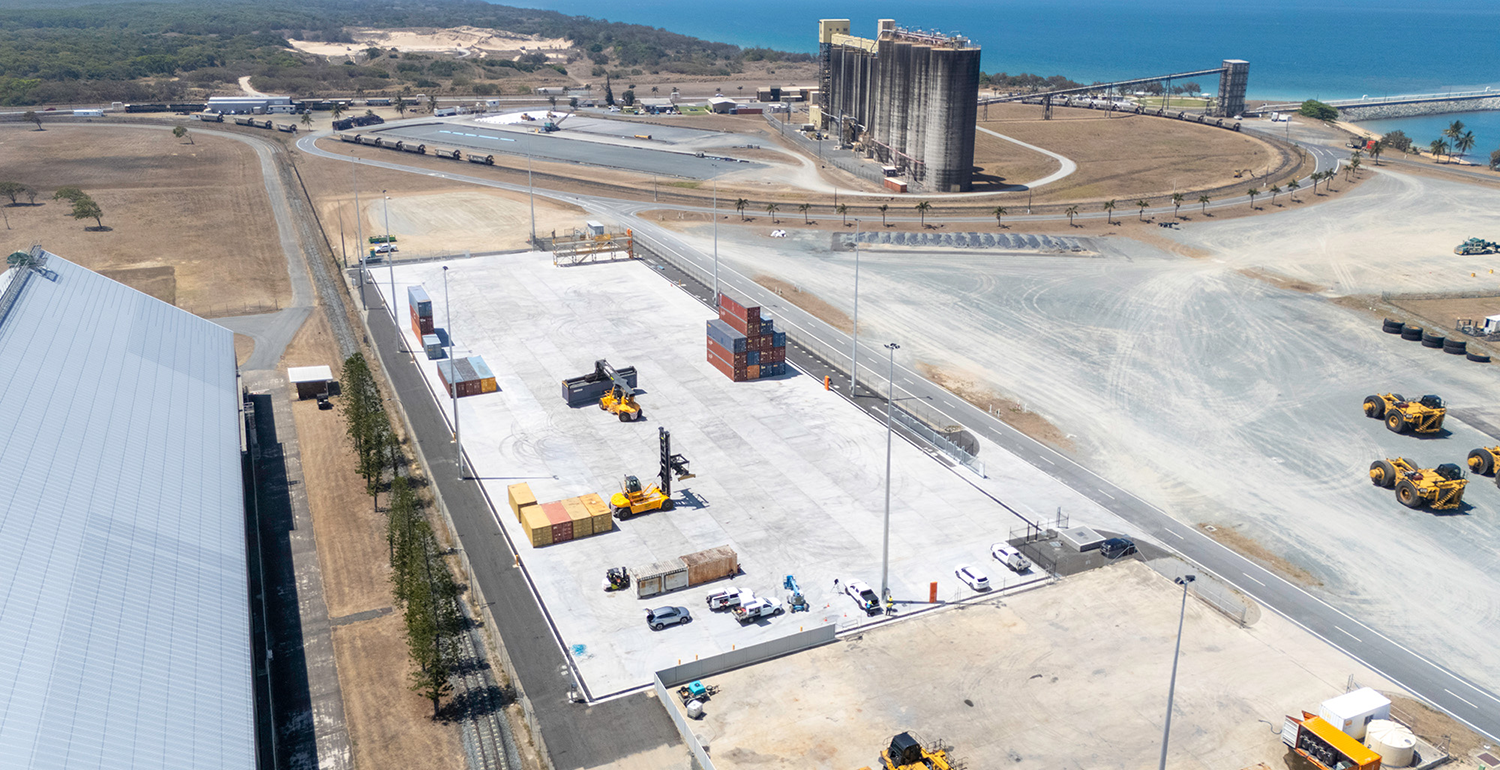
North Queensland Bulk Ports (NQBP) has partnered with logistics consultancy MPC International in the design of a 1.3-hectare facility able to handle full, empty and refrigerated containers in a configuration with a single entry gate and a single exit gate. Concreting the 4675-square-metre heavy-duty hardstand is now complete and the facility is expected to be operating by the end of the year. The new facility is expected to handle container volumes of up to 7000 TEU a year.
NQBP CEO Brendan Webb said it was pleasing to see significant progress since the project was announced earlier this year. "Once complete, local businesses and producers will have the opportunity to send and receive goods closer to where they operate, saving time, reducing costs and supporting local jobs," Mr Webb said. "Designed for heavy-duty operations, the facility will be reach-stacker ready, include refrigerated container capability and support efficient empty container management, while allowing for future growth. With its strategic location, multi-cargo capability and well-established regional links, the Port of Mackay plays a crucial role in connecting Queensland to the world."
The depot is being developed to improve access to domestic and international markets for Central Queensland industries, including mining, agriculture and manufacturing, while strengthening the resilience and efficiency of regional supply chains. Construction is progressing well, with the project scheduled for completion in late 2026.
MPC International managing director Peter Creeden said the Mackay project took a disciplined approach, ensuring the facility could be commercially successful within a realistic timeframe.
"Regional container facilities succeed when they are built around real cargo flows and operational credibility," Mr Creeden said. "From the outset, our focus has been on ensuring the Mackay depot is designed with clear commercial logic and a practical start-up pathway. The objective is to deliver a facility that performs reliably from day one and builds confidence in the regional market."

In line with the Queensland Freight Delivery Plan 2026, the Mackay depot supports broader efforts to improve regional supply chain efficiency by cutting transport distances for Central Queensland freight and offering importers and exporters more port options. Shorter hauls also help freight owners cut Scope 3 greenhouse emissions.
But Mackay is not the only regional Queensland port developing new container facilities. Further south, there are plans for two new container facilities at Gladstone.
In October 2025, Gladstone Ports Corporation Limited (GPCL) invited investors to register interest in developing and operating a new container terminal within the Port of Gladstone. Located 525 kilometres north of Brisbane, Port of Gladstone is Queensland’s largest multi-commodity port and one of Australia’s most important sheltered deepwater harbours. The Port of Gladstone is formally recognised as a Priority Port under the Sustainable Ports Development Act 2015.
The potential development area is approximately 54 hectares and the successful bidder will develop the required marine and landside infrastructure — including quay structures, yard areas and terminal equipment. The operator will establish intermodal connections to support growing regional and international trade.
GPCL Chief Executive Officer Andrew Johnson said the registration of interest opportunity marked a significant milestone for GPCL’s port development strategy with "Port Central as an ideal locality for a new container terminal to meet growing industry and market demand". A GPCL spokesperson declined to comment to DCN on the project’s status "due to the procurement process that’s underway".
Yet GPCL is not the only party seeking to build a new container terminal on the same site at Gladstone, a coastal city of 34,000 that serves a vast hinterland as a marine gateway. Private company Interport Global (IPG) also has proposed construction of a separate Gladstone container terminal with connections to the Inland Rail project. But speaking to DCN, IPG CEO Des Euen said the project was now a "can of worms" following the axing of the northern section of Inland Rail and "difficulties" with IPG’s major shareholder, Allcap Securities.
Even had Inland Rail proceeded as planned before May, IPG’s proposal is premised on an extension of the rail freight route from Toowoomba to Gladstone. But a joint study by the Australian and Queensland governments published in September 2024, Toowoomba to Gladstone Inland Rail Extension Summary Report, examined three route options to extend the line north and found "no options demonstrated a strong economic justification for the project to be progressed further".
The report found "that the forecast demand for the extension was low: the vast majority of freight from Inland Rail is destined for SEQ [South-East Queensland] and would not divert to port facilities in Gladstone".
"The Inland Rail extension would provide a small benefit for regional coal production and export, as well as general and bulk freight," the report noted. "However, the potential revenue from rail operations would not be sufficient to offset the very high capital cost to construct the project, as well as ongoing ‘whole of life’ and operational costs."
Bulk and Break Bulk trade: booming on mining
With large agricultural and resources sectors, especially in coal and liquefied natural gas, Queensland has some of the biggest bulk ports in Australia, including Gladstone, Townsville, Hay Point and Abbot Point.
The latest annual trade results from North Queensland Bulk Ports Corporation (NQBP) reveal the critical role the Port of Mackay plays for mining and agriculture. Break bulk trade at the Port of Mackay surged by more than 187% in 2025-26, driven by growing domestic demand for imported heavy machinery and equipment such as mining trucks and trays.
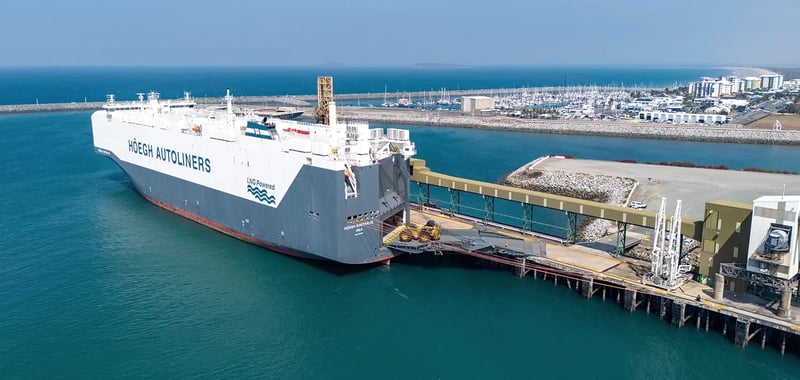
Höegh Australis at the Port of Mackay in August 2026. Image: NQBP
A landmark break bulk receival occurred in August this year with the arrival of the Höegh Australis, the first Aurora-class vessel to call at the Port of Mackay. Five Caterpillar 793F dump trucks started their journey with Freightplus Pty Ltd managing the shipment as freight forwarder. The cargo was loaded aboard the Höegh Australis in Antwerp, Belgium. With 14 decks and multi-fuel capability, the vessel is amongst the most environmentally advanced pure car and truck carriers in operation.
Mr Webb said the results demonstrate the Port of Mackay's resilience and importance to the region. "From the mine site to the farm gate, the Port of Mackay is doing double duty for the industries that built our region," Mr Webb said. "Petroleum remained our largest commodity, with imports increasing from 1.88 million tonnes to 1.9 million tonnes, ensuring a reliable fuel supply for regional businesses and communities."
The Port of Mackay is Queensland's primary exporter of refined sugar and a leading regional exporter of raw sugar and grain. It is also the largest regional importer of fuel in Queensland, with six fuel terminals servicing the mining, agriculture, aviation and transport sectors. The Port of Mackay recorded overall trade growth despite adverse weather events throughout the year, handling 3.5 million tonnes of trade in 2025-26, up from 3.4 million tonnes the previous financial year.
Air freight: vital for remote communities
In such a big state, the Queensland Freight Delivery Plan 2026 recognises that air freight is "vital for urgent deliveries and supporting remote communities, especially when disaster strikes". To that end, the plan calls for better use of the Federal Government’s Remote Air Services Subsidy Scheme "so that transport-disadvantaged communities receive maximum benefit from the timely delivery of essential air freight, including medical supplies".
"Air freight in Queensland is a low-volume but high-value component of the state’s overall freight task, underpinning global export and import pathways, as well as supporting essential supply chains across regional and remote communities," the plan notes.
Since air freight is mostly carried in passenger planes rather than dedicated cargo aircraft, boosting inbound airline services to Queensland is a key objective to increase export air freight opportunities.
Looking ahead
In such a vast state with many players in the supply chain, there are multiple factors influencing the efficiency of Queensland’s freight network.
But a couple of issues stand out.
Congestion around Brisbane is set to increase as the population grows, exacerbated by the build-up to the 2032 Brisbane Olympic and Paralympic Games. This makes development of regional container ports crucial to the state’s freight efficiency. Progress on new container terminals at Gladstone and Mackay is critical to the whole state’s freight network.
There’s a further compelling reason for Queensland’s bulk ports to diversify into the container trade where they can. With fossil fuels ultimately declining, ports dependent on the export of coal and gas eventually will fail. Container handling represents a survival, not just growth, strategy.
But ports require efficient road and rail networks to handle growing container volumes. That’s where the reset of Inland Rail’s northern section offers a potential opportunity for Queensland — rather than the blow it initially presented.
Had Inland Rail proceeded as planned before its May 2026 truncation, its northern terminus at Ebenezer would have necessitated the transfer of containers to another train or truck for the final trip to Fisherman Islands because Inland Rail’s double-stacked container trains would be unable to access the Brisbane Multimodal Terminal at Acacia Ridge (or the port itself).
Only time will tell if a better rail freight connection to the Port of Brisbane can be found, perhaps under a future reset of Inland Rail.
This article appeared in the October | November 2026 edition of DCN Magazine