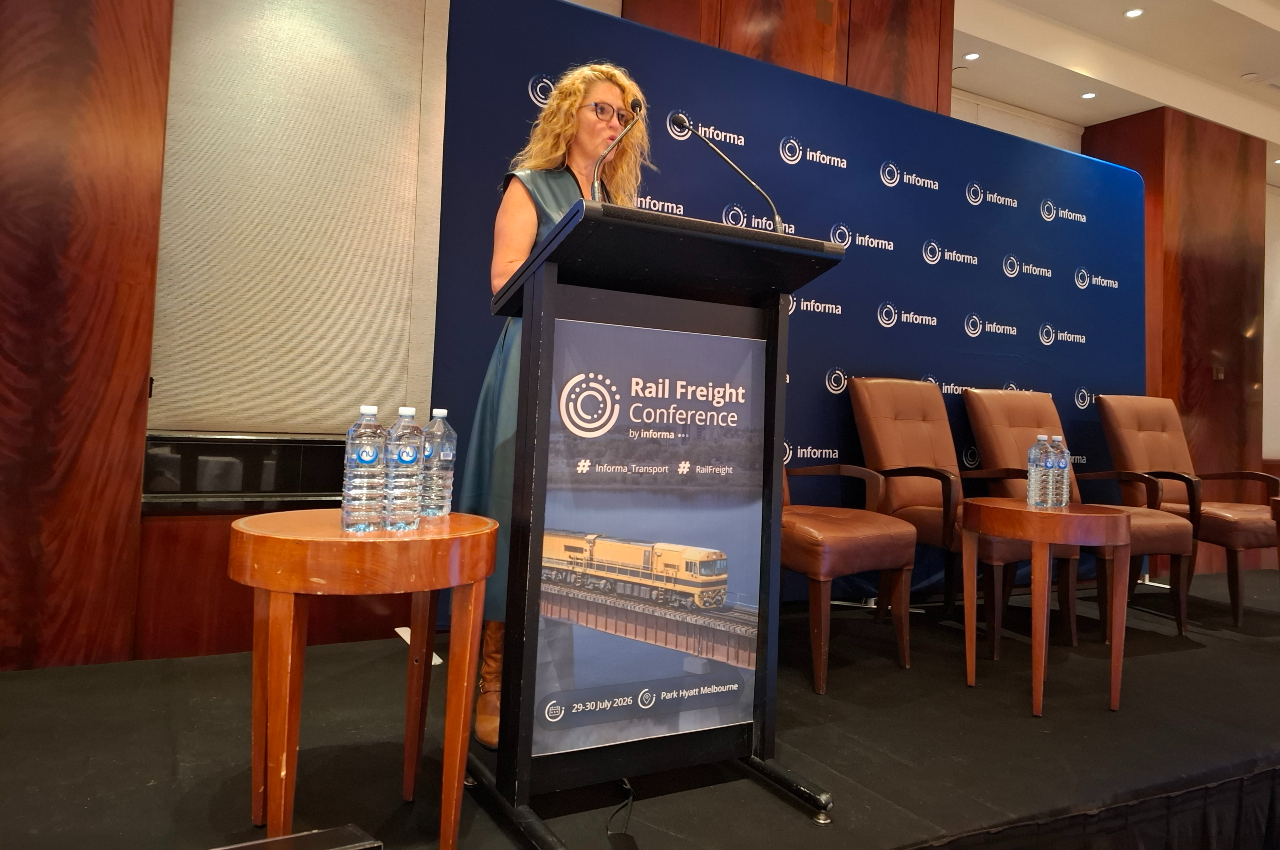
“DECARBONISATION is a team sport.” That was the observation of Heather Bone, director of sustainability and chair of the National Freight and Supply Chain Strategy, addressing Informa’s Rail Freight Conference in Melbourne.
Ms Bone noted good businesses in any sector had always tried to operate sustainably, avoid wasting resources and keep people safe, they just didn’t previously use the ESG (environmental, social and governance) terminology and reporting standards of today.
“Good businesses have always avoided waste, looked after people and planned for tomorrow,” Ms Bone reflected.
“The language might have changed but good operators have always understood that the safest businesses usually become the most productive businesses.”
The overall drive to avoid waste has taken on a new dimension with the drive to decarbonise the freight sector through mandated ESG and climate targets, Ms Bone noted. But people, not technology platforms, are the most important factor in this drive.
“It starts with the driver deciding how they operate the locomotive, it continues with the maintainer identifying the fault before it becomes a failure. It continues with planners optimising train paths … it involves engineers designing more efficient assets.”
Reflecting on Aurizon’s decarbonisation journey, Vikram Khosla, the rail freight operator’s asset strategy and growth manager, emphasised “investability” (the financial dimension of sustainability) when it came to renewing major assets like locomotive fleets.
For Aurizon, the stakes in any major conversion to a greener future are big. Originating from Queensland Rail’s former freight assets, the ASX-listed company owns and operates a 5000-kilometre network of heavy haul rail, including the 2200-km Tarcoola-Darwin line, through the centre of the continent and the 2670-km Central Queensland Coal Network, of which about 2000 kilometres is overhead-electrified.
Aurizon owns and operates more than 600 locomotives, 14,000 wagons and has port services in Townsville, Darwin and Newcastle.
Nearly all of Aurizon’s scope 1 greenhouse emissions are from diesel use by its rail and road vehicles.
Mr Khosla noted the “ironies” presented by emissions reporting frameworks. “Perversely, if we’re moving less coal, we dilute that [emissions intensity] metric … we go backwards!”
When so much of Aurizon’s customer base depends on an ultimately declining commodity, its investment decisions are much more complicated than the “goldilocks conditions” for the vertically-integrated miners extracting iron ore in the Pilbara, Mr Khosla noted.
While Aurizon has invested in step-change technologies such as battery electric tenders through a partnership with the Federal Government’s ARENA entity, there is also an important role for what Mr Khosla call “short-term emissions reduction technologies”.
These include locomotive anti-idling systems which face human challenges because loco drivers might believe they will lose cabin features such as air-conditioning if they switch off the engine.
Aurizon even considered “gamifying” a particular haul – the Emerald run – to identify the most fuel-efficient driver on a leader board, Mr Khosla revealed. “Many people are into F1, can we use that?”
Mr Khosla said Aurizon was also planning to increase its use of renewable biodiesel in its existing locomotives as part of its fleet decarbonisation.
For future battery electric locomotives, the major – and obvious – challenge was the availability of wayside charging infrastructure. To achieve climate goals, loco charging stations had to be powered on renewably-generated electricity.
“We’re learning lessons by doing,” Mr Khosla concluded. “And it’s dynamic. If history shows us anything, you set out to solve one problem and inadvertently solve another problem.”