-
Posted by Max Berry
- |
-
26 Aug, 2026
Australia’s rail freight future depends on fixing infrastructure gaps, boosting resilience and expanding intermodal links as new technology and cleaner fuels vie with road transport dominance
WITH the freight task in Australia still increasing sharply, the efficacy of the national rail freight network has never been more important.
Rail handles 68% of bulk freight, but only 17% of non-bulk freight, according to The Future of Freight Summary Report, published in 2023 by the Australasian Railway Association (ARA) and the Freight on Rail Group. But the efficiency and uptake of rail freight varies dramatically across different parts of the nation.
In north-west Australia, BHP’s iron ore trains are more than seven kilometres long: the longest and heaviest trains in the world. And trains run in the Pilbara by rival miner Rio Tinto are driverless, remotely controlled from Perth over a 1700-kilometre network.
Yet there are real questions about the fitness for purpose of rail freight infrastructure and systems in other parts of Australia.
The Bureau of Infrastructure and Transport Research Economics (BITRE) points out in Trainline 12, published in 2025, that rail’s traditional advantage for long-haul grain shipments in southern Australia is being eroded by the emergence of bigger and more fuel-efficient trucks, more on-farm storage that better suits road transport, deregulation of grain marketing and reliability problems with ageing locomotives and wagons.
Yet rail freight is up to 10 less greenhouse gas (GHG) emissions-intensive per tonne-kilometre than road transport, according to the ARA.
Inland Rail: truncated but still progressing
Murmurings about the ever-rising dominance of road transport grew louder with the Federal Government’s truncation of the 1600-kilometre Melbourne-Brisbane Inland Rail project in May 2026 when it announced the project would be truncated, now terminating at Narromine, 200 kilometres north of a major terminal at Parkes, NSW, with the northern section to Brisbane paused.
Blaming an estimated cost blowout to $45 billion from its $16 billion budget, Federal Infrastructure Minister Catherine King described Inland Rail as “started without proper planning”, “with no clear start or end points and “severely underfunded”.
Effectively, the project will now provide a rail freight corridor allowing double-stacked container trains from central NSW to a new intermodal terminal at Beveridge, 40 kilometres north of the Melbourne CBD. Plans for new rail services in Inland Rail’s northern section by freight handlers such as the Louis Dreyfus Company (LDC), which recently acquired Namoi Cotton, and InterlinkSQ in Queensland must now be revised.
ARA CEO Caroline Wilkie said it was essential that completion of the Inland Rail route remained in focus as the Federal Government confirmed construction would not proceed north of Parkes.
“We welcome the continued preservation of the rail corridor and intermodal sites to ensure we can get this project back on track in the future,” Ms Wilkie said.
Aurizon CEO and managing director Andrew Harding said the Federal Government decision to pause work on Inland Rail was a prudent and fiscally responsible decision. “Of course, we would like to see Inland Rail completed at some stage,” Mr Harding said. “But … the focus for now on preserving the corridor north of Parkes is a sensible decision that will help facilitate construction in the future.”
Improving the resilience of the rail freight network
Mr Harding welcomed the Federal Government’s budget announcement of a further $1.75 billion to improve Australia’s freight rail network, particularly after floods washed away sections of the Indian-Pacific route in 2022.
But a Telstra outage in July 2026 showed how vulnerable the V/Line network — which carries freight and passenger trains — was to the telco for its radio systems, with passenger and freight trains suspended for two days. Because V/Line relied on an exclusive contract between Telstra and Australian Rail Track Corporation for radio communications, there was no back-up after an outage, V/Line CEO William Tieppo explained in a media conference.

Victoria’s twin regional rail networks and ‘the Cape of Good Hope route’
Located entirely within Victoria, the Murray Basin Rail Project is considered a “nationally critical infrastructure project” because of its importance in moving export agricultural produce from the Sunraysia/Mallee region in north-west Victoria to ports.
After a disastrous first edition of the project in which a contractor was dismissed, the project “paused” and a scathing Auditor General’s report issued, a second iteration of the project, with a reduced scope, was successfully completed in May 2026.
But the continuing dual (broad and standard) gauge track configuration in western Victoria means that trains from the Mildura region, such as the “fruity” run for MEDLOG from Merbein, must traverse a 127-kilometre each-way detour via Ararat to Melbourne compared to the previous direct route via Ballarat. One wag has dubbed the post-2018 passage from the Mildura/Yelta and Murrayville lines the “Cape of Good Hope” route.
Several options exist to shorten the current circuitous standard gauge rail route to Melbourne from the Mallee. But none of the options for reducing the time and distance of the current standard gauge route has yet won support from the Federal or Victorian governments.
Despite the gauge mix in Victoria, completion of the “Murray Basin Rail Project (Optimised Scope)” has delivered benefits to freight handlers in the Wimmera and Mallee regions of Victoria, including MEDLOG, Graincorp and Cargill.
Network capacity across the north-west Victoria network has increased, train speeds for some trains are faster because of the upgrade to the Maryborough-Ararat Railway Line (MARL) and longer trains can now be accommodated on the network after a key crossing loop at Emu was extended. The “fruity” is now regularly 1200 metres long, with 82 wagons carrying up to 164 TEU, and some 1500-metre trains have been run.
Intermodal terminals: helping the trend to containerisation
A key factor in greater utilisation of rail freight is the availability of regional intermodal terminals and packing houses, allowing primary producers to get product packed into containers and loaded on to trains close to their origin. More regional intermodal terminals are needed to facilitate the trend away from bulk to containerised agricultural and mined products.
The curtailment of Inland Rail means that intermodal terminals planned for its route north of Parkes at Narrabri and Moree in NSW, and Toowoomba in Queensland will now be paused. National Intermodal Corporation is still proceeding with an intermodal terminal at Beveridge as the Melbourne terminus of Inland Rail, with construction by John Holland started in early 2026.
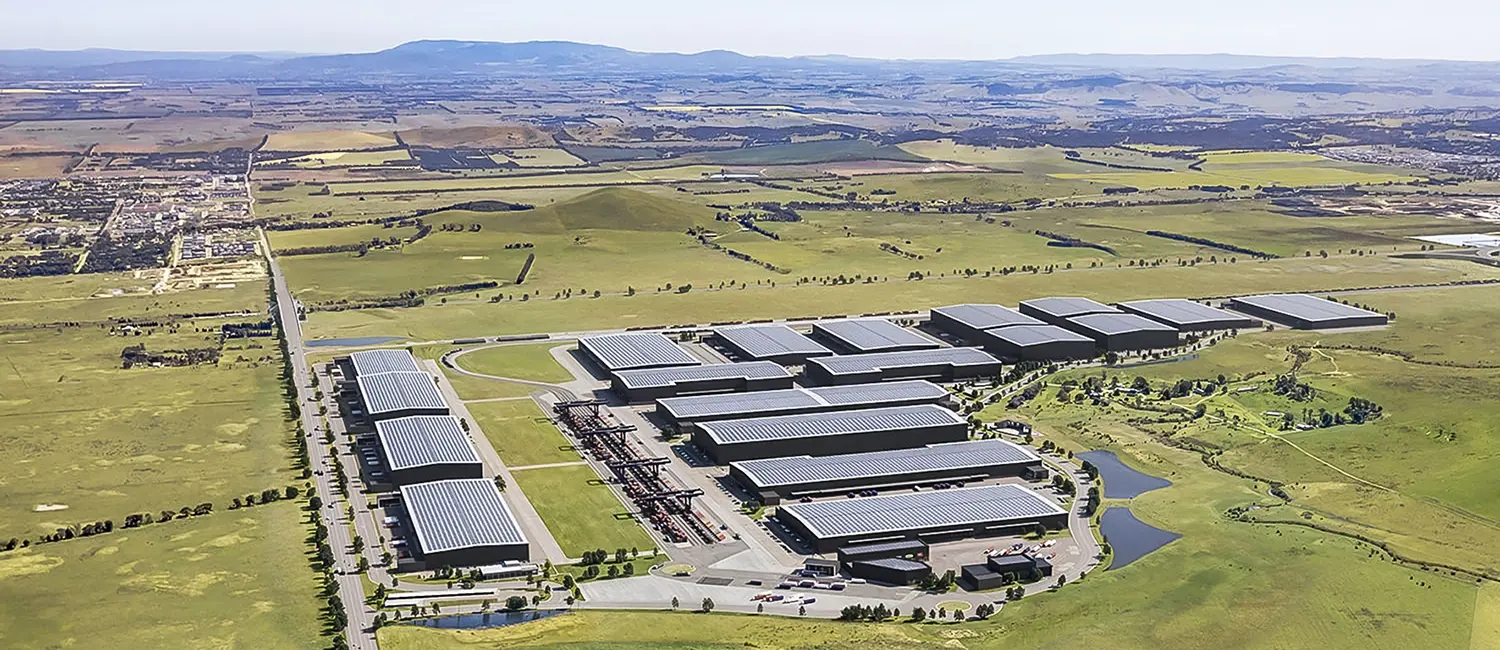
3D Render of Beveridge Intermodal Precinct. Image: National Intermodal
In Victoria, Qube Logistics — recently acquired by Macquarie Asset Management — is planning an intermodal terminal at Murtoa, in western Victoria, adding to the eight existing regional intermodals in the state.
Qube Logistics GM Commercial (Victoria) Luke Thomas said the company was working on plans for the new, multi-modal freight and logistics facility with construction expected to commence later this year and operations kicking off in early 2027.
“As well as providing a hub for road transport services, our new Murtoa site will also include a rail siding, which will mean Qube will also be able to facilitate exports from the region direct to the Port of Melbourne via rail,” Mr Thomas said.
Another regional Victorian intermodal terminal is planned for the Ballarat West Economic Zone. Ballarat Intermodal Freight Terminal (BIFT) co-tenants George Weston Foods and CHS Broadbent plan to run trains loaded with containerised grains and pulses on the Ballarat line to the Port of Melbourne.
But these plans have become entangled with a Melbourne Airport Rail Link proposal to remove crossovers at Sunshine in 2027, severing the direct link, imposing a 47-kilometre detour and jeopardising BIFT's viability*. Unless mitigated, the MARL proposal will make rail freight less competitive compared to trucks — directly opposite to the government’s policy.
The Victorian government set up a Rail Freight Working Group to identify a workaround solution but at the time of writing no solution had been determined and funded. Even if work on a mitigation starts now, the solution will not be in place once the crossovers are removed.
NSW Ports hits rail milestone
A record 504,000 TEUs was moved by rail directly through Port Botany’s container stevedore terminals, achieving a 19% rail mode share in financial year 2026, and becoming the first port in Australia to reach the half million mark.
Port Botany is the only port in Australia to have on-dock port rail at each of its container terminals.
These terminals are directly connected to a network of metropolitan and interstate intermodal terminals, including by dedicated freight only rail.
This unparalleled rail network sees about 90 trains a week being processed at the port.
NSW Ports chief executive Marika Calfas said the port’s established “dedicated freight rail connection to the vast Sydney metropolitan intermodal network has seen container volumes on rail continually grow.
“The evolution of this intermodal network has been occurring progressively over the past 20 years, with the most significant progress in the past five years through the combined effort of intermodal terminal operators, rail operators, stevedores, NSW Ports and ARTC,” Ms Calfas said.
“NSW Ports’ On-Dock Rail Investment Program has, and will continue, to support the growth of containers to and from the port by rail. Through this program, our long-term goal is to move 3 million TEU by rail.
“Increasing the use of rail is a core part of our strategy and we continue to invest in the ports’ capabilities to sustainably transport NSW’s growing freight task,” Ms Calfas said.
Phase 2 of the On-Dock Rail Investment Program at Port Botany is in partnership with DP World. The $400 million co-investment program is designed to increase the port’s total annual rail capacity.
Phase 2 is expected to create a one million TEU per year capacity on-dock rail terminal, adding to the 1 million TEU per annum rail capacity delivered in Phase 1.
Phase 1 at Patrick Terminals began operations in late 2023.
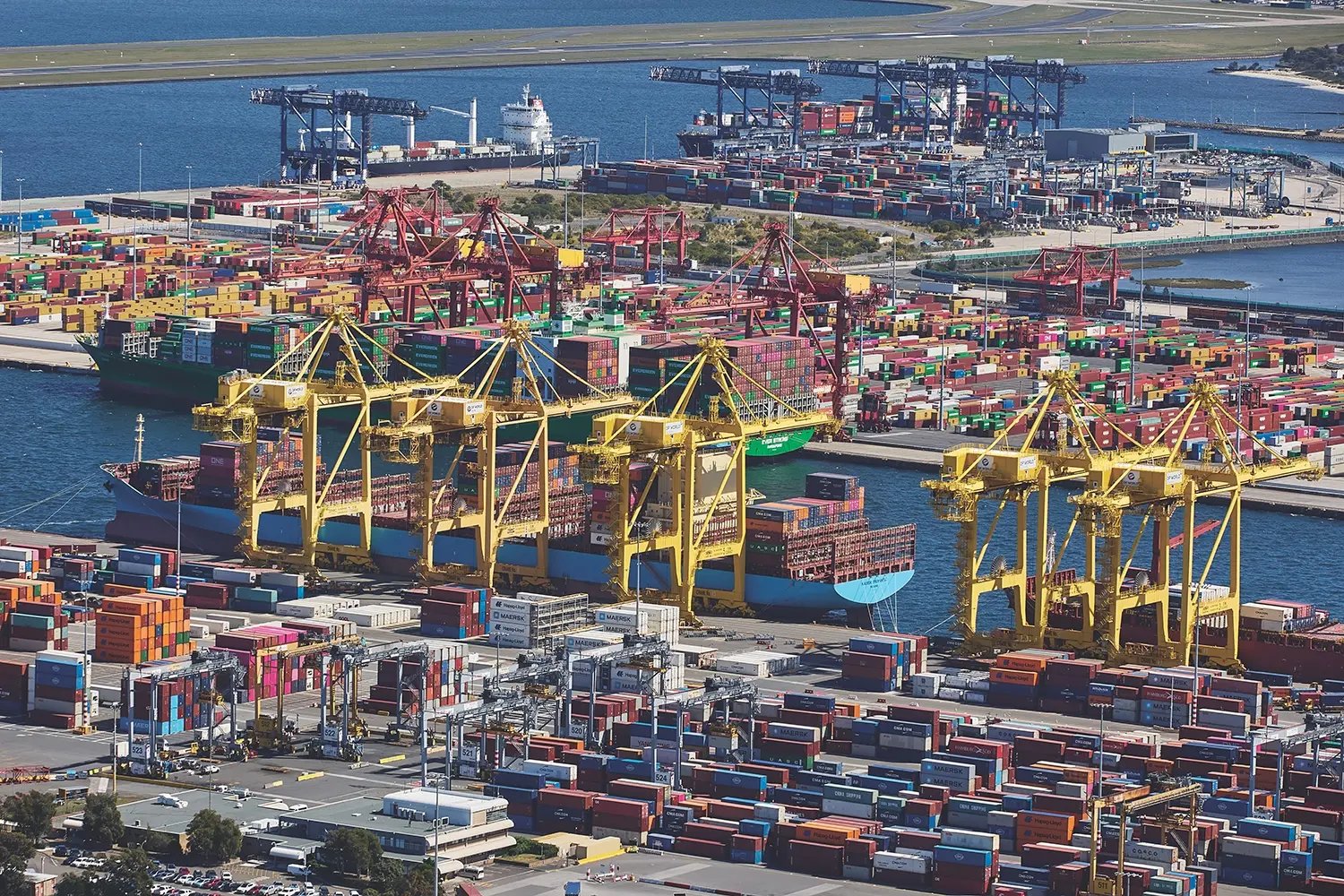 Image: NSW Ports
Port-rail shuttles: key to rail freight for overseas trade
A key factor for facilitating rail freight for overseas traded products is the availability of effective port-rail shuttles to move containers swiftly between ports and large intermodal terminals, located close to major warehouses.
Sydney has led the way in effective port-rail shuttles in Australia, with major intermodal terminals such as Moorebank and Enfield and plans for a dedicated freight line to Port Botany.
A statement from NSW Ports for DCN said: “NSW Ports has been progressively investing to grow the capacity of the existing rail terminals at Port Botany, to increase the volume of containerised freight carried by rail. Port Botany is the only container port in Australia with on-dock rail at each of its container terminals.
“Phase 2 of the On-Dock Rail Investment Program at Port Botany commenced in 2025, in partnership with DP World … Phase 2 will add a further 1 million TEU per annum rail capacity to Port Botany.”
NSW Ports has also received approval recently for development of Port Kembla as the state’s next container terminal “once Port Botany nears capacity” with on-dock rail available.
South of the Murray, the late 2025 launch of Melbourne Intermodal Terminal at Somerton, 20 kilometres north of the CBD, finally has produced an effective port-rail shuttle in Victoria, with containers now able to be railed from the port to a large terminal located close to major warehouses for Coles and Australia Post, among others.
Due to current [South East Queensland] freight rail network constraints, more than 98% of the port’s container trade is transferred to and from the port by road
Port of Brisbane spokesperson
But there are serious constraints on rail services to the Port of Brisbane. There is a direct rail line to Fisherman Island but most containers are transferred between trucks and trains at the Brisbane Multimodal Terminal at Acacia Ridge, 30 kilometres from the port.
Originally, BMT was planned as the Queensland end-point for Inland Rail but the 2023 Schott review recommended shifting the terminus to Ebenezer, 88 kilometres from the port! This only adds to road congestion in the greater Brisbane area.
“Due to current [South East Queensland] freight rail network constraints, more than 98% of the port’s container trade is transferred to and from the port by road,” a Port of Brisbane spokesperson told DCN.
“Over the last 12 months, we have continued to engage with customers and supply chain operators regarding opportunities to move more freight by rail through the BMT and we’ll continue to do so.”
Mineral sands and rare earths: an opportunity for rail freight
When its Murtoa intermodal terminal comes online, Qube will seek to transfer agricultural produce currently moved by truck to rail freight. Looking ahead, mineral sands deposits in the area are confirmed and this may become a future traffic for the company.
Qube is fast developing expertise in the containerisation and transport of mineral sands after recently launching a service for Iluka Resources, running trains from its intermodal terminal at Ultima in northern Victoria loaded with containerised mineral sands. Qube will soon also be loading containerised mineral sands and rare earths at Ultima for miner VHM Ltd.
Rare earths, often co-located with mineral sands, are now a hot commodity with demand driven by the electrification trend and shored up by a recent Australia-US trade agreement for the commodities. Successful mining could see future intermodal terminals at sites in north-west Victoria or south-west NSW, including Carwarp or Ouyen, where a local development group, Ouyen Inc, has long promoted a future intermodal terminal.
A successful strike of mineral sands or rare earths in this area could also put the so-called “Transcontinental Link”, a proposed 220-kilometre line linking the Mildura line to the Sydney-Perth line at Menindee, on the planning table.
In the west, rare earths and mineral sands mined at Malcolm and Leonora north of Kalgoorlie and nickel extracted from south of Kalgoorlie is sent by rail to the Port of Kwinana. Similar services are likely to follow in the wake of this 21st century “gold rush”.
Future fuels for rail freight in Australia
Potentially carbon-free electrification technologies are available now, but their uptake depends on favourable government policies helping operators switch from their current diesel-electric locomotives.
BHP landed Australia’s first battery electric locomotive in the Pilbara in late 2025 after being built locally by a partnership led by UGL. And a Melbourne company, Alta, has developed a battery tender that can be coupled to either an electric locomotive or a conventional diesel-electric locomotive.
We have fuel supplies, but we still don’t have fuel security. We still import 100% of our diesel – whether refined or as crude oil
Dr Hermione Parsons, Australian Logistics Council
Other logistics experts are looking to renewable diesel. Australian Logistics Council CEO Dr Hermione Parsons told a recent Rail Futures Institute briefing that renewable diesel (or biodiesel) is a “drop in” fuel that can power existing diesel-electric locomotives.
While renewable diesel is less carbon-emitting than mineral diesel, its primary advantage was in being capable of being locally produced: a benefit starkly shown by this year’s Middle East war which disrupted oil supplies and sent prices skyrocketing.
“We have fuel supplies, but we still don’t have fuel security,” Dr Parsons warned, acknowledging the Federal Government’s efforts in securing oil supplies that don’t need to traverse the blockaded Strait of Hormuz. “We still import 100% of our diesel — whether refined or as crude oil.”
Dr Parsons said the ALC was promoting rail freight in ministerial councils and the Rail Freight Taskforce as both an environmental benefit and because of its greater fuel efficiency per tonne of freight moved, especially important during the recent fuel crisis.
But a Pacific National executive told DCN that when it comes to innovation in rail technology “the biggest problem is each network in Australia [BITRE estimates there are 18] has different approval processes. There’s no incentive to innovate”.
With the truncation of the largest national rail freight project in Australia in decades — and other key gaps — the next 12 months will be decisive in shaping the future sustainability of Australia’s rail freight network.
* In a previous version of this article, in addition to the print version, it was stated that plans for an intermodal terminal at Beveridge were in jeopardy. This was incorrect. Daily Cargo News apologises for this error.
This article appeared in the August | September 2026 edition of DCN Magazine