
-
Posted by Dale Crisp
- |
-
30 April, 2026
THE MARITIME Union of New Zealand is furious about revelations the national government is using money ‘saved’ by the cancellation of an emergency towage vessel contract to upgrade an airport.
MUNZ secretary Carl Findlay told local media it was a case of the government prioritising the convenience of airlines over the lives and safety of Cook Strait ferry passengers and crew.
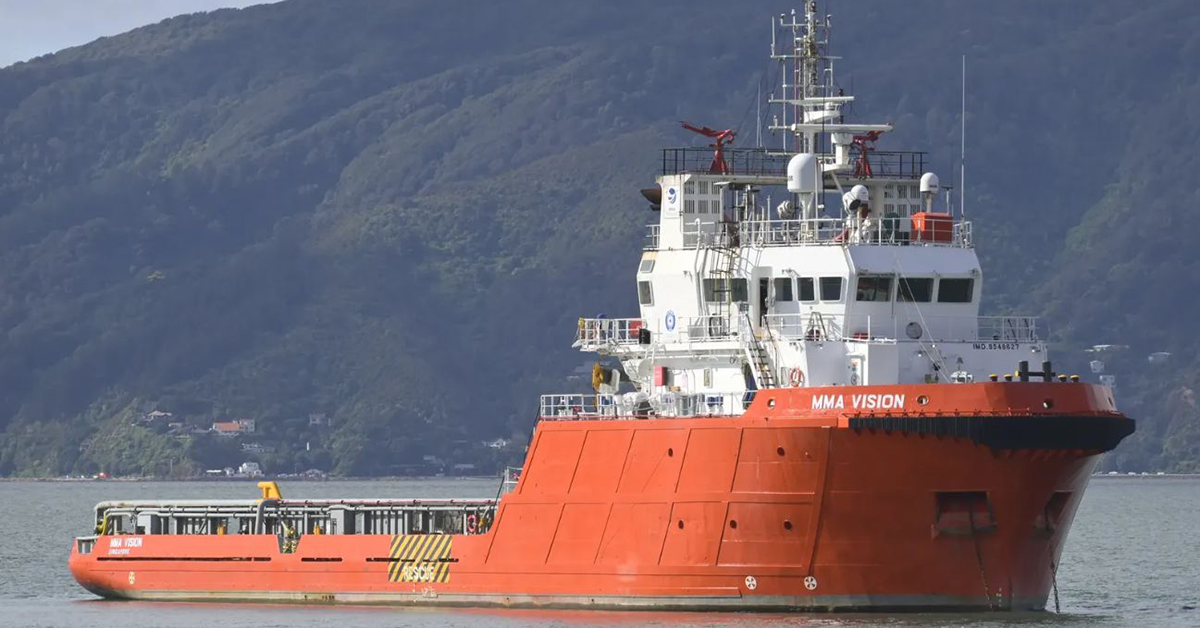
Transport minister Chris Bishop announced in November 2025 that Cabinet had decided the cost of the ETV MMA Vision could not be justified and accordingly terminated the contract early in February 2026 to save about NZ$9 million.
But it has now emerged the money has instead gone to upgrading the Ohakea Air Force Base in Manawatu so it can be used as a 24/7 alternative to Auckland and Christchurch for large passenger and freight planes. The government claims this will increase the commercial viability of flying to New Zealand.
The Post reported that the actual proportion of the proposed tug spend diverted to the upgrade has been redacted from Cabinet papers it obtained. The government insists the two matters are unrelated.
Ironically, the news comes just as Austrian energy company OMV has signed a new, up-to-five-year contract with Cyan Renewables (the former MMA Offshore) to continue the charter of the 2009-built MMA Vision for operation in New Zealand waters. The AHTS’s current charter to OMV was due to run out in July this year.
OMV NZ operates a portfolio of offshore oil and gas assets in Taranaki, supported by onshore processing and storage facilities.

The government allocated NZ$600,000 in Budget 2024 to Maritime NZ to develop a business case for emergency ocean response capability (EORC), focusing on Cook Strait, where ferry breakdowns have become all too common.
Cabinet considered an Indicative Business Case in November 2024, and a detailed business case in March 2025. The business case proposed procuring (via retainer style contracts) two separate EORC vessels: an EORC vessel based in the Cook Strait that could stabilise a stricken vessel, and a larger EORC vessel that could tow the stricken vessel to a safe harbour (a “two-strike solution”).
“The business case for the EORC noted there have been 23 incidents over the last five years where ready access to EORC may have supported the response. However, all of these incidents were resolved with existing capabilities and vessels of opportunity,” Mr Bishop said, when announcing the contract cancellation.
“Overall, while there is clearly risk in the Cook Strait, the risk is small and does not justify the procurement of dedicated EORC. The identified benefits are only realised in the top 1% of incidents, and only if the EORC solution is based close enough with a short enough activation and travel time to reach the scene of the incident,” the minister said.
“Most of the recorded incidents occurred outside the Cook Strait area, which demonstrates this limitation. The EORC vessel must also be capable enough to provide a successful response to an incident before the situation escalates to a grounding or similar outcome.
“There has also been significant cost escalation for an EORC. The indicative costs to procure the two-strike solution escalated from around $80 million over 10 years at the IBC stage in November 2024, to over $259 million over 10 years at the DBC stage in March 2025.
“While most of these costs were intended to be paid with the establishment of EORC-specific levies, there would still be significant cost pressures on the Crown to procure an EORC solution, and these levies would be passed onto consumers through higher prices.
“Put bluntly, the cost to taxpayers is too high for something that’s unlikely to be needed — and unlikely to be useful even if it is.”