

-
Posted by Daily Cargo News
- |
-
19 Jan, 2026
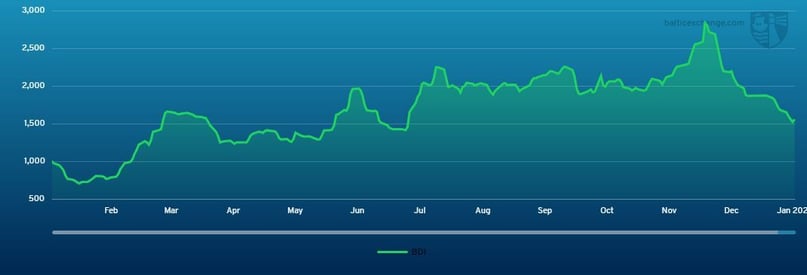
THE BALTIC Dry Index continued its downward trend, finishing at 1567 for the week ending 16 January 2026. This is a six month low for the index.
Capesize
The market endured another challenging week, with sentiment steadily weakening across most routes as rates continued to slide. In the Pacific, despite consistent miner participation and generally healthy operator activity, this proved insufficient to counter growing pressure from available tonnage. The C5 route softened throughout the week, with fixtures gradually slipping from the high-$7.00s into the low-$7.00 range, although by week’s end the market showed early signs of improvement. In the Atlantic, the South Brazil and West Africa to China market deteriorated sharply midweek, with rates falling from the low-$20s to around $19.00 on C3, as softer demand and more competitive offers weighed on sentiment. However, by Thursday, signs of stabilisation emerged, with bids edging back toward $19.00 and fixtures concluded in the low $19.00s, suggesting a possible floor. By the end of the week, sentiment had improved further as the C3 index nudged back up to $19,559. Elsewhere, the North Atlantic experienced the sharpest decline, with both fronthaul and transatlantic rates slipping noticeably. Despite sporadic activity, this proved insufficient to shift sentiment, although by the end of the week there was talk of a slightly stronger transatlantic fixture helping to lift confidence as the week came to a close.
Panamax
The week began with a cautious tone, as discounted mineral transatlantic business contrasted with more resilient grain trades, while fronthaul provided steady support. Tonnage supply across the Continent remained heavy, limiting upside despite reasonable enquiry. Midweek saw continued pressure on spot rates, although grain transatlantic commanded a modest premium and Indonesian demand stayed active, with modern vessels increasingly targeting longer Pacific employment or East Coast South America. Period activity provided some encouragement, highlighted by several mid to longer-term fixtures at firmer levels. By Thursday, sentiment had strengthened across all basins, with narrowing discounts in the Atlantic, busy fronthaul activity and firmer Pacific ideas. This improvement was reflected in the P5TC, which recovered to close the week at $13,120.
Ultramax/Supramax
A rather positional week overall for the sector. The Atlantic was a bit more buoyant certainly from the US Gulf, with more fresh enquiry and tight availability becoming tighter. Ultramax size seeing in the low $20,000s for transatlantic runs. From the South Atlantic traction was yet to be found, with a 63,000-dwt fixing in the low $14,000s plus low $400,000s ballast bonus for a trip to Southeast Asia. The Continent-Mediterranean also remained rather positional with some seeing better levels of enquiry from the Continent. The Asian arena remained a rather gloomy area from an owner’s perspective, although as the week closed it felt like a floor had been reached. A 58,000-dwt fixing delivery China for a trip to Bangladesh with clinker in the mid $13,000s. The Indian Ocean lacked much fresh impetus a 58,000-dwt fixing delivery Salalah trip to W.C. India in the mid $15,000s.
Handysize
The Handysize market endured a persistently subdued week, with overall fundamentals remaining weak as tonnage supply continued to outweigh demand in both basins. In the Continent and Mediterranean, activity was largely positional, with limited fresh inquiries and rates holding at or slightly below recent levels. A 34,000-dwt was reported fixed for delivery Varna, redelivery Continent, at around $9,000. The South Atlantic showed tentative signs of stabilisation, with some owners beginning to reassess rate expectations upward, although overall activity remained muted. A 36,000-dwt open West Africa was reported fixed for a trip delivering Recalada and redelivering Algeria at $17,000. The US Gulf continued to face challenging conditions amid a lack of fresh cargoes and a lengthy tonnage list, resulting in a softer market tone. A 40,000-dwt was reported fixed for a trip from the Mississippi River to East Coast Mexico at $15,500. Asian markets also remained quiet, with limited cargo availability weighing on sentiment. A slightly longer tonnage list, particularly on Southeast Asia–North Asia routes, applied mild pressure, though rates largely stayed near last-done levels. A 40,000-dwt was reported fixed from Rizhao to West Coast India at $10,000. Period activity was sporadic but present, with several short-period fixtures reported.
Clean
LR2
MEG LR2 freight rates climbed for the second week on week seeing the assessed TC1 rate for 75kt MEG/Japan rose 34.17 points to WS216. This moved the corresponding TCE up by $10,000 to $53,600/day on Baltic description round trip. A voyage west on TC20 90kt MEG/UK-Continent also improved this week by $331,000 to $4.65 million. The freight level for the TC15 80kt Mediterranean/East run gently moved up this week to $4.39 million (+$142,000).
LR1
MEG LR1’s also firmed this week in line with their large counterparts. The TC5 55kt MEG/Japan index went from WS191 to WS226. A run west on TC8 65kt MEG/UK-Continent ended the week a further $314,000 higher at $3.62 million. On the UK-Continent, LR1 freight held flat again this week. The TC16 60kt ARA/West Africa index remained around the WS150 level or thereabouts.
MR
MR freight in the MEG rocketed upwards this week. The TC17 35kt MEG/East Africa index shot up to WS292 (+55 points). This took the corresponding Baltic TCE to $32,000/day round trip. On the UK-Continent, MR freight climbed modestly this week. The TC2 37kt ARA/US-Atlantic Coast index was assessed 5 points higher than last week at WS121. The Baltic TCE for the round trip subsequently moved up to a little under $7,000/day. In the US Gulf, MRs continued with their strong momentum. The TC14 38kt US Gulf/UK-Continent voyage is currently at WS204 (+15 points) with the Baltic round trip TCE for the run now at $24,400/day. The Caribbean run on TC21, 38kt US-Gulf/Caribbean is also still currently marked at $850,000 (+$28,500). The MR Atlantic Triangulation Basket TCE went from $29,200/day to $32,000/day.
Handymax
In the Mediterranean, Handymaxes on TC6, 30kt Cross-Mediterranean index rocket back upwards this week to WS222 at time of writing (+68) with the corresponding Baltic TCE up 158% at $31,400/day round trip. The TC23 30kt Cross UK-Continent route improved by 16 points to WS167.
VLCC
The VLCC markets firmly rebounded this week for all the Baltic published routes. The rate for the 270,000 mt Middle East Gulf to China trip (TD3C) rocketed another 34 points to WS112.17 which corresponds to a daily round-trip TCE of $96,338 for the standard Baltic VLCC. In the Atlantic market, which was the main driver, the rate for 260,000mt West Africa-China (TD15) strongly improved by nearly 36 points to WS113.19 giving a round voyage TCE of just over $96,700. The US Gulf to China (TD22) market significantly gained over $4,250,000 to $14,326,778, which means a daily round trip TCE of just under $99,000 however, whether the ships on subjects at this level get fully confirmed remains to be seen.
Suezmax
In the Suezmax sector, rates have strongly improved in the West and to a lesser degree in the Middle East. The rate for the 130,000 mt Nigeria-UK Continent voyage (TD20) shot up by 33 points to WS166.11 which translates into a daily round-trip TCE of $76,406 while the TD27 route (Guyana to UK Continent basis 130,000 mt) gained 24 points to WS157.89 giving a daily round trip TCE of just over $72,800. The TD6 route of 135,000 mt CPC/Augusta was shocked by the mid-week drone attacks by the Ukrainians on 3 Western controlled Suezmax tankers and as a result the market steeply rose, putting on 64 points since last Friday to WS224.17 (and likely to rise further) meaning a daily TCE of a fraction under $140,000. In the Middle East, the TD23 route of 140,000 mt Middle East Gulf to the Mediterranean (via the Suez Canal) gained 9 points to the WS105 mark.
The Baltic Exchange, on Monday 12 January, started a public trial of a new Suezmax route for 145,000 mt USG/UKC (TD33).
Aframax
In the North Sea, the rate for 80,000 mt Cross-UK Continent route (TD7) gained 12 points to just under WS160, giving a daily round-trip TCE of about $67,100 basis Hound Point to Wilhelmshaven. In the Mediterranean, the rate for 80,000 mt Cross-Mediterranean (TD19) improved firmly by almost 38 points to WS207.5 (basis Ceyhan to Lavera, that shows a daily round trip TCE of over $69,100). Across the Atlantic, the market has improved dramatically. The 70,000 mt East Coast Mexico/US Gulf route (TD26) gained 47.5 points week-on-week to just over WS301 (giving a daily round-trip TCE of a little over $91,700) and the 70,000 mt Covenas/US Gulf route (TD9) gained 43 points to almost WS287 (translating into a daily round trip TCE of just over $79,400). The rate for the transatlantic route of 70,000 mt US Gulf/UK Continent (TD25) firmed by 13 points to WS248.89 which gives a round trip TCE basis Houston/Rotterdam of over $65,500/day. On the Vancouver exports, the rate for TD28 (80,000 mt crude oil Vancouver to China) was $137,500 firmer this week at $2,937,500 while TD29 (80,000 mt crude oil Vancouver to Pacific Area Lightering point off the USWC) gained 2.5 points to WS217.5 .
LNG
The LNG spot market continued to soften this week, with rates retreating further as the seasonal Q1 dip became more pronounced and the tonnage list lengthened, particularly in the Atlantic Basin. On the BLNG1 Australia–Japan route, 174k cbm vessels edged down $1,200 to $41,400/day. However, with 2-stroke availability remaining relatively tight, rates found support and avoided a sharper correction. The BLNG2 US Gulf–Continent route saw the largest drop of the week, with 174k cbm rates falling $21,300 to $26,000/day. A long position list and few fresh cargoes weighed on the Atlantic market. Similarly, the BLNG3 US Gulf–Japan route weakened, with 174k cbm earnings dropping $19,300 to $29,500/day. Time charter levels remained stable this week. The six-month rate held steady at $30,750/day, while the one-year term eased slightly by $225 to $42,150/day. The three-year period slipped marginally by $100 to $55,900/day.
LPG
The LPG market delivered mixed performance this week, with modest gains in the East contrasting with softer sentiment across western routes as momentum faded toward the end of the week. On the BLPG1 Ras Tanura–Chiba route, freight rates firmed by $2.33 to $82.50/mt, while TCE earnings increased by $1,456 to $71,798/day, supported by a steady flow of new cargoes entering the market. The BLPG2 Houston–Flushing route was flat in freight terms, holding at $80.25/mt. However, TCE earnings slipped marginally by $966 to $83,925/day. On the BLPG3 Houston–Chiba route, freight rates eased by $1.00 to $144.83/mt, with TCE earnings declining by $1,998 to $73,384/day. As the recent flurry of activity in the Atlantic began to slow, sentiment turned slightly more bearish, with the position list set to lengthen.
Container
Over the past week, container freight rates have edged slightly lower, with the Baltic container indices showing an overall decline of around 2.6% week on week. This modest softening is also evident across the main east–west trade lanes, with China–US West Coast rates down 3.5% to $2,745, China–US East Coast easing 0.5% to $3,928, China–North Europe down 1.9% to $2,898, and China–Mediterranean seeing a larger 5.4% correction to $4,539. The breadth of the declines suggests some post-GRI consolidation rather than a sharp shift in market direction.
Despite this week’s pullback, rates remain clearly elevated compared with pre-Christmas levels, underpinned by ongoing schedule disruption, extended transit times and continued capacity discipline by carriers. Planned freight rate increases implemented earlier in the year appear to have helped establish a higher pricing floor, limiting downside pressure even as seasonal demand remains subdued. Looking ahead, near-term rate direction will likely depend on the durability of capacity management measures and whether demand shows signs of improvement as the first quarter progresses.