

-
Posted by Daily Cargo News
- |
-
09 Feb, 2026
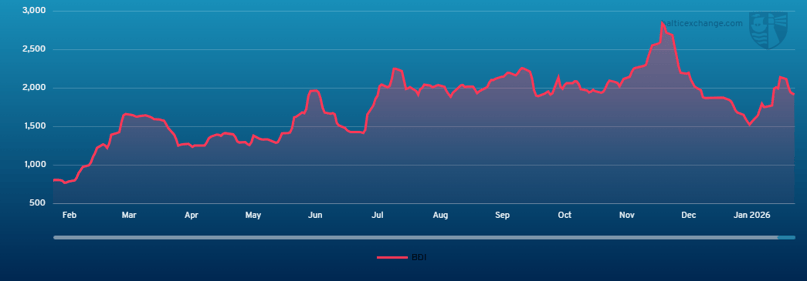
THE BALTIC Dry Index dipped last week, finishing at 1923 for the week ending 6 February 2026, down from the previous week's 2148.
Capesize
The market endured a broadly softer week, with sentiment cooling across both the Pacific and Atlantic as the BCI 182 5TC slid from the low $31,000s to finish closer to $26,468. Early optimism in the Pacific, driven by miner presence and steady West Australia volumes, ultimately failed to prevent rates from retreating. C5 corrected sharply from the mid $9.00s down into the low-to-mid $8.00s. In the South Brazil and West Africa to China market, activity remained muted through end February/early March laycans, with C3 levels continuing to grind lower into the high $22.00s by week’s end, and only sporadic fixtures emerging for later dates. The North Atlantic also softened, though by the end of the week there were early signs of a slightly tighter tonnage picture developing, despite limited activity. Overall, the week closed on a quiet and cautious note.
Panamax
The BPI drifted steadily lower over the week, with the P5TC falling from $15,735 on Monday to $14,865 by Friday, as sentiment softened across both basins. The Atlantic saw limited fresh cargo throughout, with transatlantic and fronthaul demand remaining thin and many charterers comfortably covered by backstops. Growing tonnage lists and delayed weather-affected vessels added to pressure, gradually shifting leverage toward charterers, though owners were largely reluctant to chase. Fronthaul activity cleared at or near last-done levels, with little upside evident. In Asia, the cargo book thinned further, particularly from the North Pacific and East Australia, while EC South America momentum faded. A clear split persisted, with larger, modern tonnage still attracting interest and occasional premiums despite broader market weakness.
Ultramax/Supramax
The Atlantic currently remained the more active of the two basins over the course of the week. Key areas from the Atlantic saw positive increase in demand and better numbers being discussed. The US Gulf saw ultramax size fixing in the mid $20,000s for transatlantic runs and the slightly smaller Supramax size seeing similar levels for fronthaul. Stronger levels were seen from the South Atlantic, a 64,000-dwt fixing in the low $16,000s plus low $600,000s ballast bonus for a trip to Singapore-Japan. In Asia, as the week progressed it became clear that demand had eased both for backhaul and NoPac business which in turn kept any upward moment in check. A 56,000-dwt fixing delivery China redelivery SE Asia at $8,000. Demand remained steady from the Indian Ocean, a 61,000-dwt fixing delivery South Africa trip Singapore-Japan in the mid $15,000s plus mid $500,000s ballast bonus. Period cover was still short, a 63,000-dwt open South China fixing 13-15 months trading at $15,900.
Handysize
The Handy market recorded a cautiously firm week, with sentiment gradually improving, particularly in the Atlantic basin. The South Atlantic and US Gulf were the main sources of strength, with both charterers and owners raising bid and offer levels and several fixtures concluded at improved rates. A 39,000-dwt was reportedly fixed from Houston via Texas to Nador with petcoke at $19,000, while a 40,000-dwt was fixed from Recalada to Morocco at $20,000. The Continent and Mediterranean remained mostly steady, with only marginal rate improvements and limited fresh activity. A 34,000-dwt, open Leixões, was fixed via Liverpool to Safi with scrap at $13,250. The Asian market remained the quietest region, with subdued cargo book. Although some tightening was noted in NoPac toward the end of the week, rates largely drifted sideways. A 38,000-dwt, open Sitra 8–13 February, was fixed for a trip to West Australia at $7,000. On the period side, activity was limited. A 40,000-dwt newbuilding was reported fixed for three years at 120.5% of BHSI.
Clean
LR2
LR2 Freight levels crumbled this week in the MEG. The TC1 75kt MEG/Japan rate fell from WS213 to WS190 taking the corresponding TCE down to $44,000/day on Baltic description round trip.
A voyage west on TC20 90kt MEG/UK-Continent also ticked down this week by $270,000 to $4.32 million.
The freight level for the TC15 80kt Mediterranean/East run continued to modestly improve this week to $4.98 million (+$77,500).
LR1
MEG LR1 freight levels also fell off this week. The TC5 55kt MEG/Japan index went from WS219 to WS204.
A run west on TC8 65kt MEG/UK-Continent ended the week down $142,000 at $3.42 million.
On the UK-Continent, LR1 freight held for another week with the TC16 60kt ARA/West Africa index around the high WS150’s to low WS160’s.
MR
MR freight in the MEG softened again this week. The TC17 35kt MEG/East Africa index dropped 18 points to WS251. This took the corresponding Baltic TCE to $25,300/day round trip.
On the UK-Continent, MRs made another upward charge this week. The TC2 37kt ARA/US-Atlantic Coast index was assessed 21 points higher than last week at WS153. The Baltic TCE for the round trip ended 42% up at $12,300/day.
In the US Gulf, MR freight level continued to climb sharply this week. The TC14 38kt US Gulf/UK-Continent voyage is currently assessed at WS298 (+100 points) with the Baltic round trip TCE for the run now at $42,297/day up 83%. The Caribbean run on TC21, 38kt US-Gulf/Caribbean is presently marked at $1.82 million (+$878,000).
The MR Atlantic Triangulation Basket TCE went from $31,900/day to $51,700/day.
Handymax
In the Mediterranean, Handymax’s on TC6, 30kt Cross-Mediterranean index dipped to WS253 mid-week but has since returned to WS272.
The TC23 30kt Cross UK-Continent route firmed another 39 points this week to WS227.
VLCC
The VLCC market freight levels rose slightly during the week but were last assessed at flat with last Friday. The rate for the 270,000mt Middle East Gulf to China trip (TD3C) remains at WS137.17 which corresponds to a daily round-trip TCE of $122,666 for the standard Baltic VLCC.
In the Atlantic market, the rate for 260,000mt West Africa/China (TD15) remains flat at WS124.25 giving a round voyage TCE of a little short of $107,200. The US Gulf to China route (TD22) has eased by almost $40,000 to a little under $13,800,000 which means a daily round trip TCE of just under $92,700.
Suezmax
In the Suezmax sector, the rate for the 130,000mt Nigeria/UK Continent voyage (TD20) eased by 3 points to WS153.89 which translates into a daily round-trip TCE of just shy of $68,000 while the TD27 route (Guyana to UK Continent basis 130,000mt) remains flat at about WS155 giving a daily round trip TCE of just under $70,000. In the Black Sea, rates for the TD6 route of 135,000mt CPC/Augusta dipped early in the week to WS195 but have climbed back to where they started the week at WS200, meaning a daily TCE of just over $117,000. In the Middle East, the TD23 route of 140,000mt Middle East Gulf to the Mediterranean (via the Suez Canal) slipped by 3 points to the WS120 mark.
The new Baltic route of 145,000mt USG/UKC (TD33), lost about 5 points to WS130.
Aframax
In the North Sea, the rate for 80,000mt Cross-UK Continent route (TD7) dropped by 35 points to WS187.5, giving a daily round-trip TCE of just over $90,000 basis Hound Point to Wilhelmshaven.
In the Mediterranean, the rate for 80,000mt Cross-Mediterranean (TD19) lost 10 points to the WS245 level (basis Ceyhan to Lavera, that shows a daily round trip TCE of about $88,100).
Across the Atlantic, the market significantly dropped on short and longer-haul voyages. The 70,000mt East Coast Mexico/US Gulf route (TD26) lost 48 points to WS306.72 (giving a daily round-trip TCE of $93,975) and the 70,000mt Covenas/US Gulf route (TD9) lost 42 points to WS297.5 (translating into a daily round trip TCE of almost $84,200).
The rate for the transatlantic route of 70,000mt US Gulf/UK Continent (TD25) lost over 32.5 points to WS276.67 which gives a round trip TCE basis Houston/Rotterdam of $76,639/day.
On the Vancouver exports, the rate for TD28 (80,000mt crude oil Vancouver to China) gained $187,500 and is now assessed at $3,375,000 while TD29 (80,000mt crude oil Vancouver to Pacific Area Lightering point off the USWC) improved by 6 points to almost WS229.
LNG
The LNG spot market was broadly steady but subdued this week. With much of the market attending events in Doha and preparations for IE Week underway, activity was notably thin, resulting in a particularly quiet market.
On the BLNG1 Australia–Japan route, 174k cbm vessels slipped $1,200 to $29,400/day, with the East continuing to show greater resilience than the West.
The BLNG2 US Gulf–Continent route edged up $1,000 to $11,200/day, amid a disconnect between the visible tonnage list and actual prompt availability. Similarly, the BLNG3 US Gulf–Japan route rose $1,400 to $15,000/day.
In the time-charter market, sentiment softened slightly. The six-month rate eased $350 to $26,900/day, the one-year term dipped $50 to $38,075/day, and the three-year period declined $833 to $58,667/day.
LPG
The LPG market surged this week, with fixing activity accelerating in the West and the East following the Atlantic’s upward momentum. Strength built as the week progressed, with sentiment turning increasingly bullish as the prompt tonnage list tightened, particularly in the Middle East, while firm Atlantic fundamentals continued to provide support.
On the BLPG1 Ras Tanura–Chiba route, rates climbed $8.32 to $97.93, lifting TCE earnings by $9,540 to $87,853/day. Steady enquiry in the East, a tightening position list, combined with improving sentiment from the Atlantic, underpinned the move.
The BLPG2 Houston–Flushing route also firmed, rising $1.00 to $87.88, with TCE returns up $1,704 to $93,896/day. The BLPG3 Houston–Chiba route edged higher as well, gaining $1.08 to $159.33. Corresponding TCE earnings increased by $1,087 to $84,359/day. While gains were more measured than in the East, a healthier cargo flow kept the market well supported.
Container
Many liner owners are still not committing to a Red Sea return, with the exception of Maersk who have again this week announced they will be routing more of their services through in the coming months. For now, rates should remain fairly solid and away from historical lows, with tonnage fully occupied with the extra tonne miles around the COGH. However the moment that a full safe return to Red Sea transits becomes the norm again, it will be interesting times as tonnage will free up on a huge scale and side effects will be huge for rates.
FBX01 (China/East Asia–USA West Coast) has come off $232 from a week ago, ending the week at $1,899. FBX03 (China/East Asia–USA East Coast) dropped $752 over the week, ending the week at $3,061. FBX11 (China/East Asia–North Europe) came off $172 from last Friday, ending the week at $2,571, down $429 from the start of the year. FBX13 (China/East Asia–Mediterranean) decreased by $460 since last Friday and $1,070 from the start of the year, ending the week at $3,774.