-
Posted by Dale Crisp
- |
-
04 Sep, 2026
ONCE again it’s the South East Asia trade that’s drawing attention this week with another flip-flop in rates.
According to Xeneta the mean rate from South East Asian main ports to main ports Australia rose just 1% for Week 36, to USD 3,968/FEU, compared with last week’s 9% jump. Something of a pattern has developed, with notable increases occurring fortnightly, interspersed with slight gains or reverses.
Sources suggest this coincides with increases in transhipment cargo arriving at South East Asian hubs from Europe, the ISC and China, in waves driven by congestion in ports in those countries. When on-carriage volumes are strong, rates inflate; then, backlogs are cleared and rates fall back again.
Space is tight, regardless, and particularly into Fremantle and Adelaide, and that’s pushing levels higher with a degree of consistency. Singapore congestion is continuing, with some carriers said to be expecting cargo clearance delays of three weeks or more.
For the North & East Asia trade Week 36 saw mean rates for the Shanghai-Sydney port pair rise to a new Shanghai Containerized Freight Index high of USD 4,942/FEU, unsurprising in the circumstances.
The congestion delays are only getting worse, thanks to a succession of typhoons hitting the area. Shanghai and Ningbo delays are now reported at 10-11 days and growing, while forwarders indicate 30-40% space shortfall out of Qingdao for the first half of September. Rates there are heading to USD 6,000/FEU.
“Apparently, these (recent) increases are now sticking and with all the recent blank sailings announcements discounters have been holding the line and currently rolling cargo on southbound services back into the East Coast, and West Coast services are also full,” one source told Daily Cargo News.
“Because of the reduced tonnage on the southbound berth people are accepting the higher FAK rates and even asking for the higher “premium “rates to guarantee loadings.”

When opportunity knocks, carriers are off and running, again.
ANL will be implementing a rate restoration program from 1 October at USD500 per 20’ dry/reefer & USD1,000 per 40’ dry/reefer for all shipments from North & East Asia to Australia.
On the same date ANL will hit the rate restoration button for all shipment from China/South East Asia/North East Asia/Indian Subcontinent/Middle East to New Zealand. The increase will be USD 600 per 20’ dry/NOR & USD 1200 per 40’ dry/NOR.
In other notifications ANL/CMA CGM advise that effective 1 October 2026 in accordance with a new IMO regulation, ANL’s BAF will be calculated based on the very low sulphur fuel (VLSFO 0.5% Sulphur) and decreasing from USD 800 to USD 725 per ton.
And as of the lines’ ongoing efforts to enhance the efficiency and security of Import cargo release process, a revised Letter of Authority (LOA) format for all imports customers was introduced on 1 September. The new LOA includes a validity period and the authorized agent's email address to ensure cargo releases are processed accurately and efficiently.
“Moving forward, we kindly request that all consignees complete the required fields on their company letterhead and submit the updated LOA to us. This will help ensure cargo is released to the authorized parties without delays.
“Please note that all existing LOAs that do not include a validity period will remain valid only until 31 December 2026. After this date, all import consignees will be required to submit the new LOA format with details of their current active agent before this date.”
On 1 September ANL & CMA CGM also implemented a new booking confirmation format as the efficiency and experience drive. A sample new booking confirmation can be found on the website.
Affected countries are: Australia, Papuan New Guinea, East Timor, Fiji, French Polynesia, New Caledonia, Samoa, American Samoa, Solomon Islands, Tonga, Vanuatu, Wallis and Futuna. New Zealand to adopt the same during last quarter, 2026.
Neptune Pacific has announced that effective 1 October 2026, it will be simplifying how local charges are categorised and presented on invoices for Australia, New Zealand and Fiji imports and exports.
“This change reflects our ongoing commitment to reducing complexity and streamlining invoices for our customers.
“To achieve this, some existing charge code lines will be consolidated into new subtotals on each invoice. This change only affects how charges are described and grouped on invoices. The total dollar amount charged will remain unchanged.”

The tables below show the new consolidated charge structure alongside the current charge structure for each market and equipment type, plus the total charge values:
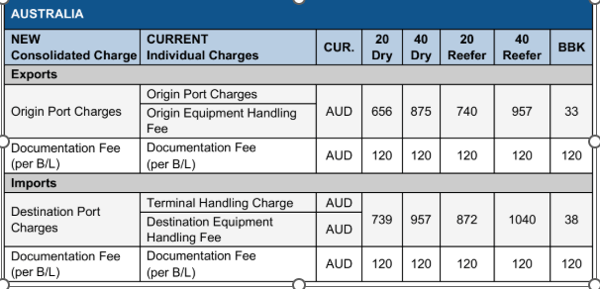
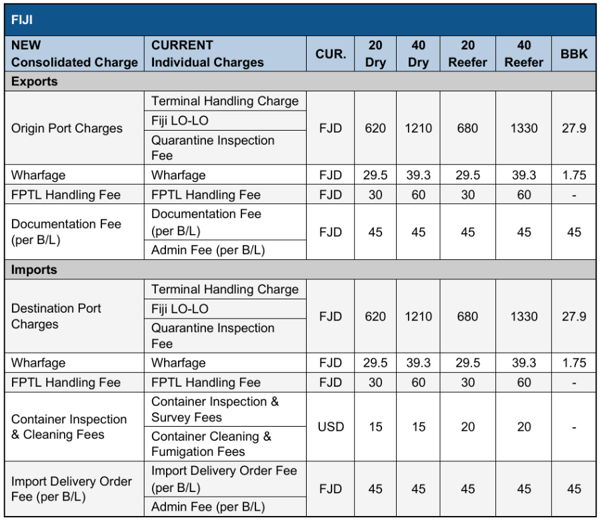
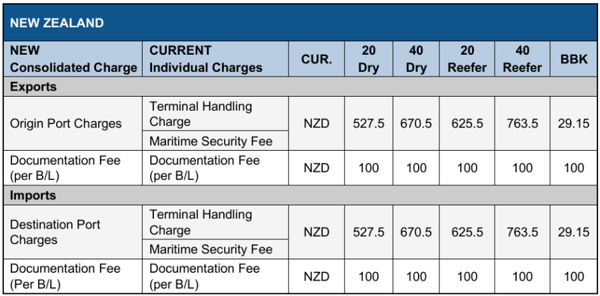
Source: Neptune Pacific
MSC will enact a rate restoration on all cargo moving from China, Hong Kong, Taiwan, Japan, Korea and South East Asia to Australia, at USD 600/TEU, on 15 September. MSC has also announced revised origin terminal handling changes applicable 1 October.
On the same date revised northbound bunker surcharges will apply:
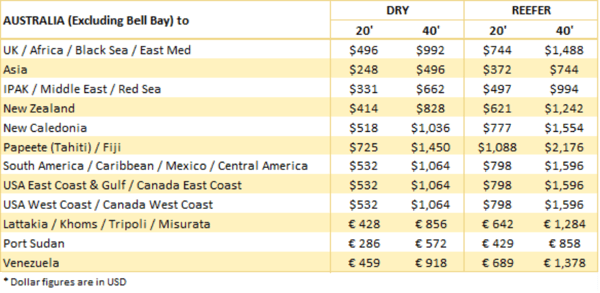
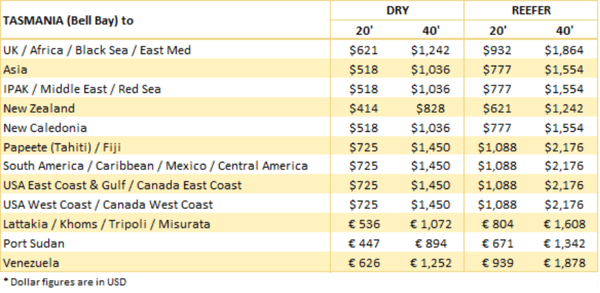
Source: MSC