-
Posted by Allen Newton
- |
-
14 Aug, 2026
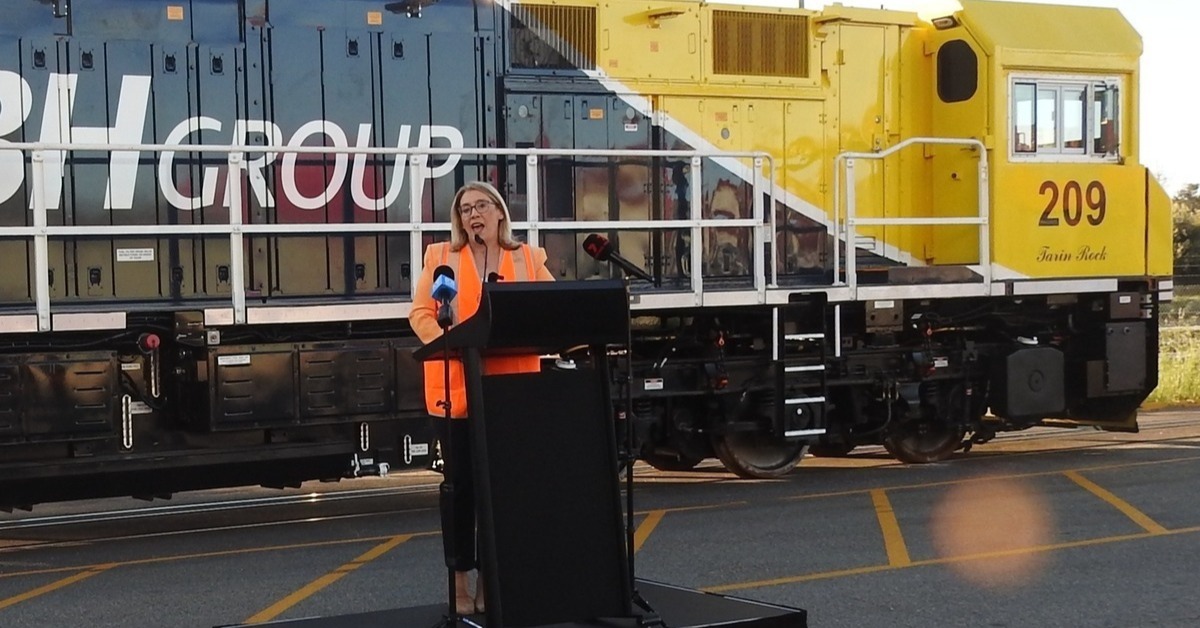
THE COOK government has used the launch of CBH’s new rail fleet to reaffirm its plan to bring Western Australia’s freight rail network back under government control.
Speaking at the launch at CBH’s Forrestfield operatation this morning, deputy premier Rita Saffioti described the move as essential to lifting productivity, safety and long‑term competitiveness across the state’s supply chains.
She said the government was “very much jointly committed” to ensuring the network can support heavier trains, faster loading, and higher‑volume movements — and confirmed work was underway to transition the network back into public hands.
“We’ve made a commitment in relation to the rail network to bring it back into government control. That work continues… and we are very much jointly committed with CBH on all those three parts,” she said, referring to locomotives and wagons, loading facilities, and network capacity.
Ms Saffioti said freight on rail “makes so much sense” for WA’s vast geography, improving productivity, road safety and maintenance outcomes, and reducing truck movements into Fremantle and regional ports.
CBH chief executive Ben Macnamara said the arrival of the cooperative’s new locomotives and wagons marked a “historic moment” for WA grain growers and a major milestone in CBH’s Path to 2033 strategy.
“Today we’re celebrating the arrival of CBH’s new custom‑built locomotives and wagons… the largest rail fleet investment in the cooperative’s history,” he told a group of executives and media at Forrestfield for the launch," he said.
The new fleet includes: 17 new narrow‑gauge locomotives from Wabtec; 200 standard‑gauge wagons; 450 narrow‑gauge wagons from CRC Meishan; with additional standard‑gauge locomotives arriving from December 2026.
This will take CBH’s owned fleet to 49 locomotives and 1222 wagons.
Mr Macnamara said the investment was designed to keep pace with WA’s rapidly expanding harvests and to ensure grower‑owned infrastructure remains competitive.
CBH’s rail expansion is part of a broader network upgrade including: faster outloading, longer sidings, additional storage and port pathway improvements across Geraldton, Albany and Esperance.
Mr Macnamara said CBH had already lifted monthly outturn capacity from 1.6 million tonnes to two million tonnes, and in January reached 2.5 million tonnes, two years ahead of schedule.
“The challenge now is to make that level of performance repeatable… helping us build towards our 2033 target of 3 million tonnes per month," he said.
CBH chair Simon Stead said the cooperative model was central to the investment, with grower surpluses reinvested directly into the supply chain.
“What you see behind us today is grower capital reinvested back into grower infrastructure… a visible example of the cooperative model in action.”
Mr Stead noted WA growers had delivered 100 million tonnes into the CBH network during the past five years — 30 million tonnes more than the previous five — and that harvests of 20 million tonnes are now the norm.
CBH has invested more than $2 billion in the network over the past five financial years, including $590 million in 2025.
Ms Saffioti highlighted the importance of CBH’s upgrades to the state economy, noting that agricultural output directly influences WA’s GSP.
She also pointed to the Agriculture Supply Chain Improvements (ASCII) program, through which the state and federal governments are co‑investing in rail‑siding upgrades across the Wheatbelt, Midwest and Great Southern.