
-
Posted by Dale Crisp
- |
-
1 July, 2026
SHIPPER shock appears unlikely to abate soon, with rates on the main East Asia-Australia route on an absolute tear over the past couple of weeks, even with up to 8,000 TEU of extra weekly capacity joining the trade this month.
“Relentless”, was one customer’s description as the SCFI mean spot rate for Shanghai-Sydney shipments this week, Week 27, jumped an astounding 15% to USD 4,156/FEU. This follows successive increases every week since Week 13, when the SCFI was USD 1,242/FEU. There was a 10% rise in Week 25.
In South East Asia trades, there was a further 2% rise this week, following recent increases of 10%, 3% and 6%. But at USD 2,061/FEU the average rate is still less than half North & East Asia.
There are reports that some N&EA carriers have virtually no space available for weeks to come, and a scattering of extra-loaders are finding it difficult to obtain terminal windows. This is thanks to congestion- and weather-disrupted schedules putting ships way out of whack, plus the advent of the new Maersk Qilin and A3 Express services. Some lines are applying weight limitations on southbound containers.
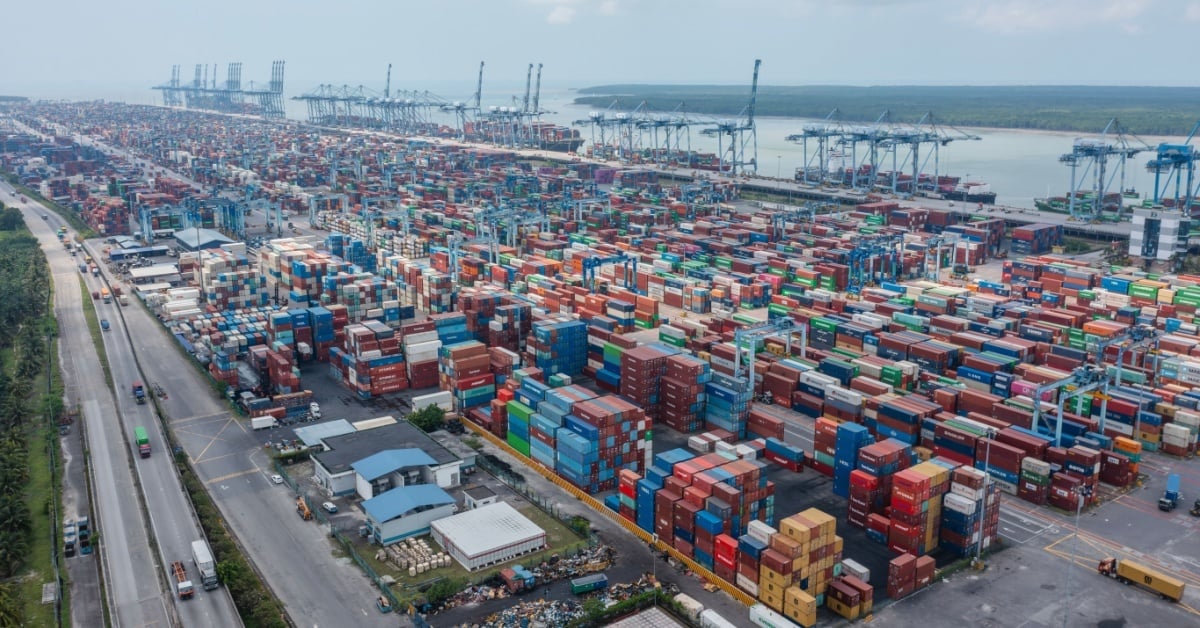
As noted in last Friday’s Bradford Bulletin in DCN, Ningbo/Shanghai, Singapore, Qingdao, Shenzhen and Port Klang all appear in the current list of the world’s most congested ports.

Ship supply is also restricted, carriers say, as while the China-Australia rates have exploded they’re still not rising as fast as some trans-Pacific routes and Asia-South America, making those more attractive deployment options. Congestion in East and South East Asian ports is effectively chewing up further capacity.
Additionally, Asia-USA and Asia-Europe – the latter still taking the long way around the Cape of Good Hope thanks to Middle East unresolved turmoil – are enjoying early peak seasons, ensuring the predicted container biz over-capacity remains at arms’ length.
A good measure of changing fortunes was AP Moller-Maersk’s Monday [29 June] announcement that it was substantially upgrading its guidance for full-year 2026.
The company said it now expects Underlying EBITDA of USD 8-10 billion (previously USD 4.5-7.0bn); Underlying EBIT of USD 2-4bn (previously USD -1.5-1.0bn) and Free cash flow of at least USD -1.5bn (previously at least USD -3bn).
Maersk attributed the upwards revision to continued strong demand in the container market, particularly in the Far East, and a recent sustained increase in spot market rates. It is now also forecasting a volume growth outlook for the global container market of about 4% (previously 2-4%) for full-year 2026.
Still, if shippers are finding all this “absolutely bonkers” as DCN was told it’s not surprising. In BAF notifications for August issued yesterday, MSC’s went down while PIL’s went up.
Recent notifications
ANL has announced it is replacing its peak season surcharge on the East Asia-Australia & New Zealand routes with a new emergency space surcharge (ESS): “In continuation of our previous communication regarding Peak Season Surcharge (PSS02), we would like to provide an update on the measures we will implement to manage the current market situation on our North East Asia–Oceania services.
“To safeguard service stability and ensure continued access to capacity on the North East Asia–Oceania network, the ESS will override & replace the previously announced Peak Season Surcharge #2 (PSS02).
“PSS02 will therefore not be applied; instead, the ESS will be implemented until 30 September. The ESS is intended to help us serve you better during this period by supporting stable vessel deployment and consistent sailing schedules on the Asia–Oceania trade,” ANL said.
The ESS will be as follows: N&E Asia to Australia, effective 22 July, USD 350/TEU dry & reefer, 700/FEU dry & reefer. N&E Asia to New Zealand, effective 1 August, USD 250/TEU dry & reefer, 500/FEU dry & reefer.