
-
Posted by Dale Crisp
- |
-
06 Jul, 2026
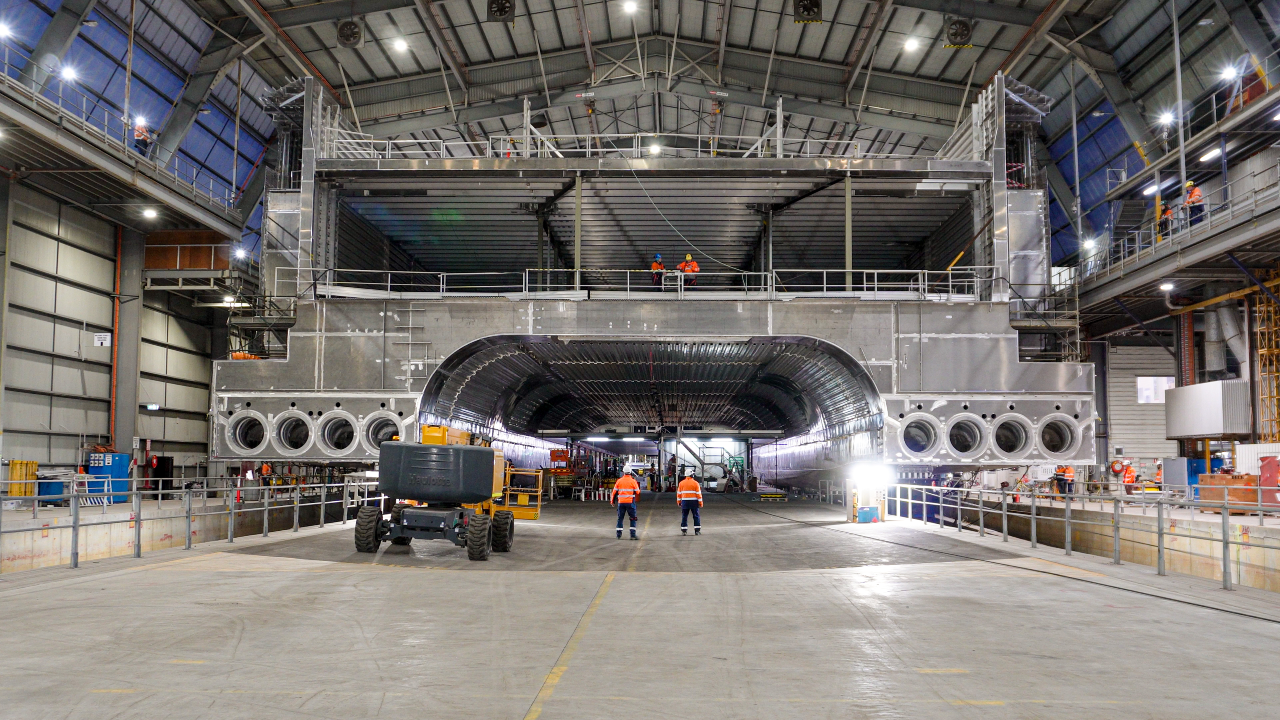
INCAT Tasmania on Friday marked a major construction milestone in its landmark electric ferry programme for Danish operator Molslinjen, successfully completing the rollback of Hull 102 at its Prince of Wales Bay shipyard.
Incat says the successful rollback represents a significant step forward in the construction of the 129-metre battery-electric ferry and will allow for the installation of the vessel’s passenger deck superstructures.
Hull 102 is one of three 129-metre battery-electric ferries being built by Incat for Molslinjen as part of the world’s largest electrification project at sea. Once delivered, the vessels will be the largest electric ferries operating in Europe.
Incat chairman Robert Clifford said the achievement reflected the scale of the project and the strength of the company’s workforce.
“This is an important milestone, not just for this vessel, but for the entire programme,” Mr Clifford said.
“These ships are at the forefront of the global transition to sustainable high-speed ferry transport, and every step forward reinforces Tasmania’s place at the centre of that transformation.
“The successful completion of today’s rollback is a credit to our workforce. It was a complex operation carried out with professionalism and precision, and it highlights the capability and commitment of our team.”
The three-vessel programme forms part of Molslinjen’s decarbonisation strategy and will operate on Denmark’s busy Kattegat routes, delivering high-speed, high-capacity, low-emission transport.
Construction continues across all three vessels at Incat’s Hobart shipyard as the company scales up production to meet growing international demand for large-scale electric ships.
Also last week, Molslinjen chose Nordic energy storage specialist BOS Power to deliver the two large shoreside battery packs that will charge the electric high-speed ferries on the Kattegat route between Jutland and Zealand.
BOS Power has been awarded a turnkey Battery Energy Storage System (BESS) contract covering two coastal sites, in the harbours of Aarhus and on Sjællands Odde. Each battery pack will have a capacity of 118 MWh and will ensure the large catamarans can recharge every time they berth at one of the two ports.