
It was a matter of time
-
Posted by Dale Crisp
- |
-
25 Jul, 2025
AS MSC continues its saturation of global container trades – not to mention luxury cruise shipping, Mediterranean ferry services, European towage, worldwide landside logistics and, most probably, container terminals – no-one should be surprised the Swiss/Italian giant has decided to take its fate into its own hands on the ANZ-North America trade route.
According to Alpaliner, with a fleet capacity of 6.6 million TEU MSC is now some 2.1 million TEU ahead of 2M divorcee and principal competitor Maersk. The gap alone is almost greater than the fleet of world Number 6, ONE. And MSC’s orderbook is also over 2 million TEU!
MSC elbowed its way into the East Coast and West Coast North America-ANZ trades in 2011, when it boldly announced it was beginning a fortnightly service that would cover both coasts, ramping up to weekly. Doubtless this sent shudders through the then leading players of the time (mostly the same as today) and the West Coast/Oceania vessel sharing agreement and the East Coast OC1/Trident service of Maersk/Hamburg Süd found ways to “accommodate” the interloper, allocating MSC slots on both coasts (and the Gulf).
Federal Maritime Commission documents show MSC currently buys 177 TEU slots or 2,620 tonnes per vessel voyage leg northbound and 177 TEUs or 2,478 tonnes per vessel voyage leg southbound, whichever is used first, including 50 reefer plugs, on each US Pacific Coast sailing, from Maersk. Originally the purchased slots were spread across OVSA members but the arrangement was later simplified and allocations per vessel adjusted accordingly.
On the Atlantic Coast, as well as Panama and Columbia, MSC buys from Maersk a total slot allocation of 525 TEU or 8,400 tonne per voyage northbound or 7,350 tonnes per vessel voyage southbound, whichever is used first (average weight 16.0 tonnes per TEU northbound and 14.0 tonnes per TEU southbound), including 100 reefer plugs roundtrip.
This total allocation is split as follows: (a) from the U.S. Atlantic Coast to Australia/New Zealand, a maximum southbound allocation of 275 TEUs or 3,850 tonnes (whichever is used first) and to the U.S. Atlantic Coast from Australia/New Zealand, a maximum northbound allocation of 275 TEUs or 4,400 tonnes (whichever is used first), with the allocation in each direction to include 100 reefer plugs; and (b) from Colombia/Panama to Australia/New Zealand, a southbound allocation of 250 TEUs or 3,500 tonnes (whichever is used first) and to Colombia/Panama from Australia/New Zealand, a northbound allocation of 250 TEUs or 4,000 tonnes.
While MSC has yet to disclose the size of the 11 vessels it is to deploy on the new Eagle service when it gets underway in February next year, shippers can reliably expect more than the present few hundred slots will be available.
DCN understands MSC has been in discussion with major shippers for many months and has picked up on widespread dissatisfaction with the current services to/from both coasts, which comprise the sole West Coast, dual loop operation of ANL, Hapag-Lloyd and Maersk, and on the East Coast, Maersk’s OC1 (now with Hamburg Süd completely absorbed) and the CMA CGM/Marfret service, which starts and ends in Europe. All three services have endured a degree of unreliability since the COVID years and while carriers have no doubt worked hard to bring schedules under control there’s lingering discontent – reflected in LinkedIn comments in reaction to last night’s Eagle announcement.
Last night’s announcement details a port rotation of Port Botany, Melbourne, Brisbane, Tauranga, Rodman, Cristobal, Philadelphia, Savannah, Freeport, Rodman, Papeete, Auckland, Port Botany. Matters such as windows and terminals are yet to be finalised
While MSC has disclaimed any immediate interest in West Coast coverage, and instead is promoting connections to Europe and the Mediterranean, US Gulf ports and Central and South America the proffered port rotation is revealing on several fronts. DCN is told MSC has not at this time relinquished the West Coast slots with Maersk.
Crucially for Australian meat exporters the Brisbane call is the last on the East Coast Australia rotation, and rather than transits being impacted by eastbound South Island NZ direct calls – presumably that cargo will be fed to Tauranga by MSC’s Wallaby service – there will be fast connections to Philadelphia, the main US meat import port.
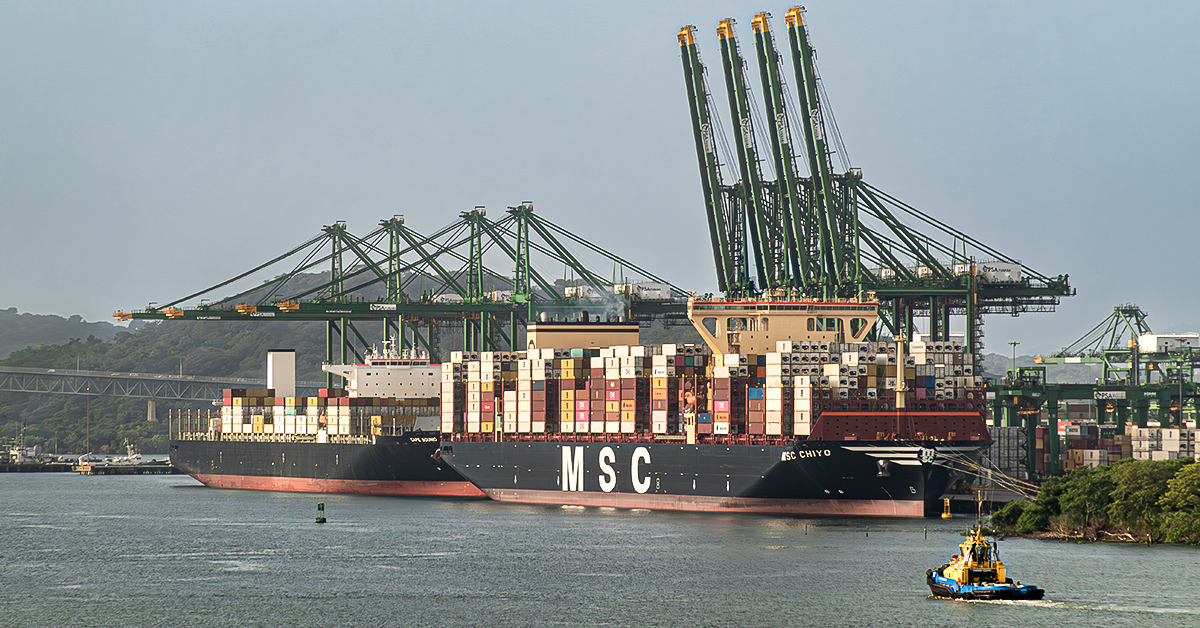
There are three hub ports calls in all in Panama (at each end of the Canal) plus the Bahamas, most notably perhaps at Rodman, a port just south of Panama City on the Pacific entrance to the Canal. This writer, frankly, had never heard of Rodman before but it turns out to have been developed on the site of a former US naval base and features a terminal run by PSA International – and not one of the contentious Hutchison facilities. One would think its also very well positioned for any relay operations to/from WCNA.
Indeed, early examination by “interested parties” show the three hubs plus Savannah and Philadelphia are variously served by seven different MSC transatlantic services, giving plenty of options for European liftings. At the same time, this routing will take some pressure off MSC’s AES, Europe-via-the-Cape of Good Hope service (in conjunction with CMA CGM, labelling it NEMO) which is regularly over-booked out of Australia: faster transits for NZ exports (rather than via Melbourne on Wallaby) and releasing space for the Australian export growth markets of the Indian Sub-Continent and the Middle East.
Needless to add, the three hubs also present a number of relay opportunities to MSC services covering both coasts of South America (where MSC was once quite strong into/out of ANZ) and those through services linking those ports with ECNA and WCNA.
Looking at the southbound roster, the standout is the Papeete call, which is a classic case of thumbing the nose at the French who have long enjoyed near exclusive, profitable access to French Polynesia for desirable high-value home country exports. Maybe the French will stick with the French, or maybe money – or less of it, given the inevitable freight rate war - will talk.
Eagle’s advent also opens questions about existing local MSC services, including the regularly-expanding Noumea Shuttle and the rather meandering Wallaby, but this will be clearer in due course.
It’s impossible to imagine operators of existing services won’t be forced to respond to the Eagle taking flight. There have been ‘several fruitless attempts to rationalise the ECNA services, and the West Coast operation attempts to be all things to all shippers (even mid-Pacific) but perennially struggles. They have six months to do so, as DCN understands the notification period for cessation of the slot deals is six months.
Nevertheless, MSC seems confident, based on discussions with shippers, that its initiative will be rewarded, regardless of the very fluid circumstances of trading with Trump’s USA.
And being MSC, who would doubt them?