-
Posted by Peter van Duyn
- |
-
26 Oct, 2026
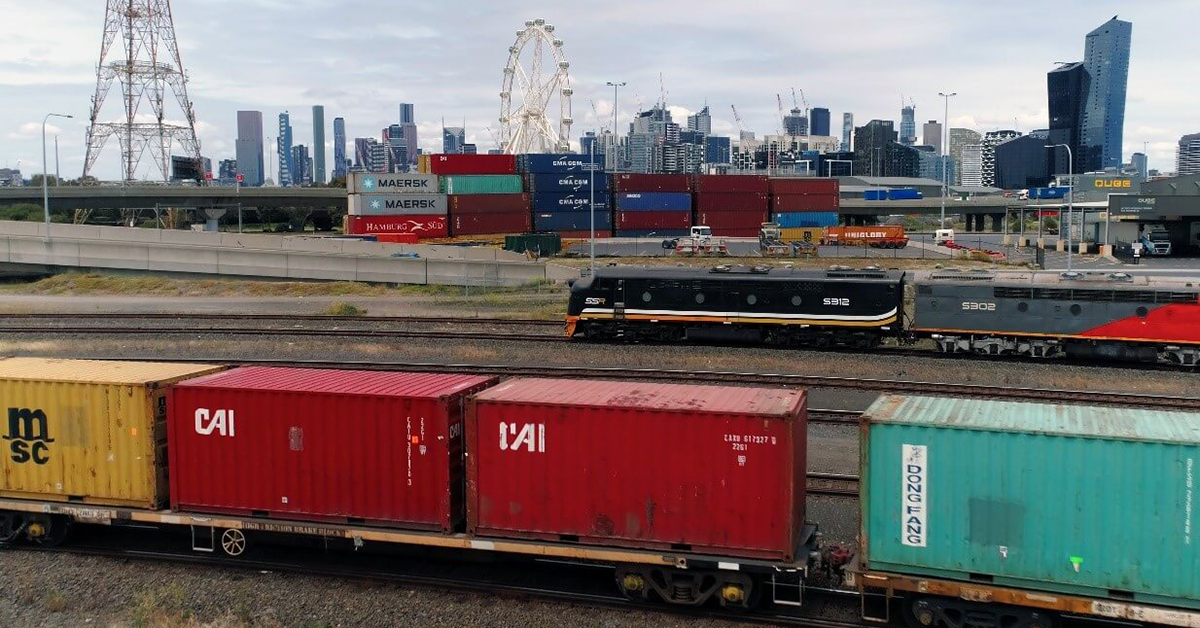
THE VICTORIAN government recently released the Victorian Rail Freight Plan 2026-2036 as well as the latest Container Logistics Chain Study Refresh (CLCS). The freight plan mentions moving freight on rail extensively, but mostly with respect to bulk freight rather than containers. The part that went unmentioned in both publications was establishing a rail link to the existing and proposed container terminals at Webb Dock.
The freight plan only mentions the Port Rail Shuttle Network (PRSN) and the Port Rail Transformation Project (PRTP) briefly on page 18, and in a general statement that the Department of Transport and Planning “will continue to work with the Port of Melbourne and all PRSN rail services and terminal operators to ensure that rail access to the Port operates on an efficient and fair basis relative to road” on page 31.
A decline in rail freight
The CLCS mentions that "the share of goods moved by rail through the Port of Melbourne has declined from 7.0% in FY 2019-20 to 5.9% in FY 2024-25 despite the absolute volumes increasing over this period, from 180,700 to 183,441 TEU.
"This is due to the growth in overall volumes through the port, the movement of which has been primarily taken up by road transport, with the Victorian International Container Terminal (VICT) terminal at Webb Dock, responsible for the largest share of the growth, having no direct rail connection".
During this time, on-dock rail facilities were established at the Swanson Dock container terminals, partly funded by the port as well as the terminal operators, and additional metropolitan intermodal capacity has come online. In the meantime, importers have been paying an additional $9.75 per TEU since 2020, with no specified end date, to fund the PRSN. So far, the uptake of moving container freight on rail has been slow.

A bet each way
Currently, nearly 40% of the port’s container throughput is being handled by VICT with no rail connection. This volume is likely to double in years to come as the Port of Melbourne, under its Port Capacity Enhancement Program (PCEP) at a cost of nearly $3 billion (in 2024 dollars), is looking to relocate the Tasmanian shipping services and develop another international container terminal to the north of the VICT terminal with a capacity in excess of one million TEU. Those additional containers will all have to be transported by road unless a rail link is established to Webb Dock.
The Port of Melbourne in its 2050 Port Development Strategy (PDS), released in 2020, stated that “connecting Webb Dock to the rail network is a key priority in the next phase of our plan for rail”. However, in the recently released 2055 PDS the port appears to be having a bet each way by stating that it will work with the Victorian government on the potential future delivery of the Webb Dock Freight Link, whilst simultaneously saying “that the road network to Webb Dock is expected to have sufficient capacity for forecast trade volume through to 2055”. The volume of containers to be moved from Webb Dock by road by that date could potentially be 4 million containers (TEU).
The Essential Services Commission, under its new role of assessing upfront (ex-ante) project proposals from the Port of Melbourne for major projects, recently asked for feedback on guidance for reviewing the Port’s infrastructure projects. Going forward it will be looking at the PCEP costings once more details have been provided by the Port, and how these costs might be included in the port’s charges upfront.
Revive Bay West?
The Victorian government previously set a target of 30% of containers to be transported by rail. There is no mention of this anywhere in the recent Freight Plan and industry has criticised the government for not setting specific, measurable targets. It should be noted that the rail share at Fremantle Ports is currently more than 25%, albeit with government subsidies, and in Sydney (Port Botany) it is currently 19%. Maybe it’s time for the government to dust off the ‘Bay West’ container port option which has much greater potential for moving container freight on rail.