-
Posted by Ken Hickson
- |
-
16 Sep, 2025
AUSTRALIAN ports must adopt smarter policies and invest in mangrove conservation, not only to protect the environment, but also to safeguard Australia’s future economy.
That was the view of Stuart Bettington, Haskoning Australia coastal and maritime technical director, who delivered a paper to the recent Australasian Coasts & Ports 2025 Conference in Adelaide on Engineering Positive Outcomes for Mangroves.
He provided some examples of positive outcomes in Queensland (including the Port of Brisbane) as well as New Zealand due to effective port management.
Mr Bettington said mangroves were important in supporting communities, ecosystems and improving biodiversity.
He also mentioned advice from the Department of Climate Change, Energy, the Environment and Water on the value of mangroves.
The federal government has stated that “coastal mangroves and saltmarshes have historically been undervalued and considered by many to be wastelands”.
“As a result, many areas have been drained, reclaimed, become degraded from a range of human activities or otherwise lost,” the Department of Climate Change stated, noting the ecological value of these habitats was now understood and served several purposes including:
- provide feeding and breeding habitat for fish, birds and crustaceans
- act as filters for nutrients and sediments, reduce erosion and maintain water quality
- provide protection from storms and cyclones
- act as a carbon sink.
Mr Bettington called on port managers, local councils and national policy makers to take action and invest in this natural asset.
A focus of his study was:
- What works, or does not, with habitat rehabilitation and expansion.
- The role of nature-based solutions and working with nature in project success.
- Key issues with current approaches and how this could be improved.
He advocated smarter policies and investment in mangrove conservation, not just to protect the environment but to safeguard Australia’s future economy.

The study explains that mangroves are adaptive and good at colonising, due in part to the dynamic nature of coastal areas.
“Where conditions are right, with suitable tidal inundation, mild wave or current climates and relatively stable bed levels, mangroves will naturally establish,” Mr Beddington said.
“If a planting program is required, engage with local conservation groups and consider using fractured rock to stabilise the bed and assist seedlings.”
Mr Beddington said the vast majority of engineers and scientists working in the coastal zone want positive outcomes for mangroves and other near-shore habitats.
He believes that much can be achieved based upon meeting the needs of mangroves and hopes that the planning and approval process can also focus on delivering better outcomes.
“This can be achieved with more rational advice and attitudes to marine plants,” Mr Bettington said.
“Developing targeted programs of works to rehabilitate or expand mangrove footprints funded from offset charges.”
The study by Mr Bettington and team mentioned Beachmere Wetlands situated on the north bank of the Caboolture River where it enters Moreton Bay.
Due to anthropogenic changes to flow paths, the northern end of the wetlands experienced significantly reduced tidal exchange leading to widespread death of mangroves.
In 2017, Moreton Bay City Council undertook the construction of two tidal channels through the foreshore to facilitate tidal ingress.
This simple and affordable solution has resulted in a dramatic increase in mangrove activity. The construction of these channels is a good example of how an understanding of coastal systems, combined with some simple engineering, can have dramatic positive impacts.
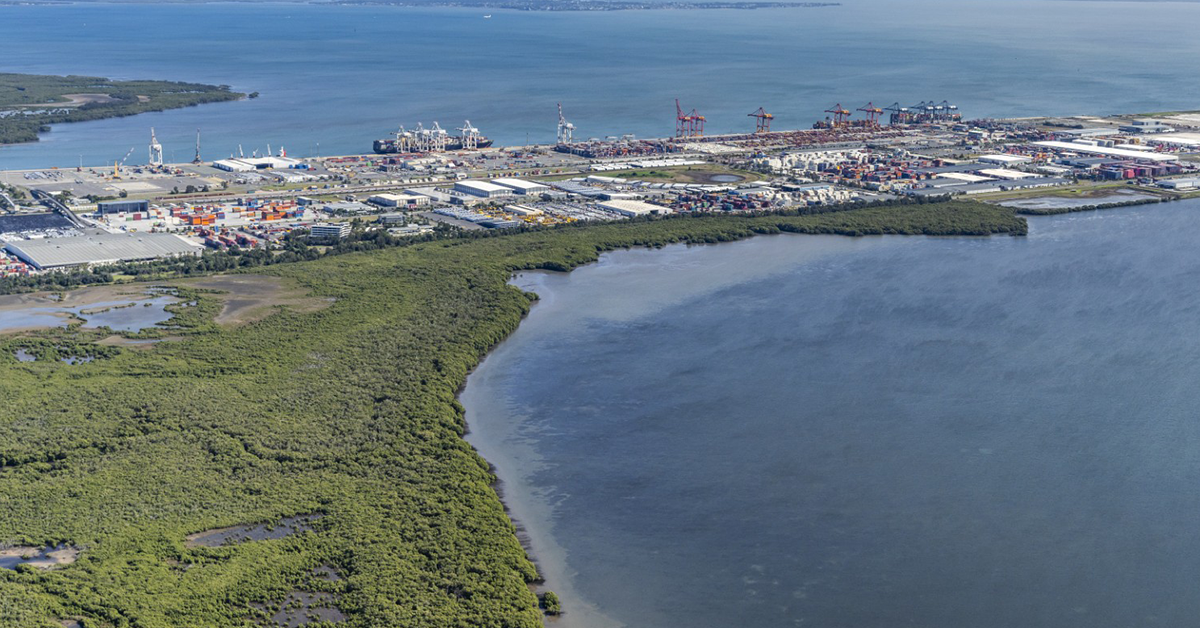
The Port of Brisbane also provides some good examples of what to do to maintain its mangrove reserves, as its spokesperson tells us that it operates in an area of high environmental significance at the mouth of the Brisbane River and on the edge of Moreton Bay.
It borders Ramsar Wetlands (a wetland site designated to be of international importance under the Ramsar Convention) and the Moreton Bay Marine Park.
Mangrove conservation is an important part of Port of Brisbane’s environmental management program, with annual mangrove monitoring in place since the early 2000s and numerous rehabilitation projects undertaken at sites around the port over the last 10 years.
A key project underway is the Port’s Whyte Island rehabilitation project—being delivered with the environmental organisation, B4C—which is rehabilitating valuable mangrove, saltmarsh and woodland habitat.
This site adjoins the claypan area, which is an important migratory wader habitat, so restoring the Whyte Island site provides additional buffer to this habitat.
Starting in late 2023, works have been undertaken at Whyte Island to prevent unauthorised access, manage invasive pests (weeds and animals) and replant native vegetation.
This has resulted in significant improvement in both saltmarsh habitat (0.74ha rehabilitated) and estuarine wetland (4.2ha rehabilitated).
Port of Brisbane has also undertaken other marine habitat improvement projects at Bulwer Island, at the Port West Industrial Estate (Lytton) and adjacent to the Brisbane International Cruise Terminal.
Via the port’s annual mangrove monitoring program, it was identified that adequate rainfall/freshwater was an important fact in mangrove help.
Port planning has thus been changed to ensure that treated stormwater runoff from new developments is redirected to marine plant areas to benefit these, seeing significant improvements as a result.