-
Posted by Dale Crisp
- |
-
16 Jan, 2026
GLOBAL agricultural commodities giant Cargill has taken delivery of a chartered newbuild bulk carrier operating on green methanol, which will load on its first commercial voyage in Western Australia.
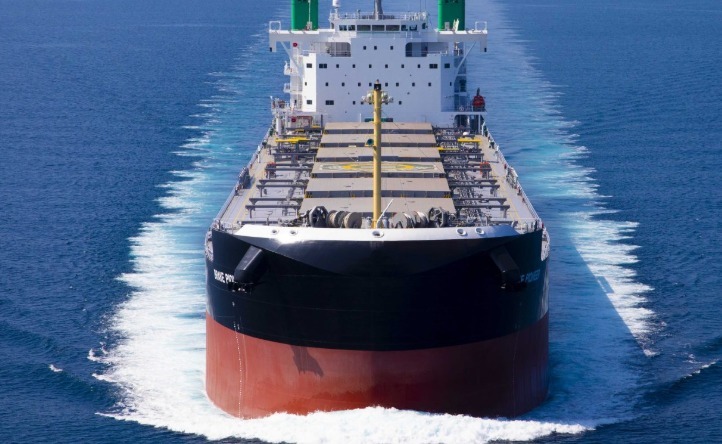
The Mitsui & Co-owned, 82,000 DWT Kamsarmax Brave Pioneer (IMO 1031812) was built at Tsuneishi Shipbuilding’s Tsuneishi Heavy Industries yard at Subic Bay and officially named yesterday [15 January] by Philippines President Ferdinand Marcos Jr. It is said to be the world’s first methanol dual-fuel Kamsarmax.
It is the first of five dual-fuelled vessels chartered by Cargill and marks another important milestone in the company’s broader decarbonisation efforts – “one focused on innovation, testing and learning as the company works with customers and partners to refine future-ready solutions for Cargill and the industry”.
Brave Pioneer is equipped to operate on both conventional marine fuels and green methanol, a lower-carbon alternative. The estimated CO2 saving of using green methanol compared to conventional fuel is up to 70%.
Upon delivery the bulker departed for Singapore to bunker green methanol in Singapore, then proceed to WA before sailing onward to Europe. Through Brave Pioneer’s maiden voyage, Cargill will conduct a series of operational trials designed to evaluate green methanol bunkering readiness, understand how environmental attributes can be traced and verified through carbon accounting systems, and assess market appetite for low-carbon freight services.

“Decarbonising global shipping requires a mix of technologies and the willingness to take bold steps before the entire ecosystem is ready,” said Jan Dieleman, president of Cargill’s Ocean Transportation business.
“Technologies like green methanol or wind-assisted propulsion come with uncertainty. But as an industry leader, we have a responsibility to test these innovations on the water, share what we learn, and help shape the systems and standards that will enable wider adoption.
“We know the road to low carbon shipping will require a mix of solutions and green methanol is one part of that portfolio,” Mr Dieleman said.
“Our new fleet is about optionality and adaptability. These vessels are engineered to perform at a best-in-class level on conventional fuel today, while allowing us to switch to greener fuels as availability improves. It’s a practical way to future-proof ocean transport.”
As one of the world’s largest charterers of dry bulk freight, Cargill says its actions send a strong demand signal to the market and serve as an open invitation for others in the maritime sector to join in advancing the transition to sustainable shipping.
THI says the Kamsarmax design is renowned for its high versatility. The vessel features both a shallow draft and low air draft, enabling access to a wide range of ports worldwide. With a length of 229 metres, the vessel is also capable of entering major bauxite export port Kamsar in the Republic of Guinea.
“This milestone marks a significant step forward in THI’s efforts to advance sustainable shipbuilding and support the decarbonisation of the maritime industry,” the company said.
“By adopting methanol as a propulsion fuel, the vessel achieves a reduction of approximately 10% in carbon dioxide (CO2) emissions, 80% in nitrogen oxides (NOx), and 99% in sulphur oxide (SOx) during operations compared with conventional vessels.
"The use of green methanol further enhances the vessel’s potential to reduce environmental impact and promote environmentally responsible shipping.”