
-
Posted by David Sexton
- |
-
01 Jul, 2026
THE FAILURE of a wagon axle that contributed to a freight train derailment near Rockhampton highlights the importance of systematic risk management, a report from the Australian Transport Safety Bureau (ATSB) has found.
The incident, which occurred back in January 2023, saw the freight train derail and for a second train to collide with one of its containers.
On the evening of 29 January 2023, a Pacific National-operated freight train was approaching the hamlet of Marmor, Queensland.
While travelling at about 100 km/h, an axle in the train’s sixth wagon broke, and the rear eight wagons of the train subsequently separated and derailed, piling up at a level crossing.
The driver was initially unaware of the separation but opted to apply the brakes after feeling the train was not responding as expected and then saw sparks in the locomotive mirrors.
The front section of the freight train remained on the tracks and came to a stop about 1.3 km from the initial derailment location.
Meanwhile the driver of an Aurizon-operated coal train travelling in the opposite direction on the adjacent track applied emergency brakes after seeing dust generated by the accident ahead.
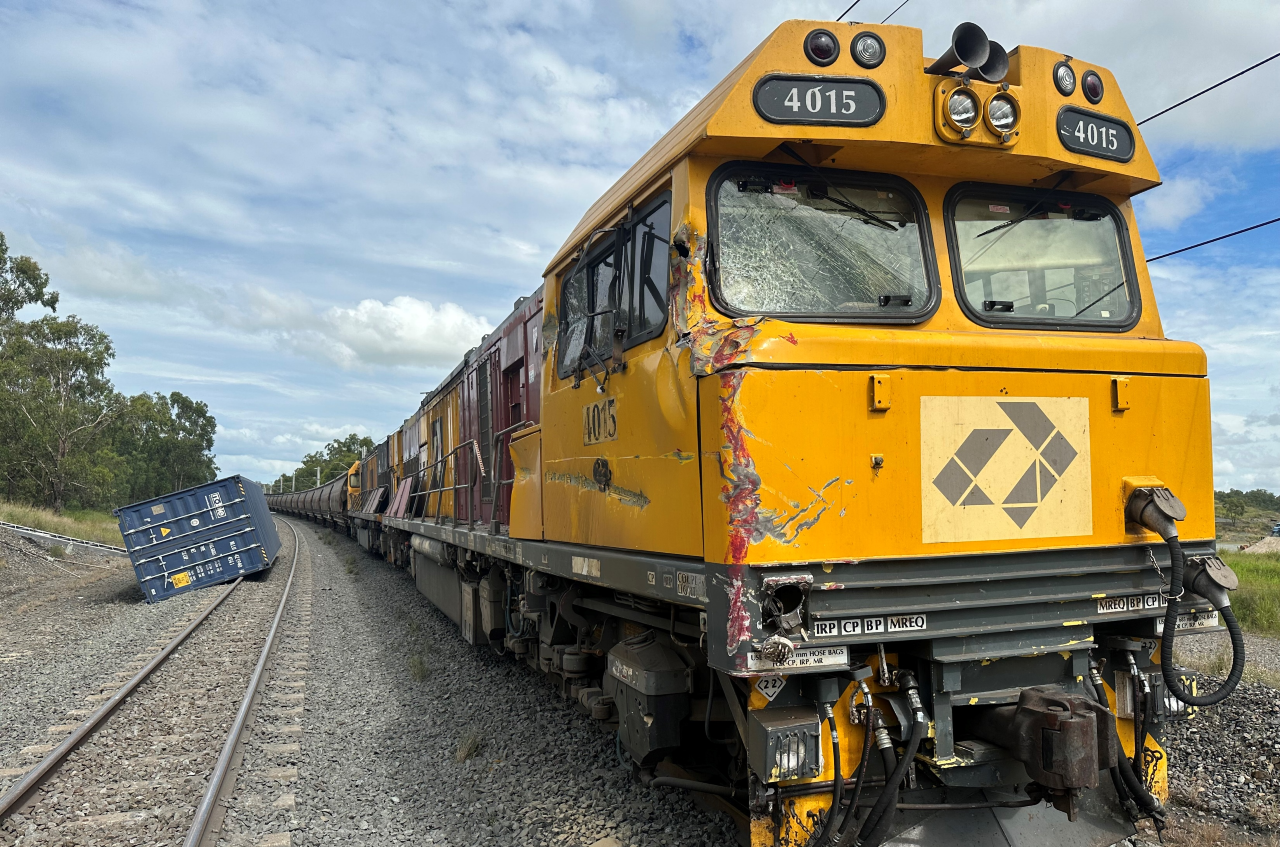
A short time later, the coal train passed the front section of the freight train, and its lead locomotive collided with a shipping container which was still attached to the front section of the freight train but was said to be “fouling the track”.
The coal train fortunately stopped before reaching the wreckage at the level crossing.
Both trains were substantially damaged in the accident, but each train’s crew was uninjured.
ATSB chief commissioner Angus Mitchell said the appearance of fracture surfaces on the failed axle was consistent with fatigue crack growth, followed by overstress fracture.
“The fatigue crack very likely initiated from impact damage to the axle surface at some time before the accident.
“It was found the specific design of the fractured axle presented a greater risk of failing as a result of a damage-initiated fatigue crack than another axle design used by Pacific National," Mr Mitchell said.
Since the accident, Pacific National has phased out axles conforming to this design.
“Importantly, the investigation found the operator’s risk controls before the accident did not provide the best opportunity to address axle damage capable of initiating a crack, or to ensure axles with growing cracks were removed from service."
Moreover, the operator did not ensure that the responsible work group within the organisation performed risk management activities in accordance with documented procedure, specifically regarding the use of risk registers and training.
Pacific National has subsequently taken several measures to address these issues, which are detailed in the final report.
“Systematic risk management, where risks are identified, assessed, eliminated, or controlled, is critical for rolling stock operators to remove safety risks as far as is reasonably practicable,” Mr Mitchell said.
The investigation report notes the national rail regulator expected operators to use risk registers to monitor and review identified risks on an ongoing basis.
“Risk registers ensure that there is a mechanism promoting re-evaluation of a risk where controls have been implemented to ensure the controls are effective,” Mr Mitchell said.