-
Posted by Dale Crisp
- |
-
20 May, 2026
UPDATED: 20 May, 2026
THE RAMIFICATIONS of CSL Australia’s cement carrier Goliath’s collision with TasPorts tugs in Devonport on 22 January 2022 continue to be felt, with the High Court rejecting the company’s last attempt to limit liability.
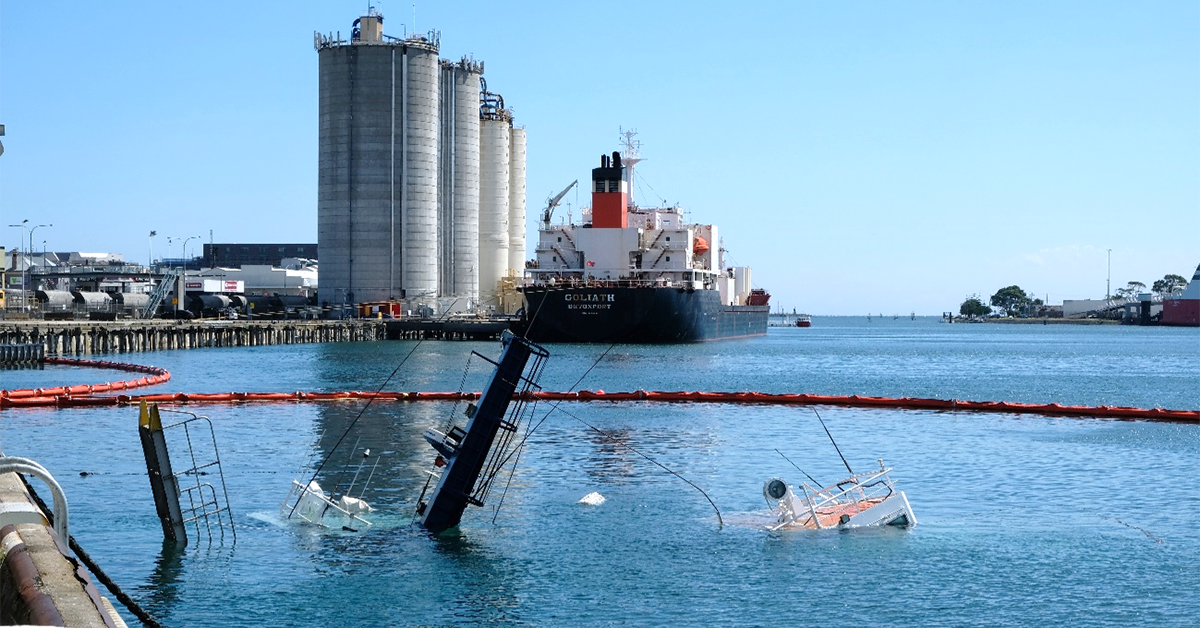
Goliath collided with the moored tugs York Cove and Campbell Cove just before midday during a routine berthing manoeuvre in the Mersey River. The tugs, which were unmanned at the time, sustained significant damage and subsequently sank.
Authorities ashore initiated pollution control and oil spill recovery measures and the ensuing loss of fuel and other oils from the tugs were largely contained. Goliath sustained minor damage to its bow while the tugs were both subsequently declared a constructive total loss.
The Australian Transport Safety Bureau (ATSB) investigation found that, in the process of a transfer of manoeuvring controls from Goliath’s bridge to the bridge wing, the correct steering mode was not selected. Consequently, control of the ship’s rudders remained at the wheel, inside the ship’s wheelhouse, while the master attempted to manoeuvre the ship in the swing basin using the bridge wing VecTwin joystick panel.
The master’s manoeuvring orders, issued in the belief that the ship was in joystick steering mode, had the effect of increasing the ship’s speed as it closed on the tugs before colliding with them. The investigation found that neither the master nor the second mate had undertaken the required bridge resource management (BRM) training and that BRM on board was ineffective. The design of the ship’s joystick system was also identified as having increased the risk as it was misleading and did not provide a positive visual confirmation that the correct steering mode had been selected.
Finally, the ATSB observed that, while the TasPorts risk assessment for Devonport had considered the potential for collisions between ships manoeuvring in the swing basin and smaller vessels in the vicinity, the risk of injury to personnel on board those smaller vessels was not specifically considered. “On this occasion, it was largely fortuitous that there were no personnel on board the tugs at the time of the collision,” the bureau found.
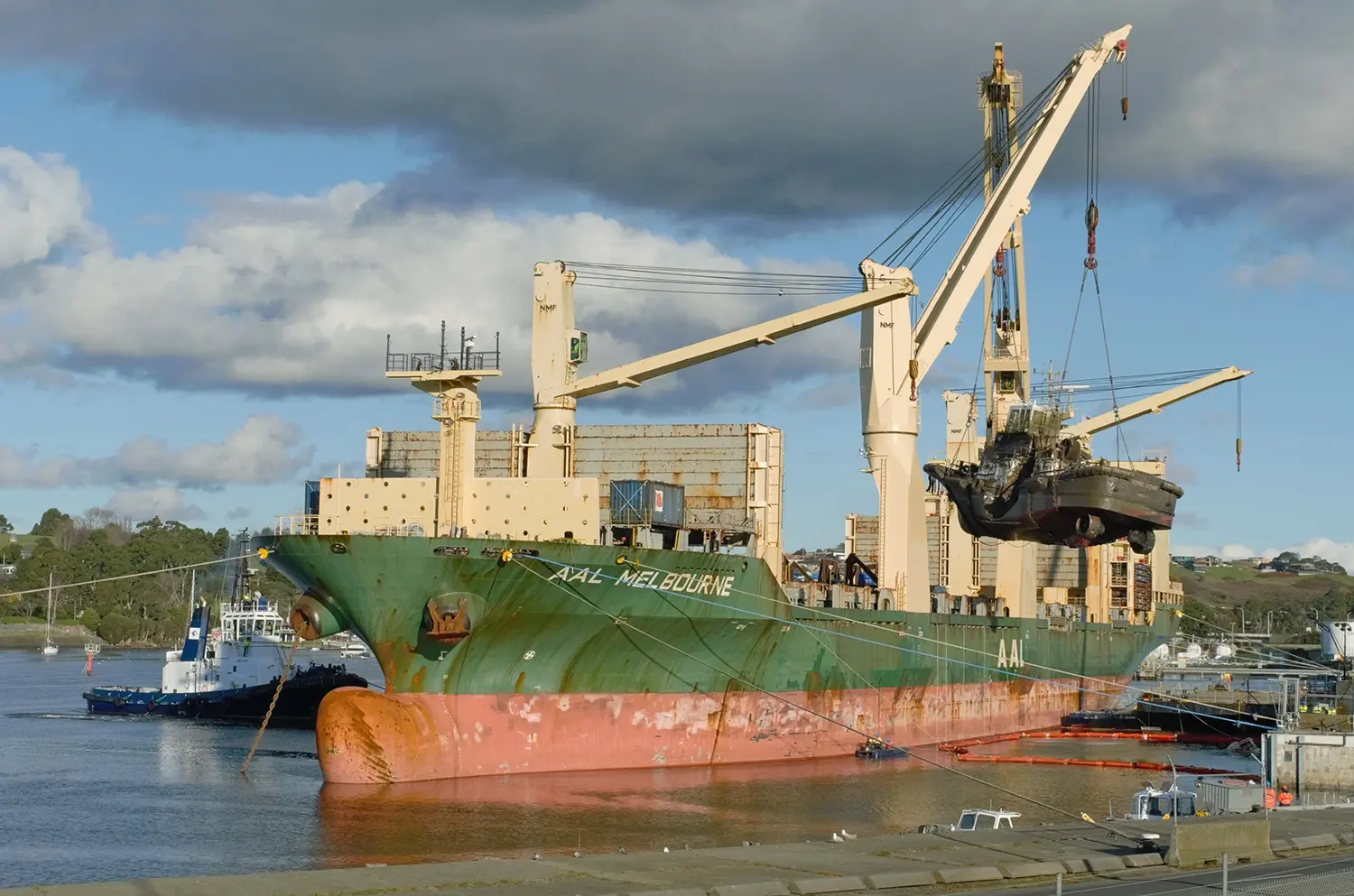
AAL Melbourne recovering the sunken tug York Cove.Image: Cody Williams
Subsequently, the wrecked tugs were raised by the AAL Shipping heavylift/MPP AAL Melbourne and transported to Brisbane for demolition. Goliath resumed coastal service following repairs.
TasPorts, as owners of the assets, incurred costs of approximately $23 million, with around $17m of these costs incurred in the removal of the two wrecks and their fuel. CSL submitted that it was entitled to limit liability to approximately $15.7m, a claim originally accepted by courts but overturned by the Full Federal Court of Australia in April last year. CSL then lodged an appeal with the High Court.
Responding to the latest decision, CSL told DCN: “We respect the High Court’s decision and the integrity of the judicial process, however we are disappointed with the outcome.”
Iain Sharples, head of marine underwriting at Salt Marine Risks Australia and regular DCN contributor, commented:
The High Court of Australia has dismissed the appeal by CSL Australia against the Federal Court’s decision in April 2025.
The full Federal Court of Australia had found in favour of TasPorts’ appeal against the original decision, which meant the port could recover all the costs incurred from damage to the wharf, the loss of two tugs and most importantly, the wreck removal of the tugs.
The unappealable High Court decision has confirmed that CSL cannot limit its liability in respect of the wreck removal costs so TasPorts will effectively recover its losses in full, including legal costs incurred in answering CSL’s appeal.
The High Court’s reasoning follows similar lines to the original Federal Court decision with the focus being around a specific part of the Limitation of Liability for Maritime Claims Act 1989 and how Australia decided to enact the Convention on Limitation of Liability for Maritime Claims (1976).
The decision provides clarity for future claims in Australia but as other countries may have chosen to enact the Convention differently that could result in an alternative outcome where limitation would still apply to wreck removal costs overseas.
It is an interesting case to review and presumably meets with the original legislators’ intentions that limitation would not apply to wreck removal because those claims can become so expensive and would potentially end up sitting with Australian entities that have to deal with the wreck.