
Incat celebrates Hales Trophy anniversary
-
Posted by Dale Crisp
- |
-
17 Jul, 2025
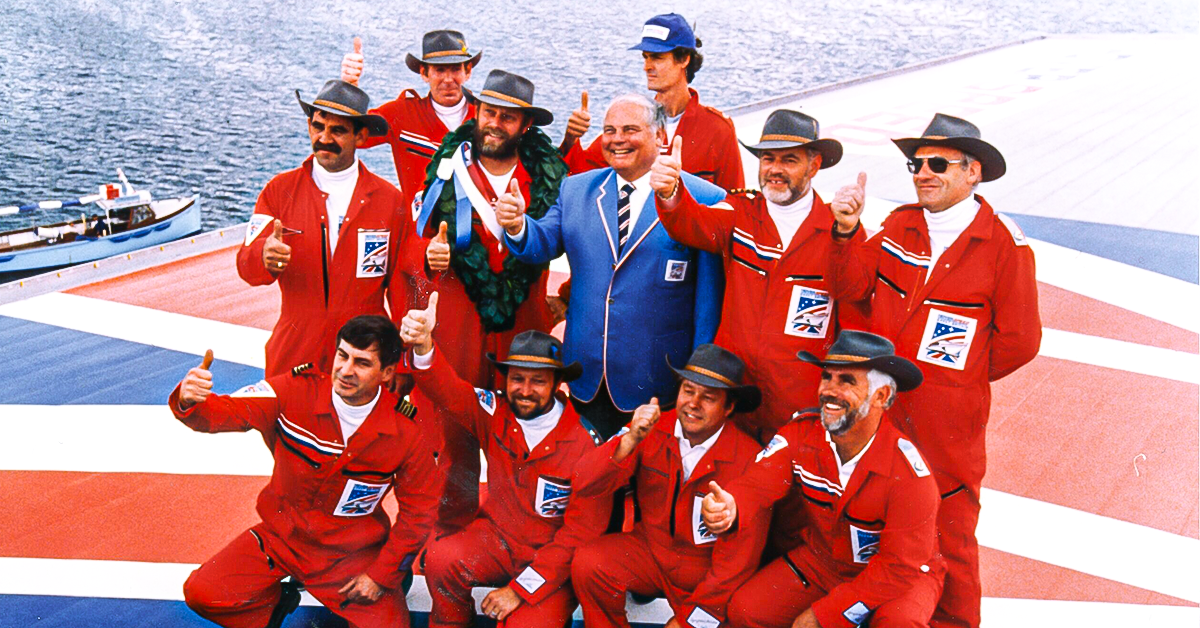
TASMANIAN shipbuilder Incat is reflecting on the 35th anniversary of wave-piercer Hoverspeed Great Britain taking the Hales Trophy, the legendary Blue Riband for the fastest crossing of the Atlantic Ocean.
The catamaran ferry had started life at Incat’s Prince of Wales Bay yard as Hull No. 025, one of an order for five 74-metre vessels placed by the James Sherwood-led Sea Containers of the UK. Initially named Christopher Columbus it was launched on 28 January 1990 and renamed as it began sea trials.
Incat founder Robert Clifford hatched a plan to challenge for the Blue Riband, which had been held for nearly four decades by the conventional liner United States (soon to be sunk as an artificial reef off Florida) which had crossed from New York’s Ambrose Light vessel to the Bishop Rock lighthouse, Isle of Scilly, Cornwall, UK in July 1952 in three days, 10 hours and 40 minutes. The quad-screw, steam turbine United States achieved an average speed of 35.59 knots over the 2,949 nautical miles.
Hoverspeed Great Britain sailed from Hobart to New York and set out on its Blue Riband challenge on 20 June 1990. It completed the Atlantic crossing on 23 June at an average speed of 36.966 knots to take the trophy for the fastest commercial passenger ship crossing of the Atlantic without refuelling.
Incat vessels went on to better that record twice more on delivery voyages, with 91-metre Hull 091 Catalonia in June 1998 at an average of 38.877 knots and then in mid-July 1998 with sister Cat-Link V at an average of 41.284 knots. (current Port Phillip Sea Pilot director Damian Laughlin was part of the crew on this crossing).
In a release this week Incat noted the Hales Trophy is proudly on display at the entrance to the shipyard in Hobart, “its final resting place, because this is more than a record – it’s a benchmark in maritime innovation that will never be exceeded.
“Winning the Hales Trophy proved what was possible when you combine bold ideas with the latest technology. We didn’t just chase speed – we redefined it. And no other shipbuilder has come close since,” Robert Clifford said.
“Could the Hales Trophy be won again? Not with fossil fuels – those days are gone. And not yet with electric batteries or hybrid-electric propulsion either. I feel very confident in saying that the Trophy’s not going anywhere.”
While we may no longer be chasing records for speed, Incat says it is now setting the pace for the maritime industry in clean energy, sustainable shipbuilding, and future-ready design: “As we celebrate 35 years since that historic Atlantic crossing, we honour a past achievement unlikely to ever be surpassed – and a future that continues to challenge what’s possible on the water.”
Remarkably, Hoverspeed Great Britain is listed as still in service in the Mediterranean for Greek operator Seajets – owners of many Incat (and Austal)-built fast ferries – under the name High Speed Jet.