
-
Posted by Dale Crisp
- |
-
24 Jun, 2026
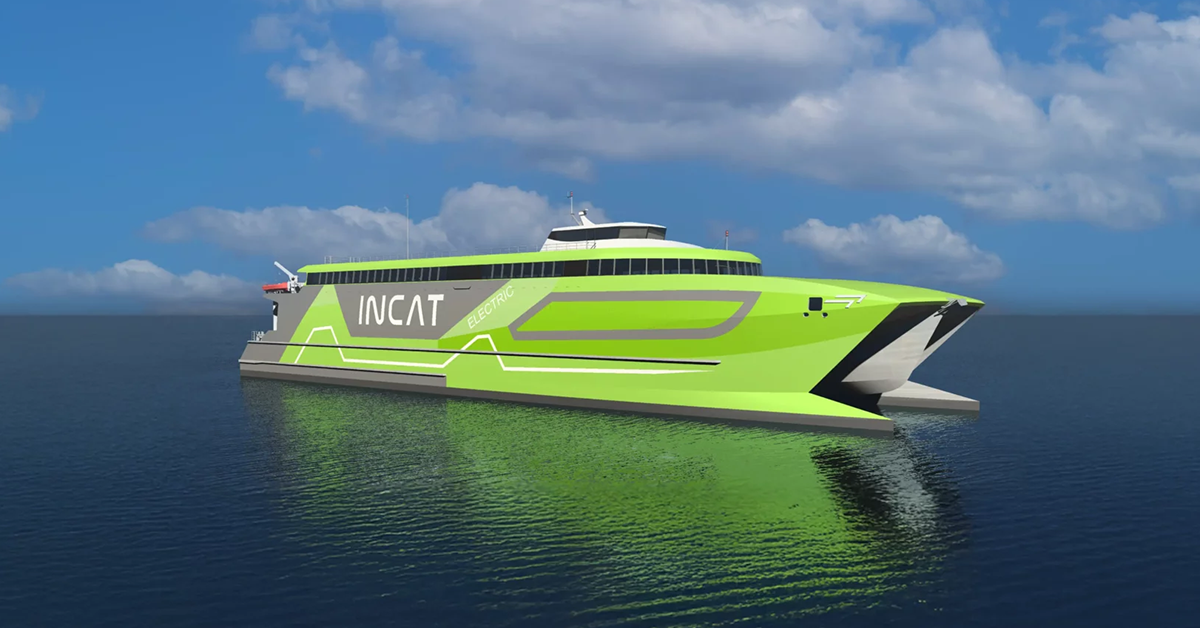
SWEDISH maritime battery supplier Echandia has secured its first contract to supply its Core system to Incat Tasmania, for installation in the builder’s new hybrid electric catamaran.
Designed with low-emission operations in mind, the 78-metre, light-weight craft represents the next evolution in Incat’s electric ferry range, incorporating lessons learned from the world’s largest battery-electric ship, Hull 096 (China Zorrilla) soon to be delivered to South America for owner Buquebus.
With flexible propulsion options — fully electric, hybrid, or generator-assisted — the 78-metre vessel offers unmatched versatility for operators navigating the transition to cleaner energy, Incat says. Sized to replace the first generation of high-speed craft now approaching 35 years in service, this vessel is a future-focused solution for operators needing sustainable, fast, and efficient transport.
The vessel has been designed and built to ensure maximum deployment flexibility whilst significantly reducing OPEX, allowing operators to transition away from fossil fuels in the most practical and cost-effective way. It can carry up to 650 persons and 120 cars at a maximum speed of 28 knots.
The vessel can operate in fully-electric, hybrid, or generator only modes, allowing operators to run zero-emissions on short crossings and in emission-control zones while extending range across longer routes. The vessel will be available for bareboat or time charter from January 2027.
“The vessel has been conceived as part of a series with flexibility and modularity as a high priority to ensure the vessels can serve many applications over its design life," said Incat chief technical officer Stewart Wells.
"We need a battery system that can handle both high power demands and frequent charging cycles across different routes. Echandia Core gives us exactly that."
Built on LTO chemistry, which experiences minimal degradation, the system maintains stable performance throughout its lifecycle. This also enables capacity to be expanded later without meaningful performance differences between existing and new modules, Echandia says.
“A vessel built with this flexibility in mind needs a battery system that keeps future options open,” Felix Backgård, head of technical sales at Echandia, said.
“Because LTO chemistry exhibits minimal degradation over time, capacity can later be expanded without a performance mismatch between old and new modules. Echandia Core is designed for that full lifecycle flexibility”.
Echandia Core has been developed to lower one of the main barriers to wider LTO adoption in maritime applications: the initial investment. LTO is often highly competitive over the full lifecycle, thanks to long service life, minimal degradation and high operational reliability. But for many vessel projects, the upfront cost has remained a barrier. Echandia Core lowers that threshold.
Compared with Echandia’s previous battery system, Core is claimed to deliver 30% lower upfront cost and 30% smaller footprint, while preserving the safety, lifetime and reliability that make LTO especially well-suited for demanding marine operations.
Echandia is headquartered in Sweden, with offices in North America, the UK, Singapore, China, and Denmark.