-
Posted by Dale Crisp
- |
-
2 June, 2026
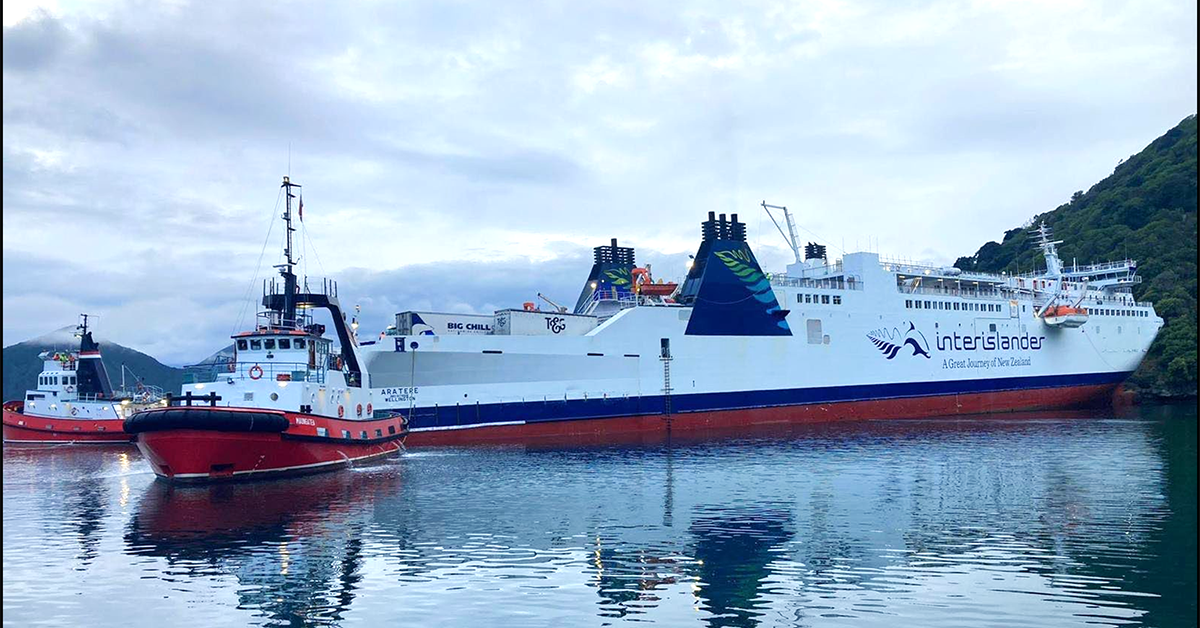
KIWIRAIL’s management has come in for harsh criticism in NZ’s Transport Accident Investigation Commission’s final report into the 2024 Picton grounding of rail/ro-pax Aratere.
TAIC’s report reveals risks of incompletely-managed changes to safety-critical systems, the principal cause of the vessel’s grounding on 21 June 2024 after an unintended turn towards the shoreline while on autopilot.
“For leaders and senior management, audit and assurance systems should detect when day-to-day operational practices start drifting away from safe practice.” TAIC says.
“When upgrading safety-critical equipment, identify and test operational differences before returning to service, and use trials and training to prove crews can safely operate the modified equipment in real conditions.”
To recap, shortly after Aratere’s routine night time departure for Wellington from Picton, the ship’s pilot engaged the autopilot and pressed the ‘execute’ button expecting the steering system to make a programmed three-degree right turn.
However, the ship had already passed the programmed waypoint for that small turn, so the autopilot locked onto the next waypoint and made a much larger 34-degree right turn.
The bridge team responded quickly and decisively upon realising the vessel was deviating from the passage plan. But they were unable to regain steering control because they were unfamiliar with procedures for the ship’s newly installed steering control system that differed from the old system, TAIC found.
They sought to stop the ship using reverse thrust. While slowing, the vessel grounded.
Aratere’s watertight integrity was not compromised and in the following two days, Aratere was refloated with the assistance of harbour tugs. The grounding dented the bulbous bow and damage to the internal structure required repair before the ship’s return to service. There were no injuries.

Why it happened
“The operator had installed a new steering system, focusing mainly on physical installation of the equipment, treating it as a like-for-like replacement, which it wasn’t. But the change management process was not robust, so operational differences between the old and new systems were not fully identified before the vessel returned to service. And sea trials, evaluation, and training did not adequately test or address those differences,” TAIC says.
“Safety audit and assurance checks were not being properly carried out, so shoreside management lacked visibility of day-to-day practice on the bridge drifting away from ideal. Safe navigation procedures were described in the operator’s safety management system and were available for the bridge team, but implementation was inconsistent.
“And hazard controls intended to prevent exactly this type of occurrence – such as challenge and verification, role definition, and good communication – were operating but not effectively enough at the time of the grounding.”
Also, the bridge team had not received training on two safety-critical operational differences: first, that to transfer steering control from one command console to another, rudder command settings on both consoles had to be aligned within two degrees. And second, that a force takeover function could override this requirement, the Commission found.
Safety findings
The Commission’s report identifies two key safety issues:
- Management oversight of safety-critical project: The project to replace the steering control system did not adequately manage the safety implications of introducing changes to a safety-critical system.
- Bridge team coordination: Safe navigation and bridge resource management procedures were not being consistently implemented onboard.
TAIC reports that Interislander has addressed both issues. They have:
- Revised bridge resource management training.
- Updated navigation assessments.
- Improved management-of-change processes.
- Developed ship-specific steering system guidance and training.
“As a result, there was no need for the Commission to make recommendations.”
Lessons
The report carries four lessons for anyone responsible for workplace safety (“that’s everyone”):
- If you modify a safety-critical system, analyse the risks, follow change management processes, and do the training to address operational differences from previous systems.
- Consistently apply procedures for teamwork and good communication and safe navigation to interrupt small errors before they escalate into serious accidents.
- Quality assurance programmes, such as audits and assessments, are part of ensuring safety-critical procedures are consistently and fully implemented.
- Safety-critical upgrades succeed when responsibility, change management, and return-to-service testing are clear.
Meanwhile Aratere, now named Vega after sale for demolition in India via Middle Eastern intermediaries, arrived at Wellington yesterday [1 June] to load bunkers and stores for the much-delayed delivery voyage.
Vega has spent many months anchored in Tasman Bay, Nelson, awaiting export/import clearances.