

-
Posted by Kate McHugh
- |
-
4 March, 2026
MANDATORY climate reporting is about to change reporting for thousands of Australian businesses. Roughly 7000 companies will be captured, and the ripple effects will reach thousands more small and medium businesses.
However, at this early stage, there’s a lot of confusion, and misinformation in the market for medium-sized businesses.
Who needs to report?
Let’s start with who needs to report. Mandatory climate-related financial disclosures (Australian Sustainability Reporting Standards, or ASRS) are being phased in for three groups. The groups are defined by meeting at least 2 of 3 criteria as shown in the following table. Entities already reporting under the National Greenhouse and Energy Reporting (NGER) framework are also captured.
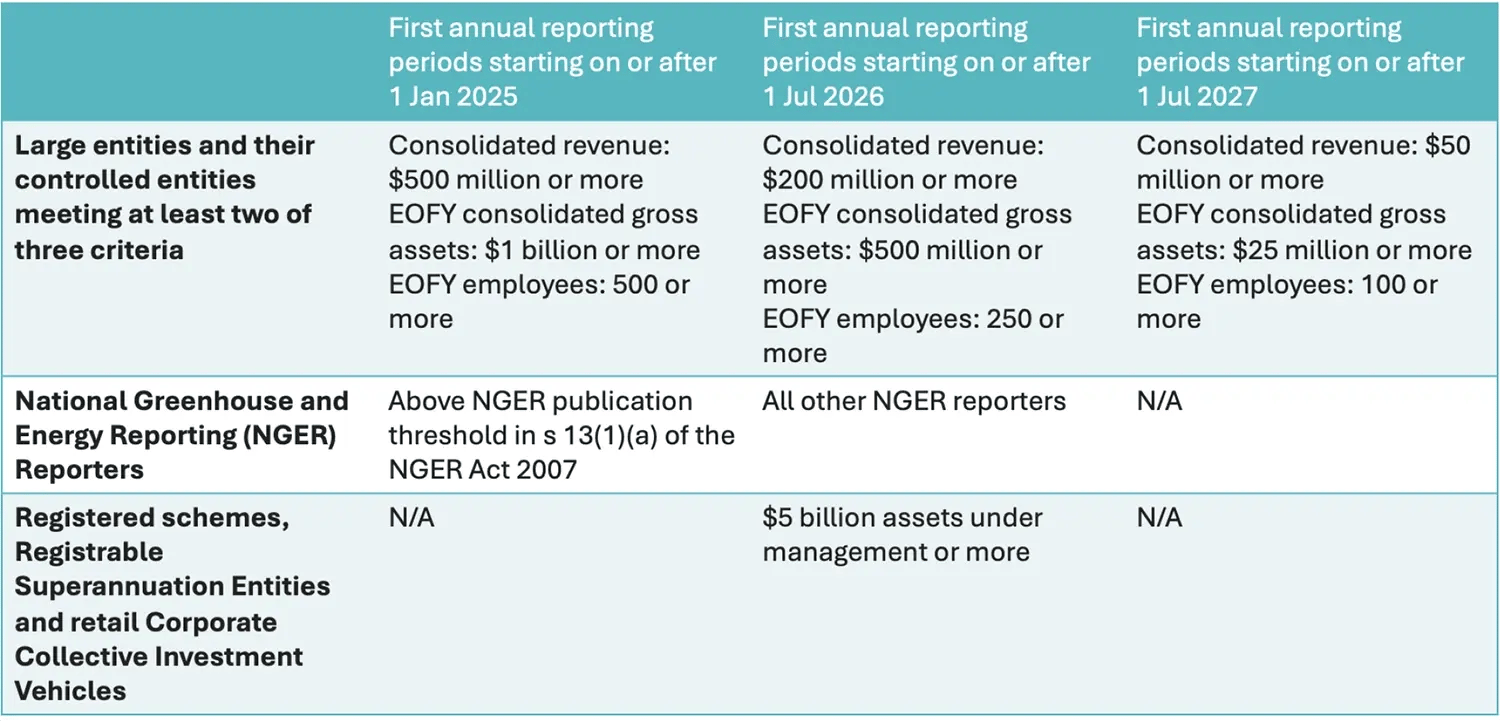 Entities that are not required to prepare annual financial reports under Ch 2M are not required to prepare a sustainability report.
If you don’t fall within the reporting criteria however, it’s worth understanding what the disclosures entail, because many of your customers, suppliers and competitors will be reporting, and they’ll be thinking about things differently as a result.
What needs to be reported?
If every conversation you’re having about climate disclosures is focused solely on emissions (Scope 1, 2 and 3), you’re missing the point. Yes, emissions metrics are part of the new climate-related financial disclosure standards, however they’re only a part of the story. And they’re not where the real strategic value lies. There's a significant gap between 'we have a carbon accounting tool' and 'we have an ASRS-ready disclosure'. Most businesses don't realise until they need to disclose.
As well as metrics and targets, reporting entities are required to report on:
- Material climate related risks and opportunities for the entity.
- Information about the entity’s governance, strategy and risk management in relation to the risks, opportunities, metrics and targets.
In doing so, companies need to understand their physical and transition risks of climate change.
Physical risk refers to the ways in which climate impacts may disrupt your assets, operations, supply chains and workforce.
While transition risk requires understanding which regulations, technologies, markets or customer expectations could create risk, or opportunity, for your business as the economy decarbonises.
And here’s the kicker. You must analyse these questions under two different future scenarios. Emissions metrics alone cannot tell you any of this.

Why does it matter?
Financial markets, regulators and governments are regulating climate related financial disclosures for transparent and comparable climate related data. It gives stakeholders and financial institutions insight into opportunities arising from the transition to a low-carbon economy and into risks “baked in” to the system already. It can also minimise the risk of greenwashing, support policy makers into better understanding broader systemic risks and ways to address them, and foster collaboration across value chains.
A common mistake business make when starting on ASRS is to set targets first. They typically look like, Net zero by 2040. 30% Scope 2 reduction by 2028. They may be right. They appear arbitrary. Without a genuine risk assessment first, there's no way to know.
The right sequence is to understand physical and transition risks under two climate scenarios, build governance and risk management around them and understand the metrics. Then, set targets that are anchored to the risks you've identified Targets without that foundation are a liability. They signal to an auditor that you did the visible work without the substance.
Speaking of auditing, the legislation provides for a phasing in of assurance requirements. Limited assurance of scope 1 and 2 emissions is required for the first year of reporting, progressing to reasonable assurance in the second year. Limited assurance of governance and strategy is also required for the first year of reporting, progressing to reasonable assurance in the second year. And limited assurance over all other disclosures from the second year of reporting is required, progressing to reasonable assurance in the fourth year.
Director and company penalties apply for non-compliance
You might be tempted to defer to AI. While AI can produce a document that looks like an ASRS disclosure, AI cannot produce a compliant ASRS (climate disclosure) report. The challenge is that assurance auditors don't only read the document. They test the judgment, governance process, and evidence trail behind it. Those things require human decisions made in the context of a specific business. That won't change before your first filing date.
While many businesses are eager to fall below the thresholds and avoid mandatory reporting, the risk and opportunities assessment is a useful tool to play to where the ball is going. The real opportunity for businesses of all sizes is understanding what the economy is going to look like as it mitigates, and builds resilience to, climate change.