-
Posted by Dale Crisp
- |
-
11 May, 2026
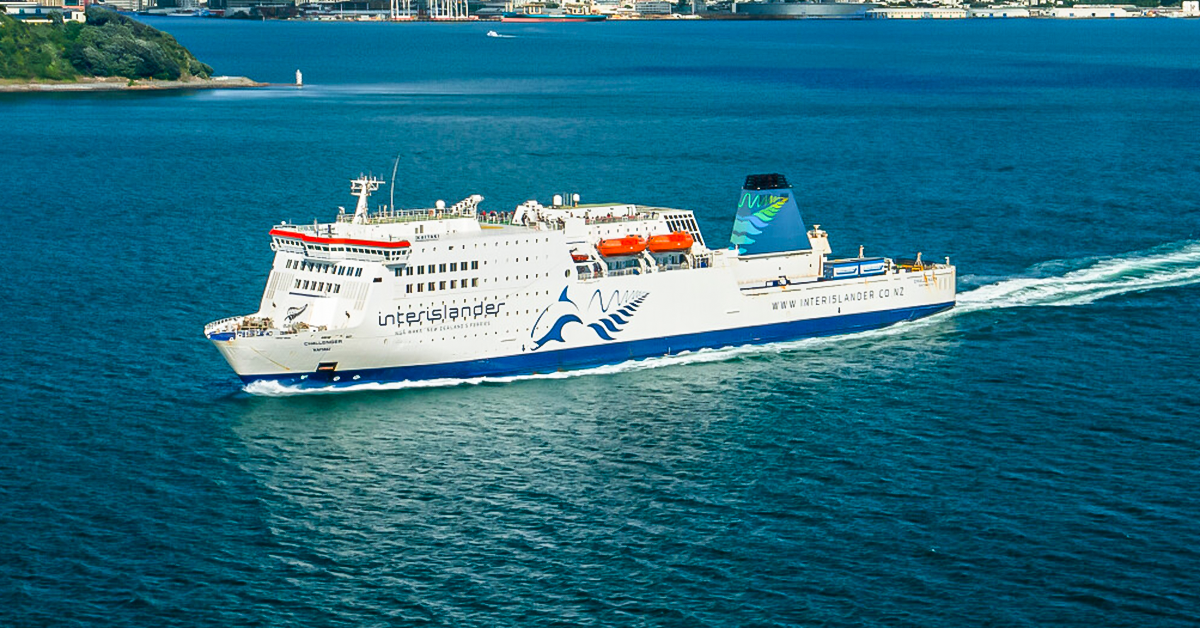
THE RELEASE late last week of the NZ Transport Accident Investigation Commission’s final report into the near grounding of ro-pax Kaitaki on rocks in Wellington Harbour in 2023 has prompted an outpouring of anger and worry in maritime circles.
Regular critic the Maritime Union of New Zealand (MUNZ) said the report into the vessel’s loss of power on 23 January 2023 “paints a shocking picture of key transport infrastructure in New Zealand in a state of decline”.
The 2023 incident saw the ferry, carrying 864 people, drift within a mile of a rocky coastline in severe southerly conditions. TAIC found a single degraded rubber expansion joint, which had exceeded its service life, was the trigger for the total loss of propulsion and subsequent blackout, and confirmed the incident was both foreseeable and preventable.
MUNZ national secretary Carl Findlay said the findings underscore a “stunning failure” of safety-critical systems.
“How a single part, which was nearly two decades old and overdue for replacement, could almost cause a disaster is horrifying,” Mr Findlay said. “Our members are out there every day on these ships, along with passengers who have a right to expect modern developed-world standards in our maritime transport.
“By scrapping the plan for new, purpose-built ferries [the iReX project], Nicola Willis left New Zealand reliant on an ageing fleet that is increasingly prone to technical failure in one of the most dangerous stretches of water in the world.
“The government has sacrificed our only dedicated ocean-going emergency response vessel to subsidise another project,” Mr Findlay said. “TAIC’s recommendations specifically focus on the need for national towage and salvage capability, yet the Government is actively stripping that capability away”.
The union’s concerns were echoed by Wellington harbourmaster Grant Nalder who said the lack of an emergency tug was still a risk which needed to be addressed, and he wanted the government to consider re-instating one.
“It's unlikely we'll need it, but if we don't have it and it goes bad, there's significant consequence. You've got a lot of people on these ships - both the ferries and cruise ships in Cook Strait," he said.
"If there is a calamity with them, in bad weather, you don't want to be in a life-boat or a life-raft...the potential for significant injuries is very high.”
Capt Nalder said the previously-contracted ETV MMA Vision was in Taranaki because it had worked in the oil and gas industry, and the next nearest emergency tug was in Bass Strait in Australia.

Meanwhile Maritime New Zealand, which was criticised in the TAIC report for failing to establish a Maritime Incident Response Team to deal with the crisis, has defended its position.
As soon as the MAYDAY call was relayed, Maritime NZ’s Rescue Coordination Centre (RCCNZ) – which is the lead for mass rescue coordination and safety of life - initiated the mass rescue plan as intended, and as acknowledged in TAIC’s report, Maritime NZ director Kirstie Hewlett said.
RCCNZ’s trained and qualified search and rescue officers quickly coordinated the movement of response assets (aircraft, boats and land support) and formed an Emergency Coordination Centre out at the RCCNZ with the relevant agencies involved.
“Once the ferry regained power, it maintained oversight until it safely came alongside at Wellington,” Ms Hewlett said.
“While we are confident our RCCNZ, the frontline safety of life function, was mobilised as soon as possible, we accept that a MIRT, our back-office function stood up in large incidents, should have been formally declared at the outset of the incident consistent with our response policy.
“However, we believe the Commission’s finding that the lack of a formal MIRT declaration would have adversely affected our ability to respond promptly had the situation escalated, misses the pulling together of key facts,” Ms Hewlett said.
While not formally declared, the necessary functions of a MIRT were in fact mobilised by Maritime NZ and in operation until the ferry was in port. The Duty Controller located to RCCNZ, as did necessary support people, and other key capabilities were supporting remotely. The National Coordination Centre (activated with the weather events on that weekend) was alerted to the event. The minister’s office was aware of the situation, and the director was being kept updated on the events.
“Given the fact the RCCNZ, which does not require a MIRT, was carrying out its role as intended, and the functions of a MIRT were informally in place, calling a MIRT at a late stage, once the engines engaged, would have made no difference in practice to this event," Ms Hewlett said.
“Consistent with any incident, we carried out post incident debriefs to learn from the event and have proactively undertaken several improvement actions. This has included regular exercising of mobilisation at the beginning of an event, to ensure MIRTs are formally called consistent with our policies, along with a range of other improvements, which are outlined in the Commission’s report.
“ Maritime NZ agrees, or partially agrees, with the Commission’s recommendations relating to Maritime NZ, and, as acknowledged by TAIC the recommendations, they have already been completed or are well underway.
“We only partially accept the recommendation on strengthening salvage and rescue capability. While we can, and do, highlight what capabilities are needed for response in NZ, ensuring the resourcing of emergency towage response capability is not something in our power to make happen,” Ms Hewlett said.
“More broadly, we investigated and prosecuted KiwiRail in relation to this event, to which KiwiRail plead guilty. We also undertook a deep dive audit on Kiwi Rail and its maintenance of critical componentry, alongside responding to an earlier TAIC safety insight into the incident in relation to the rubber joints.”