

-
Posted by Max Berry
- |
-
10 Sep, 2025
PROTECTION and indemnity (P&I) clubs are increasingly expected to work with maritime stakeholders to ensure the wellbeing of seafarers and passengers after incidents at sea, the Maritime Law Association of Australia and New Zealand’s annual conference last week heard.
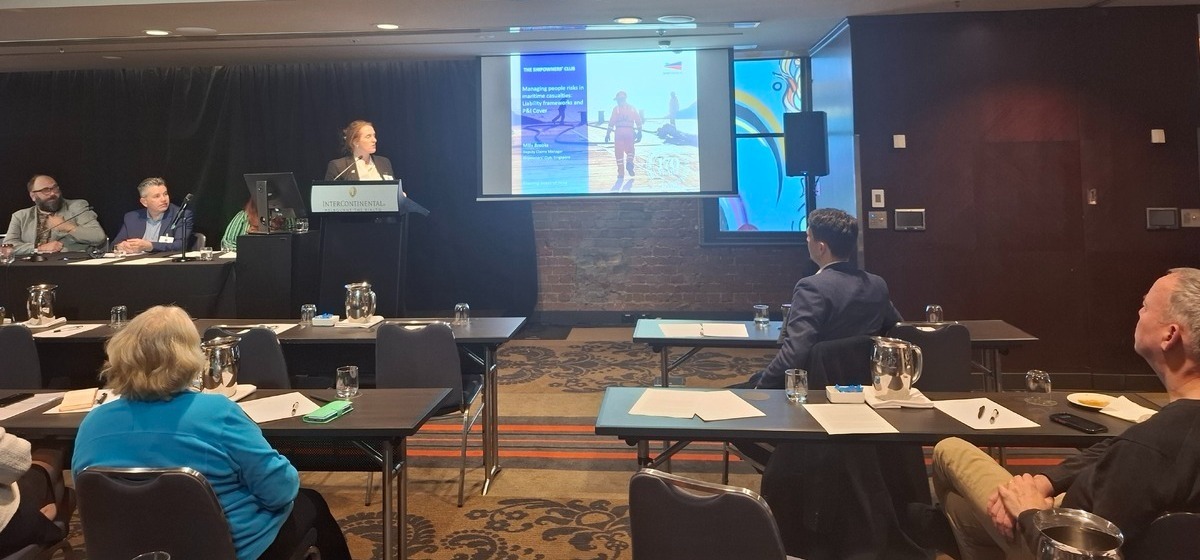
Milly Brooks addressing the MLAANZ conference. Image: Max Berry
“It’s no longer just the owner’s or master’s responsibility to ensure seafarers’ wellbeing,” said Milly Brooks, deputy claims manager at The Shipowners’ Club in Singapore, said at the MLAANZ conference in Melbourne, “particularly in cases of abandonment of seafarers by owners”.
Ms Brooks identified three categories of people for whom P&I clubs had responsibility:
- seafarers
- passengers on board insured vessels
- third parties including pilots, chartered personnel and other stakeholders.
P&I club policies nowadays expect robust inspection regimes including visiting crew quarters and ensuring compliance with the Maritime Labour Convention (MLC-compliance).
Indeed, the role of P&I clubs has now extended to advocacy for seafarer welfare, Ms Brooks observed.
The initial response following an incident at sea, particularly if a passenger ship was involved, had huge implications for the way the forthcoming claim played out.
“Questions of liability are irrelevant at this stage – we’re just interested in the safety and welfare of everyone involved,” Ms Brooks said, noting that passengers who feel mistreated can take to social media or pursue travel insurance claims.
“We need to organise any medevac or medical help needed, transport and accommodation as the first priority.”
Ensuring seafarers’ welfare was, however, sometimes more complicated than onforwarding people whose cruise had been disrupted by a mechanical breakdown for example.
“Crew members can be detained ashore in some jurisdictions pending communication with shipowners… while this sounds like arbitrary detention, it’s quite common in some places,” Ms Brooks said.
These were the sorts of issues P&I clubs had to resolve.
P&I clubs have adapted to the evolving environment and the need to comply with the Maritime Labour Convention and the Athens Convention—which sets out a strict liability regime for passenger claims (Australia is not a signatory)—by building networks of salvors, surveyors, medevac teams and other maritime specialists in some of the most distant places on Earth.
Ms Brooks said the COVID-19 pandemic had highlighted the role of P&I clubs in seafarer welfare because crews were stuck sometimes for months on vessels and couldn’t be relieved.
“There were thousands of seafarers stranded on ships well beyond their contractual period of 11 months. During this time there was a huge effort [involving P&I clubs] to ensure the repatriation of seafarers.”