-
Posted by David Sexton
- |
-
27 Aug, 2026
A VARIETY of challenges to global trade have been highlighted on the first morning of the 2026 Australia and New Shipping and Logistics Conference in Sydney.
Held at the Sheraton Grand Sydney at Hyde Park, the event has brought together key trade figures from both sides of the Tasman.
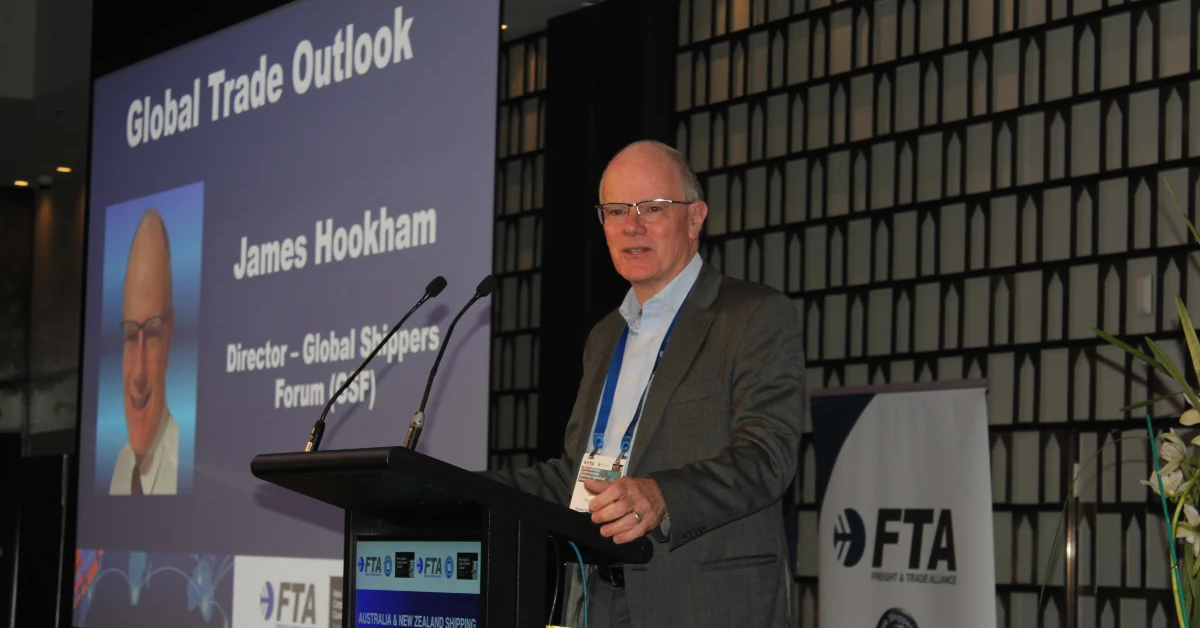
Global Shippers Forum director James Hookham outlined issues including the environment, surcharges and strategic choke points.
He highlighted the El Nino in the Western Pacific as well as drought conditions in parts of the Americas contributing to authorities having to ration transits on the Panama Canal.
Mr Hookham also spoke about fuel, noting it was still available in spite of the conflict in the Middle East, “albeit at a price” and that “this story still has some way to go”.
He spoke of “strategic choke points” including the Red Sea and the Strait of Hormuz, as well as the South China Sea and the Strait of Malacca closer to home.
“There are things that are going to be impacting us that we haven’t even thought of yet.
“There is a lot more to come I’m sure,” he said.

Mr Hookham also spoke of surcharges imposed by shipping lines and argued that “shippers deserve greater transparency” and that burdens should be shared more evenly through the supply chain.
New Zealand Trade and Enterprise Charles Finny also spoke to the conference, noting the changing environment for global trade, as identified by such figures as the prime ministers of Canada and Singapore, Mark Carney and Lawrence Wong.
Mr Wong had noted the “world has changed” and the new environment was likely to survive for many years to come.
Mr Finny, who spoke in a personal capacity, talked of the impact of policies from President Donald Trump which had forced every jurisdiction to rethink their strategies.
He said the US was widely seen as unreliable and there was a need to be “closer to our old friends”.
He noted that the US was a strong market for Kiwi exports especially prior to COVID-19, but this had declined due in part to uncertainty surrounding trade policies.
He also highlighted changes in port policy, noting likely expansion of the Port of Tauranga as well as the trends towards automation, something he said was likely to be opposed by the union movement.