
-
Posted by Allen Newton
- |
-
13 Aug, 2026
PORTS and politicians will be urged to take a more proactive approach to wind-assisted ships during a brief visit to Australia later this year by International Windship Association (IWSA) secretary general Gavin Allwright.
Speaking from his UK base on Wednesday Mr Allwright told Daily Cargo News that he felt Australia remained “reticent” about wind‑propulsion.

IWSA secretary general, Gavin Allwright. Image: IWSA
This was particularly at the port interface, where concerns persist around air drafts, loading operations, pilotage and windage. He argues these issues largely disappear once ports gain operational experience.
“Most of those problems disappear because they become very confident about the professionalism of the crews and the operational measures on the ship,” he said.
He hopes to use the Australian visit to update shipowners, designers, ports and regulators on global developments, noting that while Australia has pockets of expertise, including Advanced Wind Systems in Perth and academic specialists at the University of Melbourne, broader industry understanding remains limited.
He hopes his visit will make maritime stakeholders more aware of the rapid global expansion of wind‑assisted propulsion and will encourage stronger national support for energy‑efficient shipping technologies.
Mr Allwright, who has not visited Australia “for a very long time”, will stop in for several days on his return from the Fiji Pre‑COP meetings, where Australia is a co‑host.
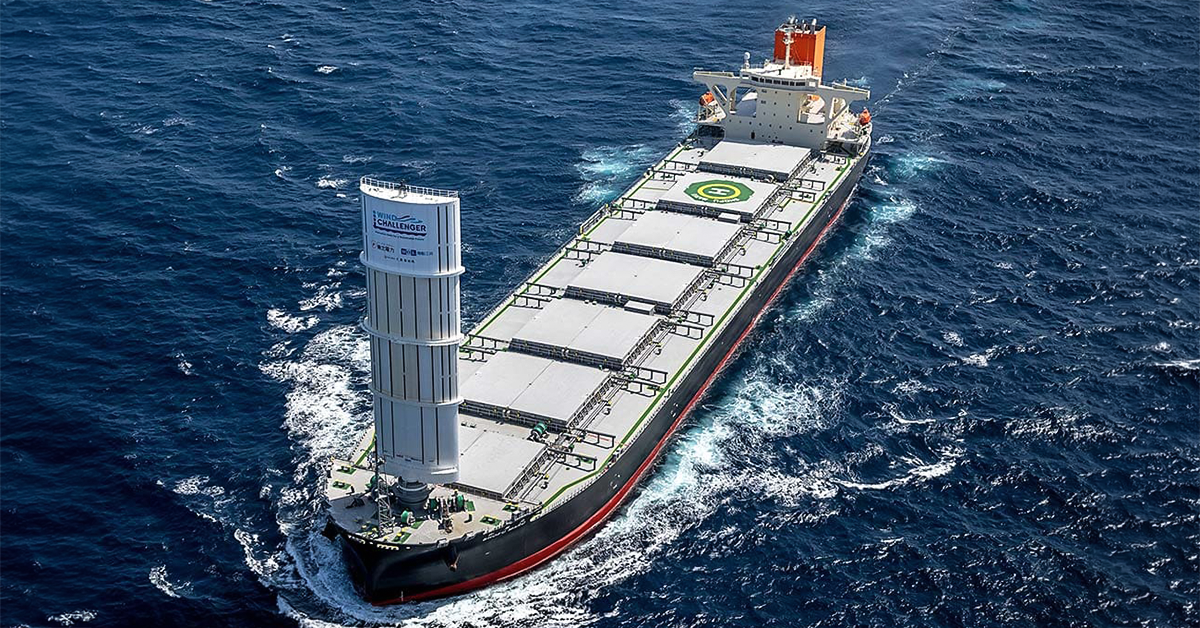
His visit comes as wind‑propulsion installations pass 100 large vessels worldwide, representing more than 6 million DWT, with several already calling at Australian ports, including Mitsui O.S.K. Lines (MOL’s) wind‑assisted coal carrier into Newcastle.
Mr Allwright said geopolitical volatility has shifted the narrative away from environmental framing and towards energy security, with wind‑propulsion offering a direct reduction in fuel demand.
He outlined a typical optimisation model: wind‑assist delivering 20% fuel savings, energy‑efficiency measures another 20% and voyage optimisation a further 20%, collectively reducing reliance on expensive alternative fuels.
“If we can take 20% off that nugget of alternative fuel… that becomes a much easier nut to crack for the industry,” he said.
Australian ports have raised questions about pilotage, windage and height restrictions, but Mr Allwright said modern systems are designed to avoid interference with port operations:
Sails are deactivated, feathered or lowered before pilot boarding.
Most systems sit below bridge height on bulkers and tankers.
Foldable rigs on larger vessels retract to clear modern port infrastructure.
He said minor operational adjustments, similar to handling geared bulkers, are usually sufficient.
While Europe remains the most mature market for wind propulsion Mr Allwright said Asia is rapidly catching up. Singapore, once sceptical, now regularly handles wind‑assisted vessels and is developing protocols for their operation.
China and Europe together can now produce up to 1000 wind‑propulsion units per year, with shipyards treating installations as “just another day in the yard”.
Fleet‑wide adoption is also emerging. UK‑based Union Maritime has ordered 32 wind‑assisted tankers, while MOL continues to expand its installations.
Mr Allwright said the IMO’s net‑zero framework now recognises wind as an energy source equivalent to alternative fuels, allowing operators to earn compliance credits for wind‑derived carbon‑intensity reductions.
With more than 100 ships now in operation, he expects the sector to reach an “inflection point” within 12 months, enabling aggregated and anonymised performance data across segments, a key requirement for large‑scale investment.
He highlighted Australia’s involvement in one of the world’s few activated green corridors, East Coast Australia to East Asia and argued that wind‑propulsion should be included alongside alternative fuels to create zero‑emissions corridors, not just low‑emissions ones.
Mr Allwright noted strong interest in the Pacific, where infrastructure constraints make wind‑propulsion an immediate, practical solution. Several vessels, including the Jura NI in the Marshall Islands, are already operating with high wind‑propulsion ratios.