-
Posted by Allen Newton
- |
-
14 Oct, 2026
PERDAMAN founder Vikas Rambal says the arrival of ammonia‑powered bulk carriers in Australian waters is no surprise, arguing major miners, particularly Fortescue, have already moved ahead of the rest of the market in adopting next‑generation propulsion.
Speaking to Daily Cargo News, Mr Rambal said ammonia‑fuelled vessels would begin appearing on Australian trade routes “much sooner than people think”, driven by large charterers who are no longer waiting for domestic policy or infrastructure to catch up.
He singled out Fortescue as one of the most aggressive early adopters.
“Fortescue is already moving. They are not waiting for Australia to catch up.”
Mr Rambal said the miner’s push into ammonia‑capable bulk carriers is a clear signal that the decarbonisation of long‑haul shipping is accelerating faster than many in the industry realise.
“These vessels will come whether we are ready or not.”
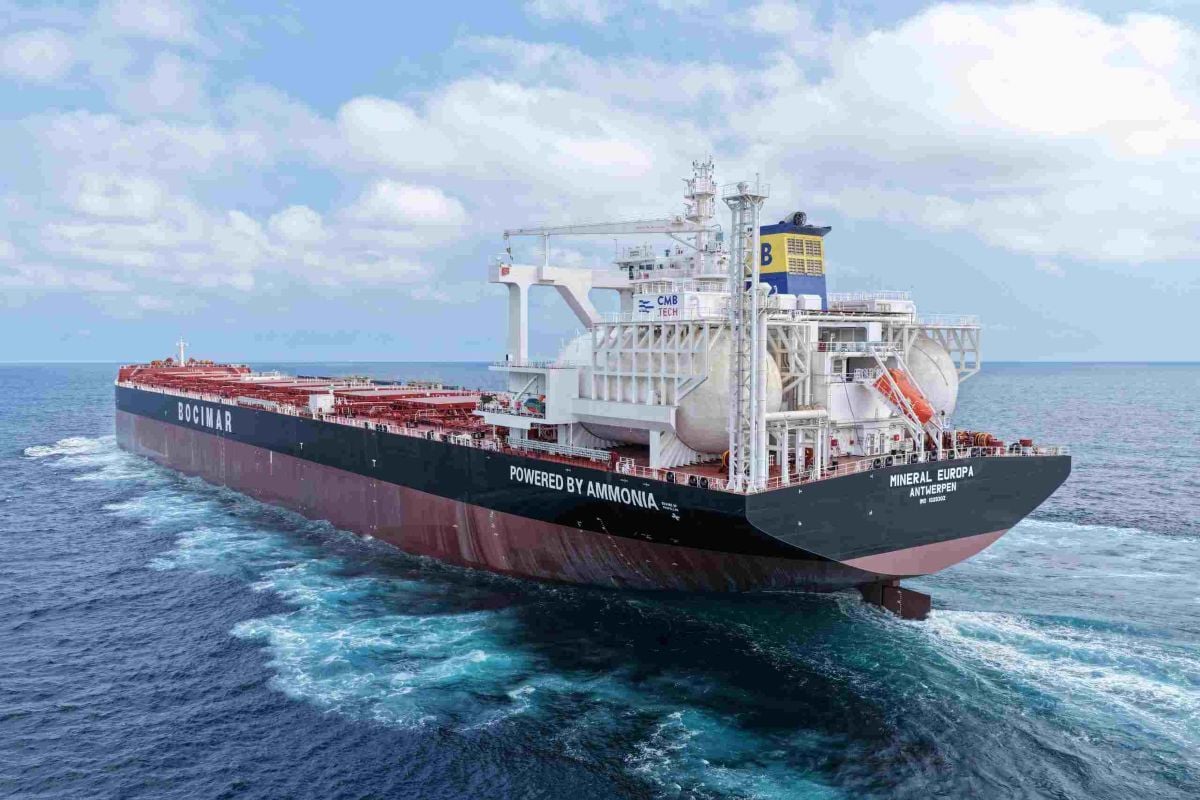
Mr Rambal’s comments come as Belgian clean‑technology company CMB.TECH announced that Mineral Europa, described as “the world’s first ammonia‑powered dry bulk vessel”, has “set sail on her maiden voyage to Australia” after completing trials in Qingdao.
In a statement published on the company’s LinkedIn page, CMB.TECH said the vessel “marks the beginning of what can be the fifth propulsion revolution in shipping” and “proves that large ocean‑going ships can be powered by ammonia, without CO₂ emissions from combustion.”
The company said 21 ammonia‑powered vessels are scheduled to join its fleet by 2029, adding “Mineral Europa is the first of its kind, but many more will follow in the months and years ahead".
MarineTraffic data referenced by industry observers indicates the vessel remained in Qingdao after trials before departing for Australia, a timeline that aligns with Mr Rambal’s assertion that ammonia‑capable bulk carriers are already on the way.
While CMB.TECH did not name the charterer, the vessel type and destination are consistent with the clean‑fuel direction Mr Rambal says Fortescue is pursuing.
In a media release, Anglo‑Eastern said it had worked with CMB.TECH for several years to help bring Mineral Europa from an early alternative‑fuel concept into service, drawing on engineering, newbuilding supervision, crew readiness and technical management expertise.
The company said the project began in 2018 with feasibility studies into hydrogen and ammonia concepts for bulk carriers, progressing to detailed design work in 2020 when rules and standards for ammonia as a marine fuel were still emerging.

The resulting concepts received Approvals in Principle from Lloyd’s Register and the American Bureau of Shipping in 2021. Anglo‑Eastern said the design prioritised crew safety, zero loss of cargo volume and robust containment of green ammonia through integrated fuel tanks, double‑wall piping, ventilation, detection and emergency shutdown systems.
“Mineral Europa demonstrates what can be achieved when an owner’s conviction is matched by deep engineering and operational capability," Anglo‑Eastern CEO Bjorn Hojgaard said.
The 210,000‑dwt Newcastlemax was built by CSSC Qingdao Beihai Shipbuilding and is equipped with a WinGD dual‑fuel ammonia engine and a Sun Rui Ammonia Fuel Supply System, allowing operation on ammonia or conventional marine fuel.
Anglo‑Eastern said operational preparation began well before delivery, including vessel‑specific bunkering, maintenance and emergency procedures, digital‑twin training, simulator work and senior‑officer participation in yard and sea trials.
CMB.TECH chief executive Alexander Saverys said they were "proving that decarbonising shipping is no longer a distant ambition. It is happening today".
Mr Rambal warned Australia risked becoming dependent on imported clean fuels unless it rapidly expands domestic ammonia production and develops bunkering capability to support the new generation of ships.
He said the shift by companies such as Fortescue should be treated as a wake‑up call.
“Australia talks about decarbonising shipping, but Fortescue and others are already chartering ammonia vessels. If we don’t produce the fuel here, we will be buying it from overseas for decades.”
Mr Rambal said Perdaman’s $6.4‑billion Project Ceres urea plant on the Burrup Peninsula is designed to underpin future clean‑ammonia production, but he stressed that national policy and port infrastructure must evolve quickly.
“This is not the future – it is happening now. Australia must decide whether it wants to lead or follow.”
He said the emergence of ammonia‑capable bulk carriers confirms the direction of global shipping and reinforces the need for Australia to position itself as a producer and supplier of clean fuels rather than a passive recipient.