-
Posted by Allen Newton
- |
-
26 Aug, 2026
THE FEDERAL government has released its Maritime Emissions Reduction National Action Plan (MERNAP), setting out a long-term roadmap to reduce emissions across Australia's maritime sector while supporting industry growth, jobs and international competitiveness.
The plan identifies practical actions for government and industry across shipping, ports, energy, domestic commercial vessels, and workforce development, with a focus on accelerating the transition to lower-emissions maritime operations.
According to the federal government, Australia's maritime sector employs almost 29,000 people and contributes $3.8 billion annually to the national economy.
The action plan argues that decarbonisation presents significant opportunities to create new industries and jobs while positioning Australia as a supplier of low and zero-carbon fuels.
Key priorities outlined in the MERNAP include supporting investment in port infrastructure and operations that enable emissions reductions, streamlining regulation for emerging maritime technologies, developing workforce skills, and strengthening collaboration with international partners working on maritime decarbonisation initiatives.
The strategy builds on a range of existing federal government programs and investments, including the $1.1 billion Cleaner Fuels Program, the Green Fuel Bunkering Strategy, the $30 million Australia-Singapore Low-Emissions Technologies Initiative for Maritime and Port Operations, the $55 million Transport Resilience and Capacity Kickstart program, and the $13.8 million Maritime Skills and Training Initiative.

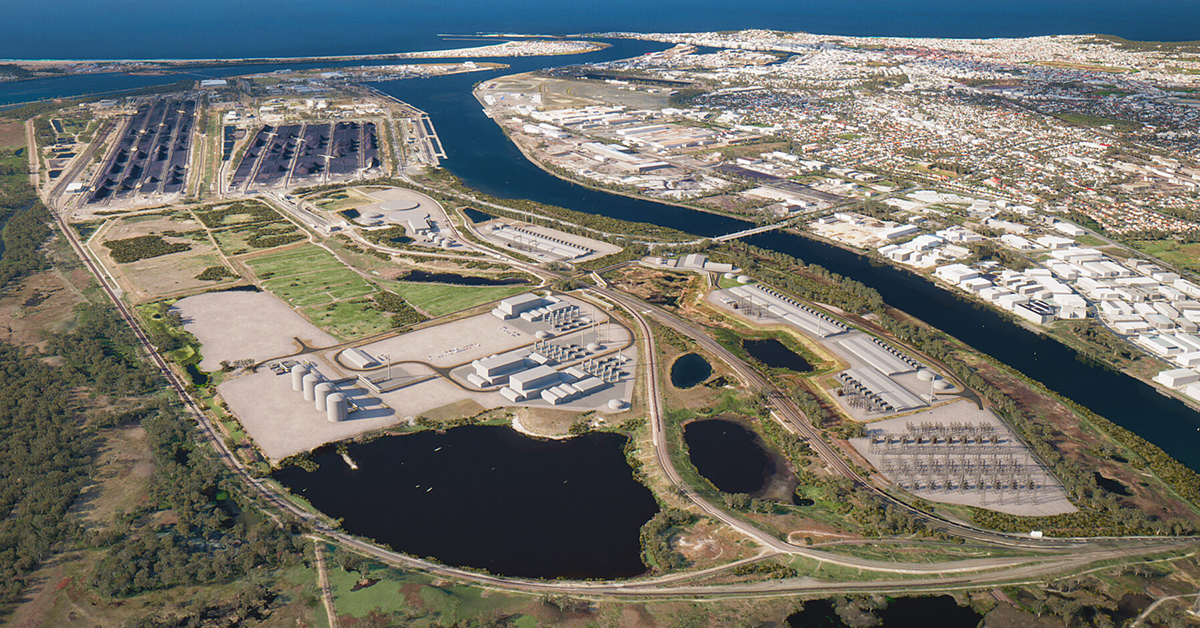
The government also highlighted its $100 million investment in the proposed Clean Energy Precinct at the Port of Newcastle.
The precinct is expected to support the production, storage, distribution and export of clean-energy products such as hydrogen and ammonia, and is forecast to generate around 5800 jobs during construction.
The release of the MERNAP follows an extensive consultation process involving maritime industry stakeholders, energy sector representatives and technical experts.
Infrastructure minister Catherine King said recent global events underscored the importance of building resilience into Australia's maritime supply chains.
"The recent conflict in the Middle East has demonstrated to us how critical it is to build resilience and sustainability within our maritime industry," Ms King said.
"In a nation where our maritime sector is responsible for 99% of our international trade, the MERNAP is a vital piece of our journey toward a sustainable future.
"It also presents an unparalleled opportunity to be a low and zero-carbon energy exporter of choice internationally, while creating new jobs and industry within the sustainable maritime sector locally."
MIAL responds
Maritime Industry Australia has welcomed the release of the MERNAP, describing it as an important signpost for an industry facing complex challenges in the transition to net zero.
The national maritime industry peak body said MERNAP would provide greater clarity for long-term investment decisions, including new vessel builds, fleet acquisitions and retrofitting.

MIAL chief executive Angela Gillham said the plan provided a roadmap for the transition to zero- and near-zero-emission shipping, but cautioned that Australia’s decarbonisation efforts must remain aligned with the global approach led by the International Maritime Organization (IMO).
“Shipping is inherently global, therefore decisions regarding the adoption of an international regulatory framework are critically important to our industry,” Ms Gillham said.
MIAL has long advocated for a national maritime decarbonisation pathway and worked closely with the government during the development of MERNAP, including through its Maritime Decarbonisation Summits.
“Shipping is a notoriously hard-to-abate sector. The vessels, fuels and infrastructure required for the transition involve significant capital investment and long investment horizons, and many of the technology and fuel pathways are still developing. Industry needs clear and consistent signals from government if it is going to make those long-term investment decisions with confidence,” Ms Gillham said.
“There is work we can and should be doing now to prepare our ports, fuel supply chains, workforce and regulatory systems for the transition, and to ensure Australian maritime businesses are well-positioned to leverage the opportunities it creates.
“The release of MERNAP is not the end of this work – it is the point from which we move from planning into implementation,” Ms Gillham said.
“MIAL looks forward to continuing to work with the Government and broader maritime industry to turn the plan into practical action, and ensure Australia has a sector that is competitive, capable, transition-ready and poised for growth.”
The Maritime Emissions Reduction National Action Plan is available at infrastructure.gov.au/mernap.