
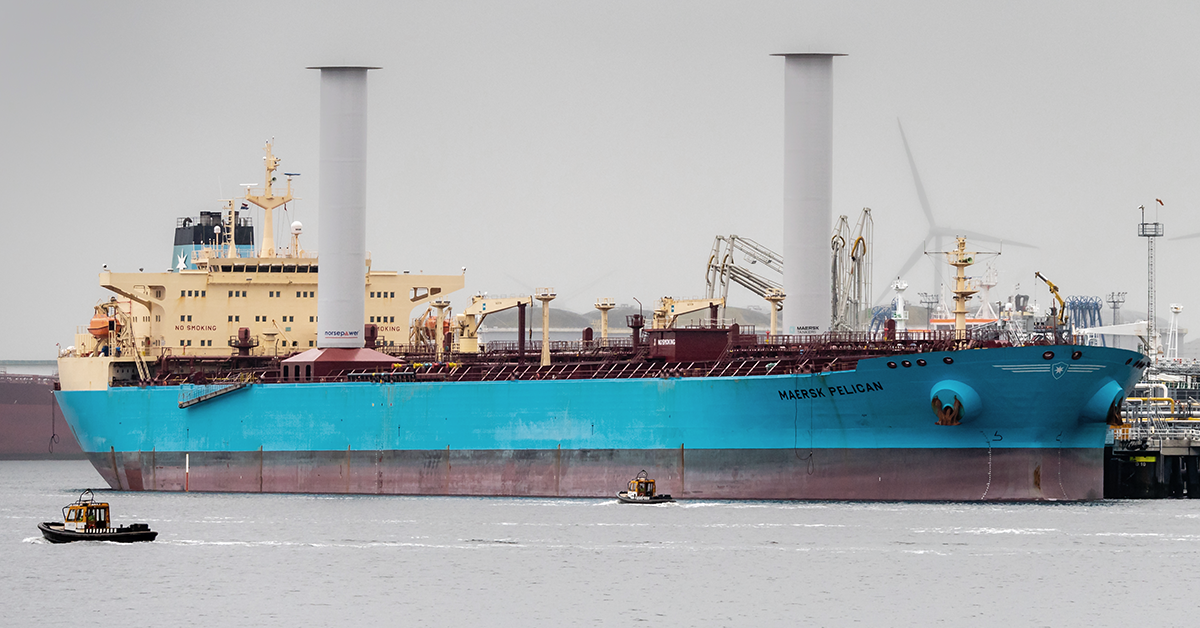
-
Posted by Ken Hickson
- |
-
22 October, 2025
BACKto the future seems to be the order of the day as a number of maritime architects and boatbuilders are inspired by the past to come up with designs of wind-powered cargo ships today.
From time immemorial humans found ways to move about on water using the sun, wind and oars. So, it is appropriate to explore the past to inspire and convince us that we can power ships today by human ingenuity and what is readily available from the heavens.
Possibly five thousand years ago, along the length of the Nile, water transport was vital to deliver people and supplies.
Reading recently Ian Graham’s book “Fifty Ships That Changed The Course Of History”, it's significant that close to half of the vessels he identifies are sailing ships which were invariably designed for trade.
The first of these vessels was unearthed in an Egyptian pyramid tomb in 1954. Pharaoh Khufu’s solar barge was made from Lebanon cedar planks and powered by five pairs of oars.
While experts are unsure of the ship’s exact purpose, it may have been part of the pharaoh’s fleet in life, but more likely the "solar barge" was a ritual vessel to carry the resurrected king with the sun god Ra across the heavens.
It is said that buried boats like this might well be a real-life equivalent of solar barges and inspiration perhaps for solar- and wind-powered vessels of today.
Of course, the Egyptians were quick to develop not only small river boats but also much larger seagoing sailing ships for trade with Mediterranean ports.
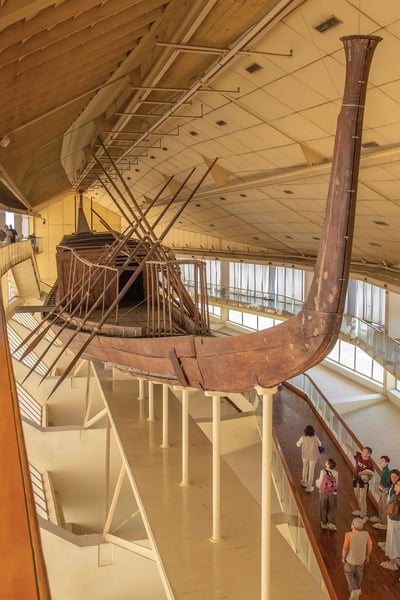
This original, intact, full-sized boat was almost certainly built for the ancient Egyptian Pharaoh Khufu more than 4,000 years ago. Image: Shutterstock
One of the best examples I’ve seen of a modern day largely solar-powered vessel is the French Energy Observer.
Launched in 2017, it operates using a mix of solar, wind — using rigid Oceanwings — and wave power to produce carbon-free hydrogen from seawater via an electrolyser, which then powers its electric motors.
When the boat visited Singapore in 2022, I was invited to board the moored vessel and see for myself this experimental platform for future energy technologies while it was in the course of its six-year global voyage.
Wind is free, and while it was only one of the renewable energy options utilised by Energy Observer, wind propulsion may prove to be the most cost-effective way to bring the world’s heavily polluting global shipping fleet into net-zero carbon compliance.
DNV’s Maritime Forecast, back in 2023, asserted that wind-assisted propulsion can serve as a valuable tool for the shipping industry to “overcome decarbonisation challenges” and achieve operational energy efficiencies.
At that time, wind-assisted propulsion systems had already been installed on 28 vessels, resulting in fuel savings ranging from 5 — 9% to date, and this figure could potentially reach 25% when retrofitted onto existing ships.
One good example is Wind Assisted Ship Propulsion — or WASP — a project funded by the Interreg North Sea Europe programme, part of the European Regional Development Fund (ERDF) to the tune of €5.4 million.
The project brings together universities and wind-assist technology providers with shipowners to undertake research, as well as to trial and validate the operational performance of a selection of wind propulsion solutions.
Using five vessels, this project enabled wind propulsion technology to gain market penetration, while contributing to a greener North Sea transport system at the same time harvesting the region's abundant wind potential.
The WASP is intended to compete with the current cargo fleet by offering lower total costs due to fuel savings and a way of transportation that is friendly to the environment. The WASP can set an example in shipping by showing that wind propulsion is a viable option.
Consider the work of Dykstra Naval Architects, whose aim is to create a technical foundation for design and operation of sailing cargo ships. The hull must be able to carry cargos while providing good sailing properties and the rig is designed to be durable and can propel the ship in many conditions. To guarantee optimal use of the sails, a weather routing program is created that can optimise the route and engine use.
There’s an Australian connection here too. Echo Yachts has commenced construction of the ASC57 — the world's largest sailing catamaran to date — at their superyacht building facility in the Australian Marine Complex, Western Australia.
This groundbreaking project brings together industry leaders from across the globe, including Dutch sailing yacht designers Dykstra Naval Architects and Australia's aluminium multihull experts One2Three Naval Architects.
The most recent advance for wind powered shipping must be the Oceanbird Wing 560. The 40-metre-high wing was officially launched on 25th of August 2025.
“This is truly a milestone. Together, we are advancing towards fossil-free shipping,” said Andreas Carlson, Sweden’s Minister of Infrastructure and Housing at the inauguration.
“We need pioneers who are willing to take risks, to innovate and to lead the way into the green industrial transformation and this is a great example of leadership. Oceanbird stands as proof of this success”.
The Oceanbird company was formed 3,5 years ago as a joint venture between Alfa Laval and Wallenius Lines. The core of the rigid, 40-metre-high and 14-metre-wide wing sail is made of high strength steel, and the aerodynamic surface is a sandwich construction of glass fibre composites and 370,000 recycled plastic bottles.
Not only capitalising on traditional wind power, but also utilising some of the materials which are currently going to waste and polluting our oceans.
That’s a plus and can perhaps be compared to the use of used cooking oil — which usually goes to waste — to produce bio diesel as ship bunkering fuel.
This has been carried out by Alpha Biofuels in Singapore for the global mining conglomerate Anglo American to successfully trial the use of sustainable biofuel to power a chartered bulk carrier ship during a voyage from Singapore to South Africa.
The trial was conducted onboard the Frontier Jacaranda, a “capesize” bulk carrier — too large to transit the Suez Canal or Panama Canal — owned by Japanese shipping company NYK Line.
Wind or waste. Solar or sea water. All have been proven for centuries to provide the fuel we need to drive us forward, whether on the road, in the air or all at sea.
They are all part of the mix to provide a clean and productive future for the global maritime industry.
This article appeared in the October | November 2025 edition of DCN Magazine