-
Posted by David Sexton
- |
-
26 Oct, 2026
As the behaviours of Australian motorists change, so does the nature of the roll-on, roll-off sector at Australian ports
THE RO-RO sector might arguably hold a mirror to Australian society.
Where once we mostly drove Fords or Holdens, then newer varieties arrived from Japan and then today when there is a trend towards imported electric vehicles.

FCAI chief executive, Tony Weber. Image: FCAI
Chief executive of the Federal Chamber of Automotive Industries, Tony Weber, says Australian motorists have considerably more choice across battery electric, plug-in hybrid and hybrid vehicles. There are now more than 130 battery-electric models and more than 50 plug-in hybrid models on the market.
"Consumer interest is being influenced by competitive pricing, potential savings in energy costs and expanding model choice," Mr Weber said.
"The federal government also offers favourable treatment regarding the Fringe Benefits Tax treatment for eligible vehicles."
Battery electric vehicles (BEVs) represented 8.3% of the market in 2025 and, during this year to August, 18.2%. Many consumers are presently choosing hybrid and plug-in hybrid vehicles as intermediate options.
Mr Weber said a growing mix of electrified vehicles required shipping lines, ports and vehicle handling businesses to maintain appropriate procedures for battery condition, vehicle storage and emergency response.
"Changes in the countries supplying vehicles to Australia may also affect shipping routes, sailing frequency, vehicle-carrier capacity and arrival patterns. These logistics considerations are significant because all new vehicles sold in Australia arrive through the maritime supply chain."
The long-term direction is towards a more electrified vehicle fleet, but the transition is unlikely to follow a straight line and individual technologies may grow at different rates.
"Manufacturers are increasing the availability of lower and zero emission vehicles in response to global product development," Mr Weber said.
"Consumer demand will continue to depend on affordability, charging infrastructure, total cost of ownership and the availability of vehicles that meet their needs and desires. There is no doubt that some of the shift we have seen this year towards electrified vehicles is structural."
Mr Weber said China had rapidly increased its importance as a source of vehicles for Australia.
"This year, 85% of all BEVs sold in Australia were manufactured in China. Japan remains a major source of vehicles, although its volumes softened as China’s grew," he said.
This does not simply represent consumers replacing Japanese brands with Chinese brands: several established global manufacturers also build vehicles in China, while Japanese manufacturers retain strong positions in hybrids, SUVs and light-commercial vehicles.
"For the logistics sector, this changing production footprint has implications for trade lanes, vehicle carrier services, port calls and distribution planning," Mr Weber said.
"It also increases the importance of supply chain resilience as Australia sources vehicles from an evolving mix of manufacturing locations."
The rapid rise in the demand for Chinese EVs amongst Australian consumers has been staggering
Paul Argue, CCO at Leeward Group
Chief commercial officer for the Leeward Group Paul Argue also speaks of the impact of the EV market.
Leeward Group is a supplier of shipping agency services and logistics solutions in Australia, New Zealand and Fiji.
"The rapid rise in the demand for Chinese EVs amongst Australian consumers has been staggering," he said.
Leeward Group ro-ro principal, Grimaldi, introduced its China to Australia service in January this year, and according to Mr Argue is "perfectly positioned to provide additional capacity and alternative solutions to the trade".
He said original equipment manufacturers (OEMs) were now more open to discussing broader supply chain solutions.
"They want to strategically influence volumes and routings as their own supply chains have scaled up faster than originally forecasted. This is where the Leeward Group is excellently placed to offer solutions via our commercially focused Quay Shipping Multimodal team and our logistics brand, Sila Global."
Significant changes
Patrick Smith is the managing director of Australian Amalgamated Terminals (AAT), the nation’s largest handler of imported cars and machinery.
"There’s no doubt that we’re seeing significant changes in the types and mix of cargo arriving at our terminals and that was a trend throughout FY26," Mr Smith told DCN.
Our investment in charging infrastructure aligns with our broader focus on electrification and decarbonisation.
Patrick Smith, managing director of Australian Amalgamated Terminals
"It was and remains a tangible demonstration of the enthusiasm Australian consumers have for innovative plug-in hybrid and electric vehicles at the moment, whether incentivised by higher fuel costs or government programs or just a desire to make the switch."
Mr Smith said they saw "a substantial increase" in vehicles imported from China during the 2026 financial year and that coincided with the increase in electric, plug-in hybrid and pure hybrid sales.
"As ever, we’ve been keen to ensure that we remain responsive to those changes and to the needs of our customers, so we now have EV charging infrastructure installed across our terminals. Our investment in charging infrastructure aligns with our broader focus on electrification and decarbonisation."
At AAT Port Kembla, for example, the company installed energy efficient yard lighting installed throughout the terminal, together with solar generation scaled to support EV and heavy vehicle charging infrastructure, including its light vehicle and forklift fleet which is entirely electric at that site.
"Pleasingly, despite the surge in volumes, we’ve seen the vast majority of pure care carrier (PCC) and ro-ro vessels berthing on arrival, which is something we always like to see," Mr Smith said.
"This performance is a credit to all supply chain participants including all our shipping lines, stevedores and, of course, the PDI providers whose excellent vehicle uplift have allowed our terminals to clear."

These results are also said to reflect "excellent terminal management" from the teams at Fisherman Islands, Port Kembla and Webb Dock West.
"It has also been a positive to note the significant reduction in quarantine failures from the levels seen in 2023," Mr Smith said.
"At that time, we were seeing up high percentages of imported vehicles failing quarantine, yet in a period of high volumes this year, May to July 2026, that was down to around only 1% of imports.
"This result reflects well on the original equipment manufacturers (OEMs) for the efforts they’ve gone to prevent and mitigate biodiversity risks in vehicle imports following that post COVID spike."
According to VFACTS, a data source from the Federal Chamber of Automotive Industries:
- 22.9% of new vehicles sold in Australia were manufactured in China for FY26
- 32% of vehicles were either electric, plug-in hybrid or pure hybrid vehicles.
Per VFACTS and the Electric Vehicle Council's published monthly sales report, a total of 140,058 new vehicles were delivered to Australian customers in June.
This was the highest monthly tally for the Australian new-vehicle market since 2017. Strong volumes were also seen throughout July and August 2026.
According to VFACTS and the Electric Vehicle Council's published monthly sales report, a total of 140,058 new vehicles were delivered to Australian customers in June.
This was the highest monthly tally for the Australian new-vehicle market since 2017. Strong volumes were also seen throughout July and August 2026.
A well-established supply chain
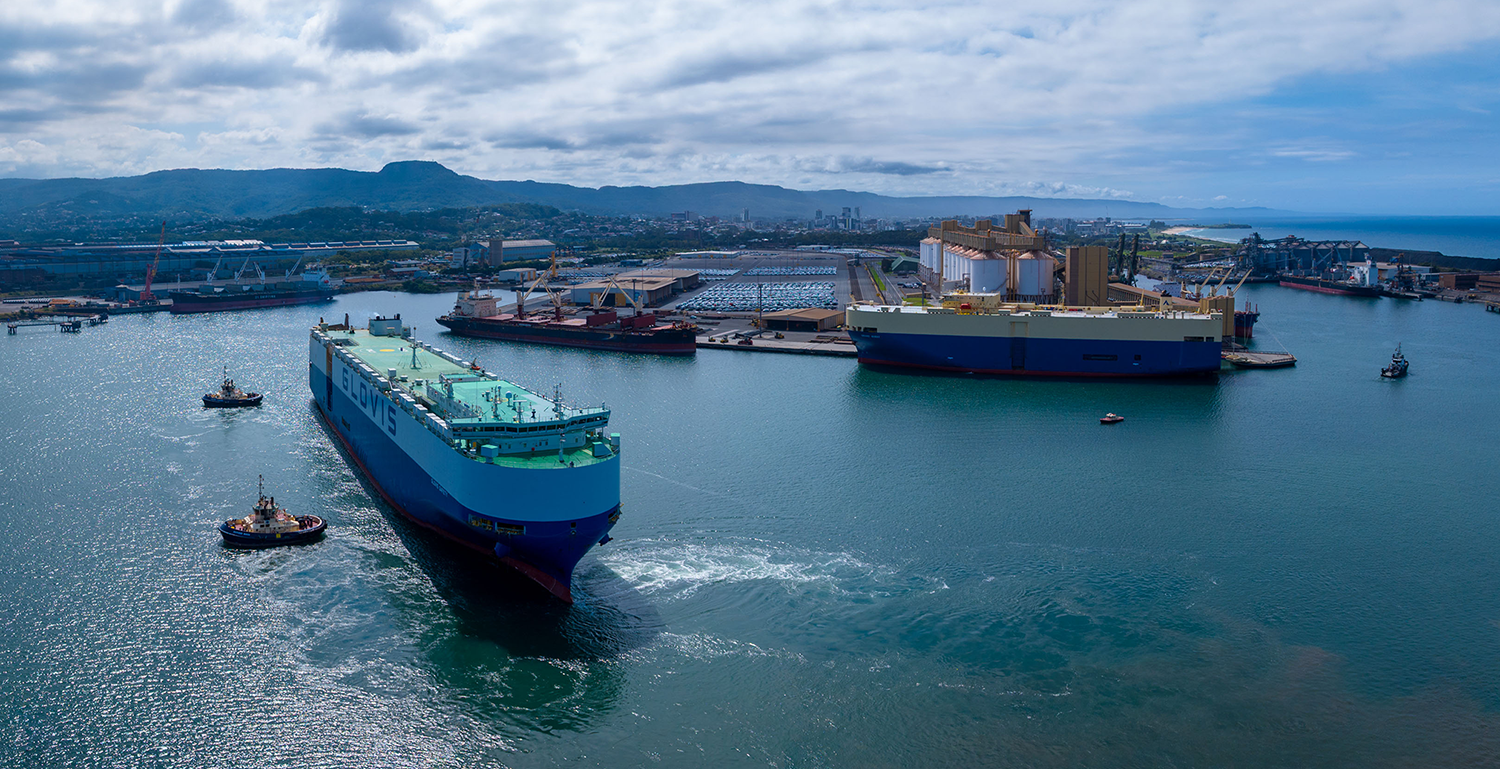
As NSW’s ro-ro port, Port Kembla has a well-established, embedded supply chain from the unloading of cargo and biosecurity procedures at the port through to pre-vehicle inspections on or near the port and distribution across New South Wales.
The car carrier vessels arriving in Port Kembla carry between 6000 and 9100 cars on board depending on the size of the ship. The next generation of car carriers are increasing in size and capacity. These vessels could carry up to 11,700 cars.
Ro-ro imports into NSW are forecast to grow into the future… and this project will add to Port Kembla’s ro-ro capabilities, enhancing resilience, capacity and flexibility to meet the state’s trade needs
Marika Calfas, NSW Ports chief executive
Port Kembla currently has four ro-ro capable berths. NSW Ports is investing $45 million to add a fifth ro-ro capable berth (at Berth 104).
NSW Ports chief executive Marika Calfas said construction of the Berth 104 Extension Project began in October last year and would be completed by mid-2027.
"Ro-ro imports into NSW are forecast to grow into the future, as population grows, and this project will add to Port Kembla’s ro-ro capabilities, enhancing resilience, capacity and flexibility to meet the state’s trade needs," Ms Calfas said.
Car imports in 2026 financial year
Port Kembla is the import hub for NSW’s motor vehicles, with the port handling approximately 390,000 vehicles during the 2026 financial year. Imports remained steady year-on-year, with a noticeable increase in the delivery of fully electric vehicles and hybrids.
The car types arriving at Port Kembla are changing, with hybrid and fully electric vehicles gaining market share.
Hybrid vehicles represented about 25% of total volume for financial year 2026, while fully electric vehicles represented about 12%.
"There was a 14% drop in the volume of cars imported with internal combustion engines over the same period," Ms Calfas said.
"However, petrol and diesel vehicles still made up the majority of car imports into New South Wales, accounting for around 57% of volumes in the financial year 2026."
The market share for Chinese manufactured motor vehicles increased in FY26:
China’s market share for motor vehicle imports into Port Kembla jumped from about 18% in the 2025 financial year to about 29% in FY26, overtaking Japan at about 28% for the first time.
Project cargo, heavy lift and out of gauge shipments
Port Kembla has established itself as one of Australia’s leading gateways for complex project cargo, heavy lift and out of gauge (OOG) shipments.
Port Kembla handles a range of project and general cargo such as onshore wind farm and solar components, tunnel boring equipment, heavy and light rail carriages, steel and transformers.
This capability has positioned the port to support some of Australia’s largest infrastructure and energy projects. Port Kembla is positioned to support both onshore and offshore wind farms across Australia’s east coast. Port Kembla has handled components for onshore wind farms, including blades, nacelles, hubs, generators and tower sections. NSW Ports continues to progress plans for an Offshore Wind Port Facility to support the delivery of offshore wind projects off Australia’s East Coast.
Specialised project cargo arriving at Port Kembla: Sydney Metro Trains
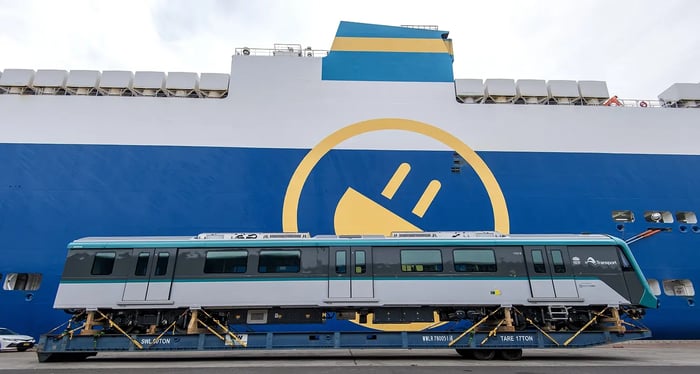
Sydney Metro Train asset unloaded at Port Kembla. Image: NSW Ports
A recent example of specialised project cargo arriving at Port Kembla was the first of 12 new trains for the Sydney Metro – Western Sydney Airport Line, delivered on 30 June by the cargo carrier Lake Qaraoun. The next-generation train travelled 23,000 kilometres from Vienna to be unloaded at Port Kembla.
Another recent example of unique oversized cargo was the arrival of John Travolta’s former Qantas jet. The iconic Boeing 707 arrived at Port Kembla in May this year, with the operation highlighting exactly what the port can do. The port’s established heavy cargo capability is underpinned by infrastructure, industrial land availability and access to experienced supply chain partners that specialise in complex logistics movements. These capabilities have enabled the handling of a broad range of oversized and high-value cargoes.
Port Kembla outlook
According to NSW Ports, the outlook for motor vehicle imports and project cargo through Port Kembla remains strong.
"As NSW’s population grows, motor vehicle imports will grow, with electric and hybrid vehicles increasing as a proportion of total imports," Ms Calfas said.
"As Australia’s energy transition gathers pace, NSW Ports expects project cargo demand to continue to grow, particularly in sectors supporting renewable generation, energy storage and network infrastructure."

Darwin and changing the economics of ro-ro
Aurizon is a prominent logistics company that has developed strong ro-ro connections, with plans to move vehicles from Darwin Port to Adelaide by rail through the desert.
For a shipping line, that changes the economics of serving Australia.
"Today a vessel serving Australia typically circumnavigates the continent, calling at several ports to deliver into each market," Aurizon head of finished vehicle logistics Patrick McGinn said.
"If it can discharge in Darwin and turn around immediately, it spends less time on the Australian coast. The value is fleet efficiency: more voyages from the same ships, without adding tonnage."
Mr McGinn said for importers and OEMs, it was about speed to market and predictability.
"Vehicles reach the southern markets sooner, and a single discharge port means fewer places for a delay to compound across a multi-port rotation," he said.
"That's less inventory sitting in the pipeline and a more reliable plan for dealers."
He said this was an option shipping lines hadn’t had at scale in Australia before, and one that becomes more valuable as volumes grow.
Mr McGinn said the announcement was recent, but the work behind it wasn’t.
Growing vehicle imports and changing global trade patterns are encouraging logistics providers to rethink how vehicles move around the country
Patrick McGinn, head of finished vehicle logistics at Aurizon
"We've spent more than two years developing the concept, trialling the operating model and building the partnerships needed to make it successful," he said.
"Vehicle movements are already occurring using our existing containerised network, and the next step will be the introduction of purpose-built auto wagons from mid-2028 financial year."
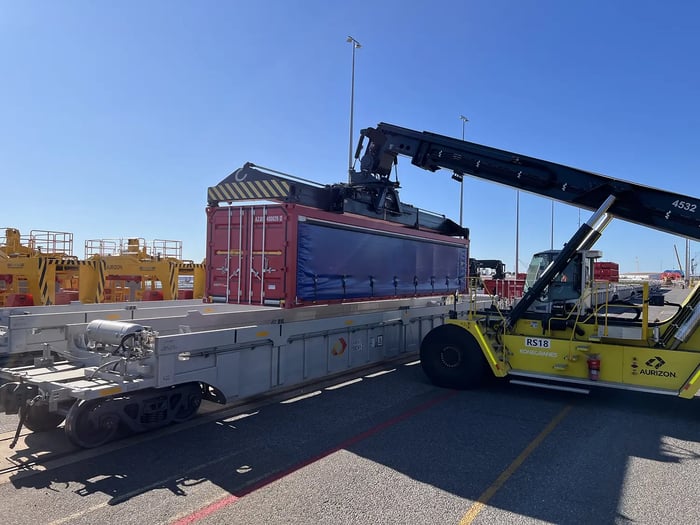
A containerised vehicle transport unit is loaded onto a wagon at the Port of Darwin for rail transport to southern markets.
Image: Aurizon
Rail plays a relatively small role in Australia's finished vehicle supply chain today, so Aurizon considers the opportunity to be significant.
"At the same time, growing vehicle imports and changing global trade patterns are encouraging logistics providers to rethink how vehicles move around the country," Mr McGinn said.
"Our view is that modal conversion can help customers move more vehicles faster while making better use of the assets they already have, which creates value across the entire supply chain."
He said the biggest challenge was mindset; things only seem impossible until somebody does them.
"For example, the concept of landbridging was part of the original plans for the Alice Springs to Darwin line when it was constructed more than twenty years ago," he said.
"However, only Aurizon has the scale and national operating footprint to make those plans a reality.
"That is why we invested in the line several years ago and can link it to our other strategically significant assets, such as terminals, around the country to drive growth for the business."
He said their partners NYK and CEVA had the vision to help us build something new, "and as the rest of the market sees the benefits, adoption becomes much easier".
"We see this as a growth story for ro-ro, not a displacement story. It is a genuine alternative for customers who are looking to enhance speed to market," Mr McGinn said.
"It runs on Aurizon’s rail line, which goes all the way from South Australia to the wharf at the Port of Darwin."
Australia is an attractive automotive market, and perhaps the question is how to support that growth as efficiently as possible.
"If a shipping line can discharge vehicles in Darwin and use rail for the long inland journey, it can create opportunities to improve asset utilisation and serve the market in new ways," Mr McGinn said.
"The objective is to help the industry handle more volume with fewer constraints, not reduce demand for vessels."
Mr McGinn said the project had implications for land use.
"Ports are under constant pressure to accommodate growing volumes of many different cargo types, and vehicles require significant space," he said.
"Our hub-and-spoke model combines the Port of Darwin with inland rail-connected storage and distribution locations, allowing growth to occur without all of that activity needing to remain on valuable, often congested, waterfront land.
"More broadly, it's about creating a supply chain where shipping, ports, rail and road each do what they do best."
This article appeared in the October | November 2026 edition of DCN Magazine