-
Posted by David Sexton
- |
-
25 Mar, 2026
BIGGER truck combinations are offering productivity increases of between 50% and 100%, the Port of Brisbane (PBPL) says.
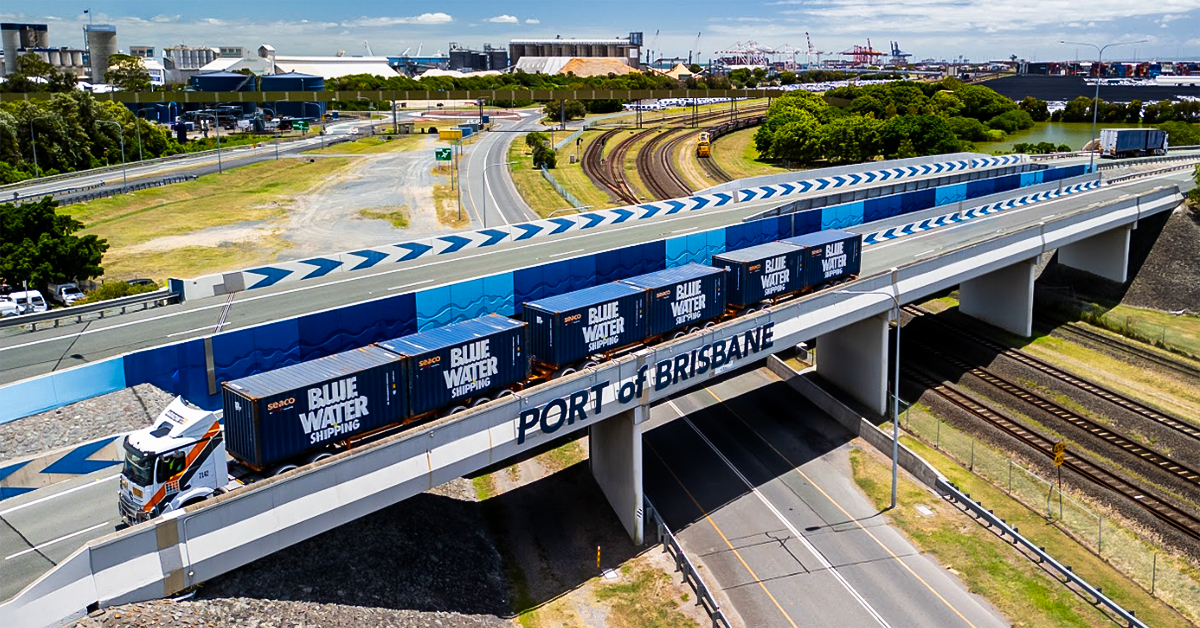
The port has successfully trialled five new higher productivity freight vehicle combinations at Fisherman Islands during the last 12 months, with notable productivity increases for operators.
Port of Brisbane, together with the Office of the Chief Engineer within the National Heavy Vehicle Regulator (NHVR), has facilitated on-road trials for transport operators including MEDLOG, South East Queensland Hauliers and Arrow Transport.
The trials are used to validate simulation studies and engineering assessments conducted by the Office of the Chief Engineer, while helping the NHVR evaluate the safe operation of the HPFV combinations.
The following new HPFVs have been granted permits to operate on routes within Fisherman Islands:
- MEDLOG B-Triple — increasing productivity of the Super-B by 50% carrying capacity, transporting empty containers between parks and depot.
- South East Queensland Hauliers:
- Electric A-Triple — a 50% increase in productivity to the A-Double carrying capacity, when carting empty containers between parks and depot.
- Super A-Double — a 100% increase in productivity to the A-Double carrying capacity, and a 33% increase on the Super B — for 4 x heavy grain containers between their depot and the terminals.
- Heavy A-Double — a 50% increase in productivity to the A-Double carrying capacity for 3x heavy grain containers between their depot and the terminals.
- Arrow Transport A-Triple — a 50% increase in productivity to the A-Double carrying capacity for both laden and empty containers for its export customer.
According to management, these build on earlier HPFV innovations trialled and operating at the Port of Brisbane from Qube Logistics, who were the first to be issued a permit for its B Triple in 2020.
These were followed by the introduction of its Australia-first Super B-Double Double-Stacked and Super B-Triple Double-Stack vehicles (both in 2023), and ACFS Port Logistics, which deployed a Super B-Triple combination on port roads, in 2023.
PBPL chief executive Neil Stephens said HPFVs were playing a growing role in moving freight within the port, improving efficiency while supporting sustainability.
“We’re pleased to support the safe introduction of new Higher Productivity Freight Vehicles by our customers at the Port of Brisbane,” Mr Stephens said.
“They help lift productivity while also responding to wider industry challenges such as driver shortages and sustainability priorities including emissions reduction.”
Mr Stephens said the growing Queensland freight task necessitated innovation.
“Queensland is growing, and so is the freight task. In FY25, the port handled more than 1.6 million containers, with around 98% transported by road,” he said.
“Our Vision 2060 research shows Queensland’s population is expected to grow from 5.5 million to 8.3 million by 2060, with container volumes tripling and freight movements increasing. It’s essential we work together to manage the growing freight task in an efficient, sustainable and connected way.”
Mr Stephens said they were focused on ensuring port roads could safely support HPFVs and future logistics needs.
“Whether maintaining existing roads or building new ones, we’re investing to ensure port infrastructure is ready for the next generation of port logistics,” he said.