
-
Posted by Michael Blake
- |
-
02 Mar, 2026
THE LOGISTICS sector continues to have a relatively distant relationship with carbon reporting. Emissions disclosure continues to be the domain of sustainability teams, annual reports and Environmental, Social and Governance (ESG) frameworks — something that happens elsewhere in the business, disconnected from the daily reality of moving freight.
That distance is closing fast. Australia's mandatory climate related financial disclosure regime is now legislated and logistics is captured on what needs to be reported. For transport operators, freight forwarders and supply chain managers, this isn't a sustainability initiative to observe from a distance. It's a fundamental shift in what the market will expect from the sector... starting now.
Understanding the basics of how carbon reporting works, what's actually being measured and why logistics is the category attracting significant attention is no longer optional knowledge. It's the minimum entry point for a conversation the sector can't afford to sit out.
What's actually being required
Australia's climate disclosure framework, based on AASB S2 and aligned with international ISSB standards, introduces mandatory reporting of greenhouse gas emissions for large entities from FY25, with Scope 3 emissions reporting phasing in from FY27.
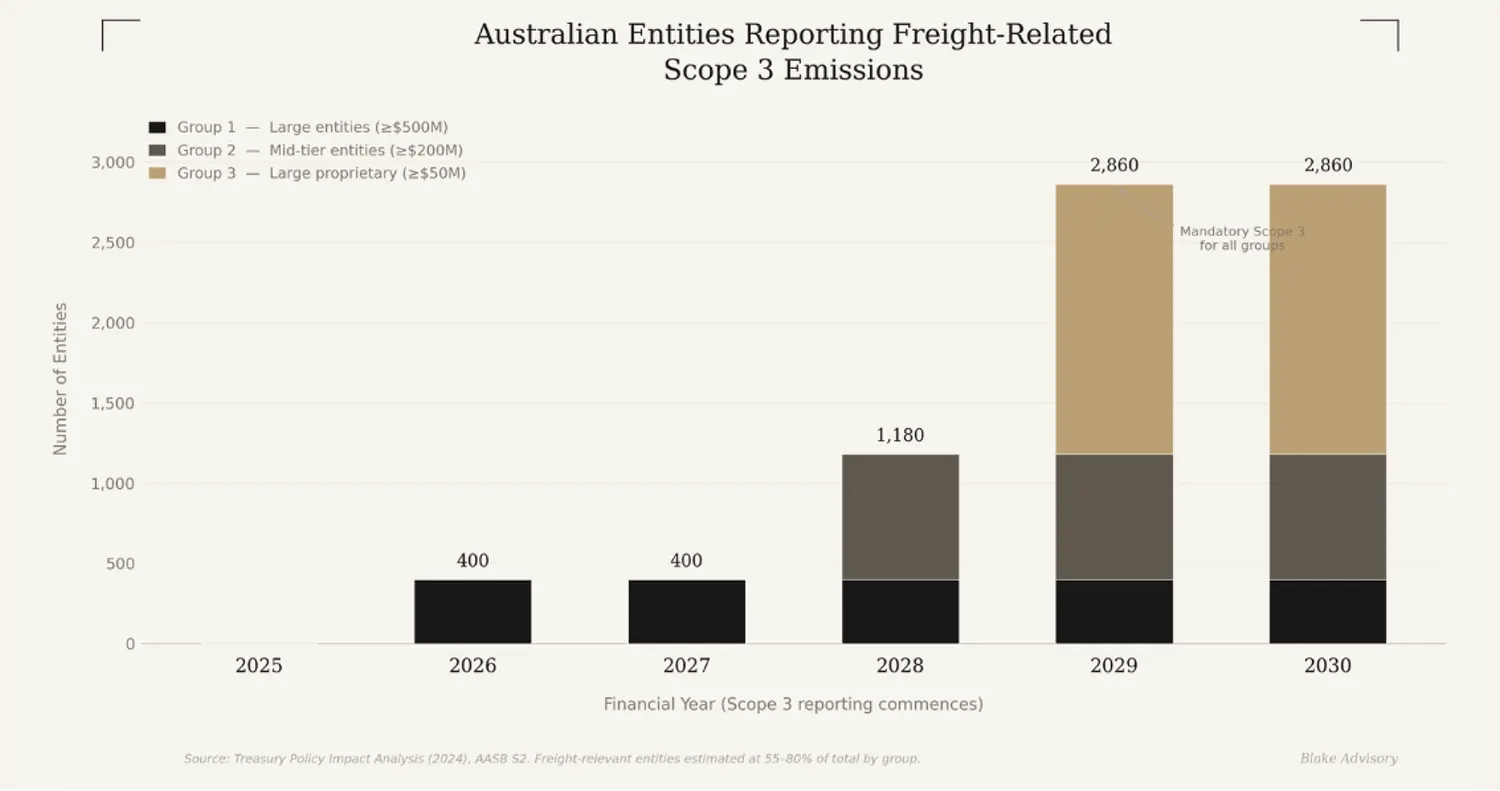
The rollout is staged. Group 1 entities — those with revenue of $500 million or more — are first, with around 400 expected to begin reporting freight-related Scope 3 emissions from FY26. By FY28, that expands to roughly 1,180 entities as mid-tier companies (≥$200M revenue) are brought in. And by FY29, when large proprietary companies (≥$50M) join, almost 2,860 entities will be reporting.
 The critical point for the logistics sector is even if a transport operator or 3PL isn't a reporting entity itself, its customers increasingly will be. That means carriers, warehousing providers and freight forwarders will be asked — with growing frequency and specificity — to provide emissions data for the services they deliver. The reporting obligation sits with the shipper. The data requirement cascades directly into the supply chain.
Emissions through a logistics lens
Corporate carbon reporting divides emissions into three scopes. Scope 1 covers direct emissions from sources a company owns or controls — for a logistics operator, that's primarily diesel combustion in its fleet. Scope 2 covers indirect emissions from purchased energy — the electricity powering warehouses, distribution centres and terminal operations. Scope 3 is everything else — the indirect emissions generated across a company's entire value chain, both upstream and downstream.
For most businesses outside the energy and heavy industry sectors, Scope 3 is where the vast majority of their carbon footprint sits. And within Scope 3, transport and logistics has a variable materiality depending on the carbon intensity in other areas of operation.
Research consistently shows that supply chain and logistics emissions are 11 to 26 times greater than a company's direct operational emissions. That ratio explains why the reporting frameworks are structured the way they are and why logistics is attracting a level of attention the sector hasn't previously experienced.
All of this gets reported in CO2 equivalent (CO2e), a standardised unit that allows different greenhouse gases to be compared on a common scale. It's the currency of carbon reporting and it's what shippers, auditors and investors will increasingly expect logistics providers to be able to quantify against the services they deliver.
Why logistics is different — and harder
Carbon reporting frameworks were originally designed with energy generation, manufacturing and industrial processes in mind — sectors where emissions sources are relatively contained, measurable and directly linked to production outputs. Logistics doesn't work that way.
A single shipment might move across multiple modes; road to rail to port to vessel, involving several carriers, subcontractors and handling points. Load factors vary. Routing isn't always direct. Vehicles are shared across customers. The same freight task can produce different emissions depending on how it's executed and that execution detail often sits across multiple parties who don't share data with each other.
This complexity makes logistics one of the most important Scope 3 categories to measure accurately — and simultaneously one of the hardest. The fragmented, multi-party nature of freight networks means that the data needed for precise measurement exists, but it's distributed across shippers, carriers and intermediaries in ways that current reporting approaches don't always capture well.
That's not a reason to avoid the task. The companies and operators that invest in understanding their emissions profile now and in building the data capability to communicate it credibly, will be better positioned as the market matures. Those that wait for the requirement to land on their desk will in the meantime be beholden to someone else's assumptions about their operations.
The sector's moment
The logistics sector has spent years advocating for investment in infrastructure, technology and operational efficiency. Carbon reporting, done properly, should reinforce that case, not undermine it. Good emissions data makes the argument for modal shift, fleet renewal, network optimisation and consolidation in terms that boardrooms, investors and regulators now actively respond to.
But that depends on the quality of the data and on the sector's willingness to engage with how its emissions are being measured and reported. The question now is whether logistics leans into this as participants or continues to be the subject of reporting done by others.
How those emissions are currently being measured — and whether these methodologies are fit for purpose — is a question worth examining closely.