-
Posted by David Sexton
- |
-
02 Apr, 2026
CLEANER energy and ammonia as a marine fuel have been key talking points at the 19th Asia Pacific Maritime in Singapore this week.
With the delay in adopting the IMO’s net-zero framework and the oil and gas trade disruption caused by conflict in West Asia, speakers noted it had become crucial to provide decision-makers with a broad range of energy sources and efficient solutions.
The conference posited that conversations on alternative fuels needed to progress, despite regulatory uncertainty, especially with concerns over energy sovereignty.
Speakers also said the industry needed to emphasise fuel optionality, because the direction towards net-zero has not changed.
A session on Ammonia as a Marine Fuel session, panelists debated ammonia-cable engines and bunkering systems and their readiness for commercial deployment.
Carbon solutions specialist for Mitsui OSK Lines, Neeraj Kumar, said interim guidelines for ammonia were already in place.
“It’s going to be developed fully and included in the IGF (International Code of Safety for Ships Using Gases or Other Low-flashpoint Fuels) code,” Captain Kumar said.
He shared how MOL worked with the Global Centre for Maritime Decarbonisation, Yara Clean Ammonia and Pilbara Port Authority for the first twin ammonia ship-to-ship transfer, showcasing how the industry is sufficiently mature to build upon the key lessons for subsequent bunkering.
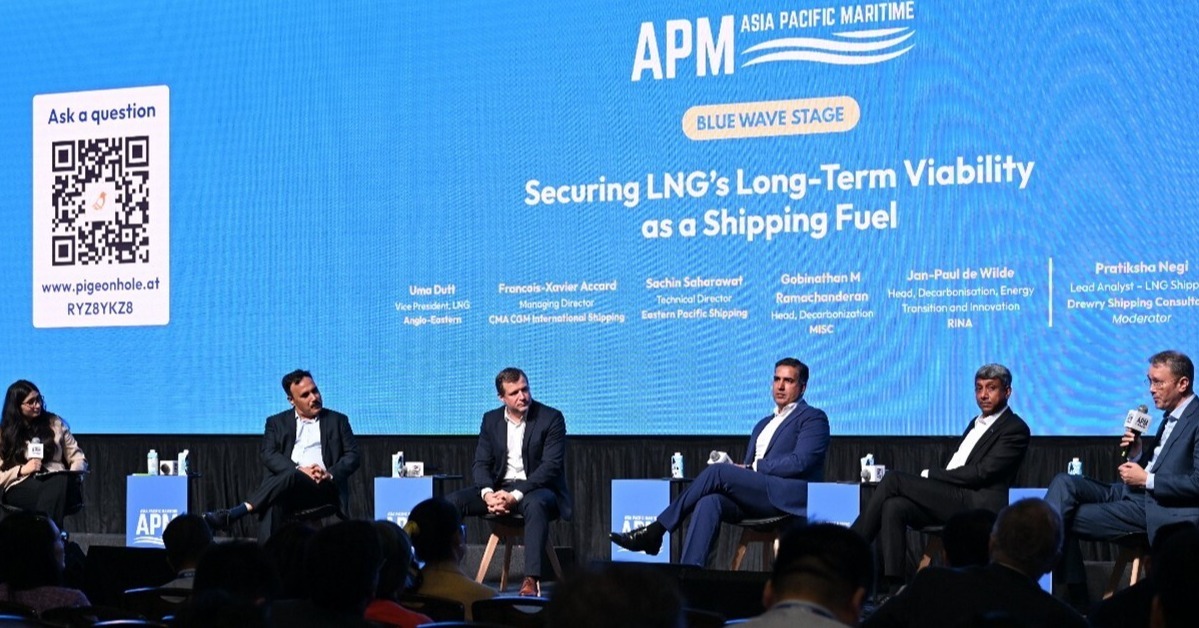
On the panel, Securing LNG’s Long-Term Viability as a Shipping Fuel, speakers delved into the renewed LNG uptake despite the pressure to accelerate decarbonisation.
“The use of bio-LNG or e-LNG is a decarbonisation pathway, and while it is not immediate, it serves as a transition,” said Gobinathan M Ramachanderan, MISC head of decarbonisation.
“Fossil LNG, which is among the cleanest fossil fuels that is already available and readily scaled, should be expedited, followed closely with the uptake of bio-LNG and e-LNG."
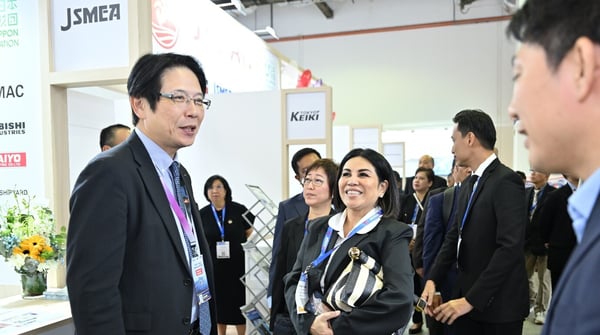
Carmelita Hartoto, chair of the Indonesian National Shipowners’ Association,
leading a delegation at the Japan Pavilion. Image: Asia Pacific Maritime
This year’s event brought together key decision-makers from across Asia, including shipowners and shipyards.
The Indonesian National Shipowners’ Association (INSA) led a delegation of 60 shipowners representing 20 shipping lines.
Carmelita Hartoto, chair of the Indonesian National Shipowners’ Association (INSA) said they were “delighted to be back at APM”.
“As a long-standing partner of APM, we truly value the opportunity for Indonesian shipowners to engage in productive conversations with global solution providers and industry leaders,” she said.
“I am confident that the connections and insights gained at APM will shape Indonesia’s growing maritime industry and drive innovation in vessel operations.”
APM group project director Yeow Hui Leng said the numerous deals and partnerships at the event underscored its role beyond that of a maritime marketplace.
“It also serves as a platform for showcasing best in class innovations and setting the stage for solutions that will shape the future of the industry,” she said.